
Active· since Apr 6, 2026
- 162
- days running
- 0
- relaunches
Ad copy
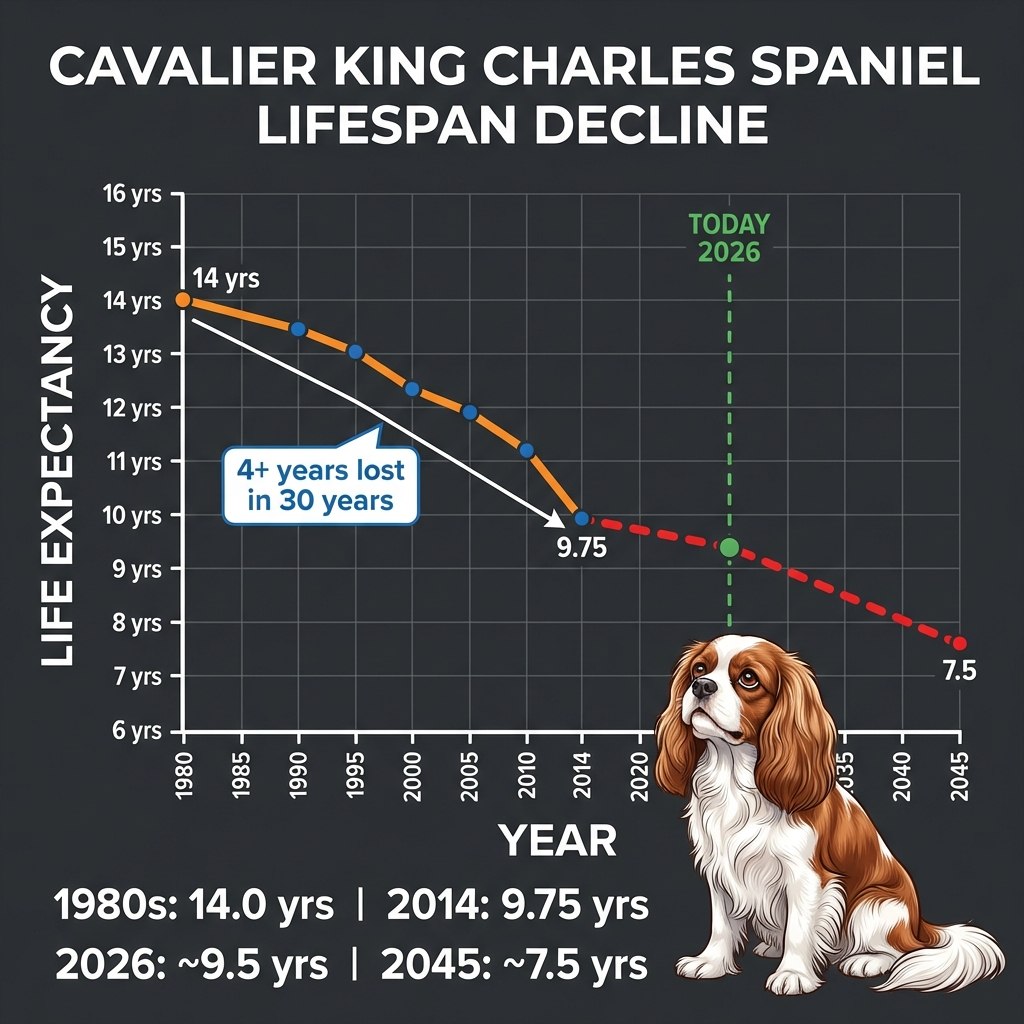
In the 1980s, Cavaliers regularly lived to 15 years old. Today the documented average is 9.5. That is nearly a 30% drop in life expectancy in one generation of a breed. During a period when veterinary medicine has never been more advanced. If you own one of these dogs, this is the most important thing you will read today. My name is Dr. Emily Sato. I am a veterinary cardiologist at a university teaching hospital in Philadelphia. I also hold a graduate degree in canine genetics. For 14 years I have been asking one question: why do Cavalier King Charles Spaniels develop heart disease at rates that would be called an epidemic in any other species? The answer starts in the same place every time. It starts with six dogs. How a breed becomes its own worst enemy After World War II, the Cavalier King Charles Spaniel had nearly ceased to exist. Breeding populations collapsed. By the time the dust settled, roughly six dogs remained as the foundation from which every modern Cavalier would descend. Six. Not six hundred. Not six thousand. Six individual animals whose DNA would be passed forward to every Cavalier born from that point on. When you rebuild a breed from a population that small, you lock in everything those dogs carried. The soft eyes. The gentle temperament. But also the defects. With no genetic diversity to dilute it, the defects travel forward intact through every generation. Those six dogs carried a structural defect in the collagen that forms the mitral valve of the heart. Every Cavalier alive today has inherited it. Then the breed got popular. And things got worse. In 1995, the American Kennel Club officially recognised the Cavalier. What followed was an 800% increase in registrations. The breed went from the 70th most popular in America to the 13th. Demand exploded. More breeding from the same compromised gene pool meant the defective valve gene did not just persist. It spread. Researchers at Uppsala University confirmed in PLOS Genetics that Cavaliers carry 6 to 13% more disease-causing genetic variants than any other breed studied. They are the most heavily inbreeding-affected breed in the world. The lifespan curve bent downward at exactly the same moment the popularity curve bent upward. That is not a coincidence. That is cause and effect. What the defect actually does Your Cavalier's heart has four valves. The mitral valve sits between the left atrium and the left ventricle. It opens and closes roughly 100,000 times a day. In Cavaliers, the collagen holding the valve leaflets together is structurally weaker from birth. Over time the leaflets thicken, deform, and stop sealing properly. Blood begins leaking backward with every contraction. The heart compensates by working harder. It enlarges. The larger it gets, the more the valve stretches. The worse the leak. A cycle that only moves in one direction. Over 50% of Cavaliers develop a detectable murmur by age 5. Over 90% by age 10. In other small breeds, mitral valve disease affects roughly 10% of dogs after age 10 and progresses slowly. In Cavaliers it is 20 times more prevalent, starts in middle age, and moves 2 to 3 times faster. The median survival time after congestive heart failure is approximately 7 months. That is what is behind that chart. One specific, predictable condition tracing directly back to six dogs. Why your vet has not explained this Your vet almost certainly has not walked you through any of this. Not because they are hiding something. Because the veterinary system does not have a protocol for what to do before the murmur appears. It has a protocol for after. Listen at the annual checkup. If nothing is heard, say she sounds great. If something is heard, grade it, monitor it. When the heart enlarges, prescribe Vetmedin. When heart failure arrives, manage it with medications costing $1,700 to $2,500 per year. That protocol is good medicine. But the valve does not suddenly become diseased the day the murmur appears. Valve degeneration is slow and cumulative. By the time your vet hears a murmur, the valve has often been deteriorating for a year or two. Your vet is catching the middle of the story. The beginning is where you still have options. What Sweden figured out Sweden made cardiac evaluation compulsory for every Cavalier in the country. Alongside that screening culture, Swedish owners adopted early nutritional cardiac support before any symptoms appeared. The risk of a Swedish Cavalier dying before age 10 dropped by nearly half. Early-onset murmurs became rare. They did not cure MVD. What they found was the window. The period before clinical signs appear where the heart can be supported while it is still functioning without compensation. That window exists for your dog right now. Why most supplements make it worse When Cavalier owners look for heart support, they usually make one critical mistake. Amazon results for dog heart supplements are dominated by products loaded with taurine and L-carnitine. These are the correct ingredients for DCM, dilated cardiomyopathy, where the heart muscle weakens. DCM affects large breeds. Golden Retrievers. Great Danes. That is not what your Cavalier has. Your Cavalier has MVD. The valve degenerates. Not the muscle. Completely different mechanism. Completely different nutritional needs. CavalierHealth.org documents that most commercial heart products contain unnecessary ingredients in large quantities and far too little of what Cavaliers specifically require. Wrong condition. Wrong formula. Nothing supported. What the mitral valve actually needs: CoQ10 in ubiquinol form (not ubiquinone, which has 70 to 80% lower absorption). Omega-3 fatty acids. Hawthorn berry extract. D-Ribose. Magnesium. These are the specific compounds that address what is happening in a Cavalier's heart during the silent period before the stethoscope catches anything. What Marcus did differently Marcus brought his Cavalier Chester to my practice at age 4. No symptoms. Running, playing, stealing shoes. Marcus was an engineer who had read about the six foundation dogs in a genetics article. It bothered him enough to book a cardiology appointment on his own. His regular vet had never suggested one. I ran a full echocardiogram. Chester had early mitral valve changes. Subtle leaflet thickening that would not have been audible for another year, possibly two. We started Chester on the cardiac support chews I now recommend to every Cavalier owner I see. At 12 months, stable. At 24 months, still stable. No measurable progression in two years. I am not telling you that is a guarantee. MVD is genetic. These are nutritional support chews, not medication, not a replacement for veterinary care. But the owners who started early consistently give me something the others cannot. Not just more stable echocardiograms. More peace. Less sitting in the vet parking lot trying not to cry. The quiet confidence of knowing you started at the beginning of the story instead of the middle. The window is open right now The lifespan data is real. The genetic trajectory is real. The six dogs are real. What happens between now and the first murmur is the only part that is not already written. Whether your Cavalier is 2 years old or 8. The valve is changing. That is the breed. The question is only whether you are supporting it while you still can. One chew. Every day. Starting now. weston-animal.co/products/h-chews P.S. The lifespan dropped from 15 years to 9.5 not because vets got worse but because a popularity explosion spread a broken gene through a gene pool that was already too small to absorb it. The window before the murmur is the only window you control. Start there: weston-animal.co/products/h-chews P.P.S. Before you search Amazon, check the label. If it says taurine and L-carnitine, it was built for DCM. Your Cavalier gets MVD. She needs ubiquinol CoQ10, omega-3, hawthorn, D-Ribose, and magnesium. The right formula for the right condition: weston-animal.co/products/h-chews
Like this ad? Make it yours.
Crush rebuilds this exact creative around your product — your brand, your colors, your offer — in about a minute.