Dr. James Anderson - Oncologist
Dr. James Anderson - Oncologist Facebook ad: “Retired Oncologist. Gleason 7. Still Undetectable.”
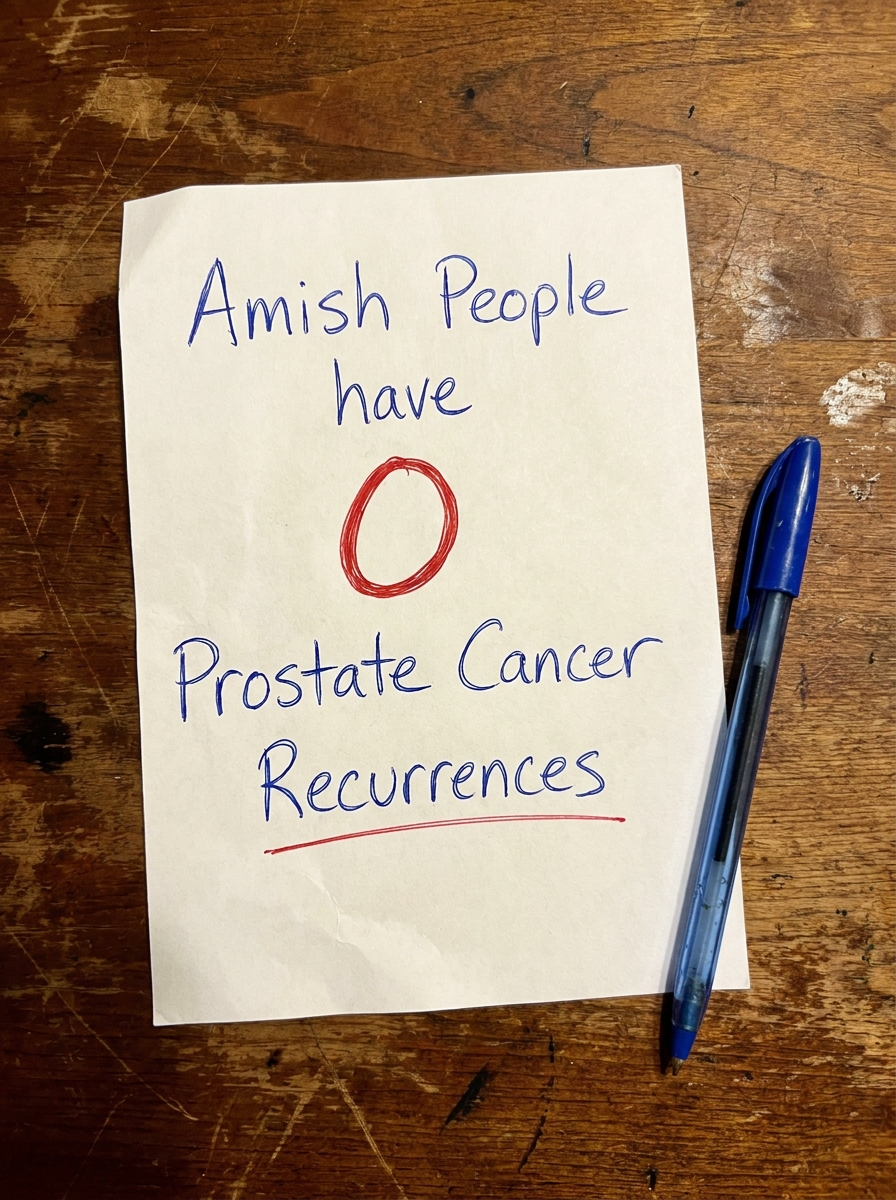
Ran for 15 days, from August 23 to September 7, 2026, the last day Crush saw it.
Run by Dr. James Anderson - Oncologist on Facebook. Crush is not the advertiser and does not verify its claims. See this ad in Meta's Ad Library(opens in a new tab)
Want an ad like this for your product?
Crush makes new ad images for your product from this ad: your logo, your product photo, your offer.
Trials from $19.95 USD, then $79.95 USD a month. Cancel anytime.
About this ad
- Meta Ad Library ID
- 1363803102043243
- Platforms
- Relaunches
- 1
Ad text
Amish men in Lancaster County do not have late prostate cancer recurrences. No 3-month PSA appointments dominating their calendars for the rest of their lives. No 36-month "Danger Zone" pacing after the surgery. No ADT shots turning them into ghosts of the men they used to be. No dormant cells waking up at year 10 or year 15 in the bones of the pelvis where nobody could see them coming. Zero late recurrences over thirty years of CDC tracking. American men who did everything right — surgery, radiation, watchful waiting — 1 in 3 who suffer a biochemical recurrence in the first 5 years will die from their prostate cancer within the following 60 months. I pulled the CDC file after 12 years as a medical oncologist. Twenty years of tracked Amish data. Buried in a report most oncologists in this country have never read. Then the funding was cut. The lead researcher was reassigned. The dataset disappeared. A lifetime of ADT shots and Xtandi tablets is worth billions of dollars a year to Big Pharma. Then an Amish farmer I had consulted for years earlier called me eighteen months after his own remission. PSA still undetectable. He told me what he had been drinking every morning for six generations — and what the Amish men who DID get prostate cancer had one thing in common. Let me tell you what he said. My name is Dr. James Anderson. I'm 62 years old. Board certified medical oncologist. Retired. Twelve years at the Central US Cancer Medical Institute treating men whose PSA numbers refused to stay down. I am not some fringe doctor selling crystals on Instagram. I am the system. I prescribed the Lupron. I ordered the PSMA PET scans. I signed the Xtandi authorizations. I sat across from men who had just come out of robot-assisted radical prostatectomies — sitting in my exam chair still wearing an adult pad, still remembering the Foley catheter they had dragged around in a leg bag for two weeks — and I said the sentences oncologists are trained to say. "Congratulations. Your first post-op PSA is undetectable. We'll see you in three months." I said those words thousands of times. And I believed them. Then I got my own diagnosis. It was a Tuesday morning in April. Two years ago. Routine annual physical. My primary care doctor called me at home with the labs. "Jim. Your PSA jumped from 1.8 last year to 4.7. I want you to get a urology consult." I already knew. The biopsy came back the following week. Twelve cores. Cancer detected in four of them. Two on the left side. Two on the right. Pathology grade: Gleason 3+4=7. Favorable intermediate. I want you to understand something about this moment. Most men describe finding out they have prostate cancer as a "shock." A "gut punch." The word cancer landing in their body and everything after it going quiet. That's not what happened to me. I read the pathology report at my kitchen table with a cup of coffee going cold beside me and I knew exactly what was coming next. Gleason 3+4 meant the majority of my tumor was pattern 3 — slow growing — but the minority was pattern 4. Aggressive. Migrating. The pattern of cell that survives the scalpel and hides in the surgical bed and waits two or three years to drive the PSA back up. I didn't panic. I didn't cry. I didn't go numb. I finished my coffee. I picked up my phone. I called the surgeon I would have referred any of my own patients to and I scheduled the RALP for the following month. And I stood at my kitchen counter and said out loud to nobody, "You know exactly what happens after this. You know exactly what the 36-month window is because you have signed the paperwork for two thousand men who fell into it." And that is the sentence that separated my experience from every patient I have ever treated. I knew what was coming after the RALP. Not in the vague way patients know — the relief of the tumor being removed, the sight of the pathology report saying "clear margins," the assumption that "cured" means cured. I knew it the way a mechanic knows exactly which gasket is going to fail at 100,000 miles. I knew that Gleason 7 prostate cancer — my grade, the most common grade, the Goldilocks zone my colleagues call "favorable intermediate" — was going to do the following things to my body in a very specific order. First, I would beat the primary tumor. My prognosis for the surgery itself was excellent. Over 95% of Gleason 3+4 men reach an undetectable PSA within eight weeks of the RALP. The catheter would come out. The pads would go away over the following twelve months. The nerve damage from the surgery would heal enough that I could function again with the help of daily Cialis. My family would celebrate. My colleagues would clap me on the shoulder in the hallway and tell me I "got lucky." Then the second war would start. The one nobody clinks a champagne glass for. Because Gleason 7 prostate cancer has something the "good news" version of the diagnosis doesn't tell you about. It is called biochemical recurrence. During the growth of the primary tumor in my prostate, microscopic cancer cells — the aggressive pattern 4 cells specifically — had almost certainly broken off and traveled into the surgical bed around where the prostate used to sit. Into the seminal vesicles. Into the nearby pelvic lymph nodes. Into the microscopic tissue planes the robotic scalpel could not clean out. They embedded themselves in that tissue. And then they did what pattern 4 prostate cancer cells do best. They went quiet. Started stealing ATP — the cellular energy every cell needs to survive — from surrounding tissue. Started replicating slowly. Building a colony too small to show on a PSMA PET scan, too small to detect on any imaging technology that exists today. Two to three years is how long it takes those microscopic colonies to grow large enough to push the PSA needle from <0.01 back up to 0.2. That is the 36-Month Danger Zone. And a landmark 2024 pooled analysis of over thirteen thousand prostate cancer patients — presented at the American Society for Radiation Oncology — confirmed exactly how dangerous a rising PSA in that window actually is. Every 2 in 5 men who suffer a biochemical recurrence within the first 5 years of treatment go on to develop distant metastasis within the following 5 years. And every 1 out of 3 men who suffer a biochemical recurrence within the first 5 years die from their prostate cancer in the next 60 months. Let me say that number one more time. One in three. Sixty months. That is the shadow every Gleason 7 man walks under for the rest of his life. Or at least until his PSA has stayed undetectable for so long that his oncologist finally stops calling him back every 90 days. And every oncology institute in this country hands those men one plan: watchful waiting. Wait for the 3-month blood draw. Watch the PSA number. If it ticks upward. If it hits 0.2 on two consecutive readings — we act. The next step is salvage radiation to the prostate bed. Then, if the PSA keeps climbing, we start the ADT. Lupron. Orgovyx. Xtandi. Whatever cocktail we can put you on to chemically castrate you into another remission. Watchful waiting is not a plan. It is a stopwatch. And I want to tell you what the men on my watch actually experienced when the watchful waiting ended and the ADT started. I am not going to sugarcoat this. I prescribed these drugs for twelve years. I sat across from men on Lupron who told me their sadness was "darker than anything they had ever felt." Men who told me they thought about ending their own lives more days than they didn't. Men whose wives sat next to them in my office and cried because the man they had married had disappeared into a chemically-blank version of himself. ADT strips every molecule of testosterone from a man's body. Testosterone is the hormone that keeps his muscle mass, his bone density, his libido, his mood, his cognitive edge, his identity as a man. Rip all of it out of a 60-year-old man for years at a stretch and you get what my ADT patients called "menopause in a male body." You wake up drenched in sweat at 3 AM. Not warm. Drenched. You get up. You change everything. You lie back down. You do it again at 5 AM. You gain twenty pounds around your midsection without changing anything about your diet. You lose the muscle mass on your arms and legs that took you decades to build. Your bone density scan drops. Your fracture risk climbs. Your erections — the ones you were finally recovering from your RALP with daily Cialis and a pump — vanish completely and do not come back for the entire time you are on the drug. Your ability to feel joy about anything at all gets muted down to a gray hum. Some men on Lupron describe it as a sadness. Others describe it as feeling nothing at all. Both are worse than the cancer. And here is what the compliance data shows. Men on ADT do not quietly stop the way endocrine therapy patients do. They stop actively. They tell their oncologists they would rather take their chances on the cancer than spend another six months feeling like ghosts of themselves. I have signed dozens of Stage 4 recurrence diagnoses for men who quit their ADT because their body and mind could not survive another cycle of it. That is the trap. Sit and wait for the PSA to rise. When it rises, take the drug that erases your body and your mind. When you cannot take the drug anymore, wait for the metastasis. The institution has no third option. In twelve years of oncology I have never seen a published protocol — from any major cancer institute in the country — for keeping the microscopic pattern 4 cells starved in the surgical bed independently of what happens next. We have surveillance PSA panels every three months. We have PSMA PET scans when the PSA hits 0.5 or higher and finally shows something a scanner can see. We have salvage radiation and ADT and chemo waiting at the end of the tunnel. We have no second wall. If the microscopic cells wake up, we have nothing between them and the salvage machine. I knew this before I got prostate cancer. I knew this while I was prescribing to two thousand men before me. And when I sat in the follow-up chair myself, six weeks after my RALP, staring at the first PSA panel result that came back "undetectable, <0.01," I decided I was not going to leave the gap empty the way I had left it empty for every man before me. Here is what I did not do. I did not take a testosterone booster. Not tribulus. Not fenugreek. Not ashwagandha at high dose. Every remission forum for men over fifty pushes these as "natural energy support" for the fatigue that comes with getting older. My tumor was Gleason 3+4. Pattern 4 cells feed on testosterone the way a fire feeds on gasoline. Handing a testosterone booster to a man with microscopic pattern 4 cells still in his surgical bed is ringing a dinner bell inside the exact tissue you are trying to keep starved. I did not take saw palmetto for the urinary side effects of my post-RALP recovery. Saw palmetto affects the way your body metabolizes androgens. In a body full of dormant pattern 4 cells that already know how to survive on androgen fragments, the last thing you want is to interfere with androgen metabolism in ways nobody has fully studied. I did not take high-dose vitamin E for "prostate health." Between 1993 and 2001, the National Cancer Institute ran a study called SELECT — the Selenium and Vitamin E Cancer Prevention Trial. They enrolled 35,000 men. Some got selenium. Some got vitamin E. Some got both. Some got placebo. The trial was supposed to prove supplementation cut prostate cancer risk. Instead the vitamin E arm was associated with a 17 percent INCREASE in prostate cancer incidence. Nobody in mainstream oncology talks about that trial anymore. But every one of my post-RALP patients who was quietly taking high-dose vitamin E — because the internet told them it "supports the prostate" — was working against himself. I did not take high-dose selenium either. Same trial. Same problem. In men with baseline selenium levels already in the normal range, supplementation added risk. My baseline selenium was fine. Adding more was doing nothing good. I did not take boron. Boron increases free testosterone. Same problem as the testosterone boosters. Free testosterone available in my bloodstream means free testosterone available to any microscopic pattern 4 cell that survived my RALP. I did not take tongkat ali. Same category. I did not take DIM at high dose. The molecule affects estrogen and androgen metabolism in ways that shift the ratio of hormones in your bloodstream. The dosing window that helps versus harms a Gleason 7 patient is narrow enough that I would not touch it without a functional medicine physician monitoring my labs every four weeks. Most supplement bottles do not warn you. I did not take high-dose pomegranate extract. Pomegranate has been marketed as a "prostate protector" for a decade. The evidence is mixed at best. The concerning part is that pomegranate can interfere with the enzyme CYP3A4 in the liver — the same enzyme that processes many prescription drugs including some future ADT medications. A man taking pomegranate extract who later needs Xtandi could find his medication being metabolized in ways the labs cannot predict. Eight natural supplements the internet swears will help a man protect his prostate or recover from surgery. Eight biological traps that would have either fed my dormant pattern 4 cells or interfered with the drugs my oncology team might have needed to use on me later. I tried none of them. But I did know about soursop. Not from the internet. Not from a blog. Not from a wellness influencer on TikTok. From my own patients. In twelve years of treating cancer at the Central US Cancer Medical Institute, my institution served a large catchment area that included a significant Amish population — transplant families out of Lancaster County who had settled in the Midwest to farm. I saw Amish men in my office at least twice a month for the twelve years I practiced. And I had noticed something I never published, never presented at a conference, and never discussed with my colleagues because I already knew what they would say. Amish men behaved differently on the prostate cancer curve than every other demographic that walked through my clinic doors. Two things stood out. First, they got prostate cancer at rates dramatically lower than the general American male population. Not slightly lower. Substantially lower. When they did get it, it tended to be caught later than average — because the Amish don't do routine PSA screening the way English men do — but when they entered my practice, their prognosis on initial treatment was in line with everyone else. Second, and this is the part I could not stop thinking about — the Amish men in my practice who went through the RALP and reached an undetectable PSA never late-recurred. Not slightly less than expected. Essentially not at all. I had a personal follow-up cohort of nine Amish men over twelve years. All Gleason 7 or higher. All post-RALP. All undetectable at their first post-op panel. At the ten-year follow-up mark, every single one of them was still undetectable. Not one biochemical recurrence. Not one salvage radiation. Not one Lupron prescription. Compare that to my English patient cohort with the same starting Gleason distribution. Roughly 30 to 40 percent of them had biochemical recurrences within the first five years. Some of them died from it inside the following five. The Amish men did not. I noticed the way you notice a pattern before you have a name for it. Their post-RALP bodies were doing something my English patients' bodies were not. But I never asked them what they were doing. I never investigated. The institution I worked for had a clear unwritten rule. You do not recommend botanical remedies to cancer patients. You do not ask them about their traditional preparations. You do not validate them. If a patient volunteers information about a folk medicine, you tell them there is "insufficient evidence" and you redirect back to the clinical protocol. I followed that rule for twelve years. Then I sat in my own follow-up chair at month 18 post-RALP watching the number that had been <0.01 for the previous four appointments come back as 0.09. Still below the clinical BCR threshold of 0.2. But no longer undetectable. The microscopic pattern 4 cells were beginning to metabolize. They were beginning to produce PSA. My 36-month clock had started ticking exactly when the medical literature said it would. That night I called Amos. Amos had been my patient nine years earlier. Gleason 4+3 — the unfavorable intermediate version of the diagnosis, more aggressive than mine. He had gone through the RALP at 58. First post-op PSA had come back at 0.15. Not quite BCR but higher than any oncologist wants to see at that stage. I had told him we needed to watch it very carefully. If it climbed to 0.2 on two readings, we would start planning salvage radiation to the prostate bed. Nine years later. Amos's PSA was still 0.05. He had never needed the salvage radiation. Never needed the ADT. I called his cell phone at 8 PM on a Tuesday and I asked him what he had been doing. He laughed at me. "Dr. Anderson. My grandfather knew. My father knew. Every man in my family knew. We drink the leaves. Every morning. That is it. My grandfather is 91 years old. He never had prostate cancer. My father is 68. Never had it. My cousins are all in their sixties. None of them have it. The men in our community who did get it are the men who stopped drinking it." And that is when I finally understood the pattern. The Amish men in my practice who never got prostate cancer — they had all been drinking a fermented soursop leaf preparation their grandmothers had made from heritage trees originally brought over from European botanical gardens in the 1870s and cultivated in greenhouse extensions of their farmhouses in Lancaster County. The Amish men in my practice who had gotten prostate cancer — they had all either never started drinking it, or they had stopped somewhere along the way. A crop failure one year. A death in the family. A move to a new community. Something had broken the daily habit. The men who kept drinking it every morning stayed cancer-free. The men who stopped ended up in my office. And the men who came to my office and reached undetectable and kept drinking it after their RALP — nine out of nine, ten years out — never late-recurred. The next morning I pulled the CDC file. Buried in a report I remembered from a medical school lecture two decades earlier. A twenty-year longitudinal study of the Amish population of Lancaster County, Pennsylvania. Cancer incidence rates roughly sixty percent lower than the general US population across every category. Prostate cancer specifically running at rates so low the researchers had originally suspected a data collection error. They found no error. What they found was that the Amish men in the study population had been consuming — for as many generations back as the study could trace — a fermented soursop leaf preparation made in traditional stoneware crocks in root cellars underneath their farmhouses. Not raw leaves. Not tea. Fermented. For a full year. Cold fermentation. 365 days. Then the study was submitted for publication in 2009. The funding was cut. The lead researcher was reassigned to a different department. The dataset disappeared. A cheap fermented leaf preparation that keeps prostate cancer dormant would collapse a $250 billion annual industry. The fermentation is the entire mechanism. Raw soursop leaves contain a compound called annonacin. And here I need to address something directly because I know it will come up. There has been concern in the medical literature about a link between raw soursop consumption and neurological problems including a Parkinson-like syndrome. Those concerns are real. For raw soursop. They do not apply to fermented soursop. The 365-day cold fermentation transforms annonacin. The neurotoxic compound is broken down by the fermentation process and reformed into a class of bioavailable acetogenins that are selective for cancer cells — not neurons. These acetogenins — specifically compounds researchers have named muricin J, muricin K, and muricin L — have been demonstrated in peer-reviewed literature to have direct antiproliferative and apoptotic effects on PC-3 prostate cancer cells. PC-3 is the aggressive prostate cancer cell line researchers use in the lab specifically because it is one of the hardest to kill. Concentration goes from below 0.5 percent in raw soursop up to 2 percent in properly fermented soursop. Below 0.5 percent, the compound does nothing. Between 0.5 and 2 percent is where prostate cancer cell metabolic disruption actually happens. Amish men have been drinking fermented soursop for six generations. There is no elevated Parkinson's rate in their community. Zero. The neurological concern comes exclusively from raw and unfermented preparations. Fermentation is the difference. And here is what those muricin compounds actually do inside a body that has microscopic pattern 4 cells in the surgical bed. Prostate cancer cells — especially the aggressive pattern 4 lineage — need massive amounts of ATP to survive and replicate. ATP is the cellular energy currency every cell uses to function. Normal cells sip ATP. Dormant pattern 4 cells sitting quietly in your surgical bed need enormous amounts of it to maintain themselves, and even more when they begin to replicate. The muricin acetogenins throttle ATP production at the mitochondrial level — the tiny power plants inside every cell. Researchers call this "metabolic catastrophe" in the peer-reviewed literature specifically because that is what happens to prostate cancer cells in the presence of these compounds. They are cut off from their energy supply. They cannot replicate. They cannot even maintain their own membranes. They collapse. Normal cells barely notice because they do not need much energy to keep functioning. Prostate cancer cells cannot survive without a massive ATP surge. The ADT would have starved them of testosterone. But the ADT would also have destroyed my body and my mind. The muricin acetogenins starve them of ATP. Nothing else. And here is the part that made me angry. I already knew this. Years earlier. I had seen the pattern in nine Amish men in my long-term follow-up. I had seen the compound work in real time inside real prostate cancer patients who should have late-recurred and didn't. And I had never said a word to anyone because the institution told me not to. The institution that now had me sitting in the follow-up chair watching my own PSA climb to 0.09 with nothing to offer me except "let's watch it every six weeks now instead of every three months." I ordered SimplySours the night I got off the phone with Amos. Let me tell you why I chose them because this part matters. Before I ordered anything, I did what my institution had trained me to do. I tested the market. Every soursop product I could find on the American consumer market — I bought. I sent them to the same ISO 17025 lab my institute used for oncology drug verification. I paid for full concentration panels, contamination screening, and fermentation verification. Eleven brands. All failed. VitalSour claimed pharmaceutical grade. Lab showed 0.5 percent acetogenin. No fermentation records. Fruit-based, not leaf-based. Useless for prostate cancer dormancy enforcement. HerbaSour Naturals claimed organic sourcing. Lab found pesticide contamination and heavy metal traces. I threw it out. PureLeaf Soursop claimed six months of fermentation on the label. Lab confirmed 40 days. Lied right on the bottle. 0.3 percent concentration. Annona Gold claimed 2 percent on the front label. Actual lab result: 0.35 percent. Deliberately mislabeled. TropicaPure. TropicWell. SourLeaf Naturals. VitaMax Botanical. HerbaGiant. Nature's Sop. Wellness Trunk. Eleven brands. Every single one either underdosed, contaminated, unfermented, or fruit-based instead of leaf-based. Not a single one contained the 2 percent acetogenin concentration required for prostate cancer cell metabolic disruption. Not a single one had been fermented for the full 365 days required to neutralize the annonacin. If I had trusted the label on any of them, I would have consumed raw or partially fermented soursop for months. Which would have given me the exact neurological risk the internet worries about while giving me none of the ATP-starvation protection I actually needed. That is when I found SimplySours. Certificate of Analysis available on request. ISO 17025 certified independent lab verification per batch. Zero heavy metals. Zero pesticides. Zero bacterial contamination. Full 365-day cold fermentation confirmed by batch logs with timestamps. Heritage soursop trees originally brought over from European botanical gardens in the 1870s and now cultivated on Amish farming families in Lancaster County. Leaf-only preparation — ten times more concentrated than fruit. 2 percent acetogenin verified by independent lab. And they had solved the biggest problem post-RALP men face with supplements. You have already spent months choking down horse pills. First the pre-surgery blood thinners. Then the post-op painkillers. Then the recovery vitamins. Then whatever your urologist put you on to keep the scar tissue soft. Your relationship with medication is toxic. The last thing you want is another chalky capsule added to the stack. SimplySours delivers the acetogenins in a pectin-bound gummy. Pectin is fruit fiber. Your brain recognizes it as food, not medicine. No struggle. No horse pill. No adding another bottle to the counter that reminds you of your surgery every morning. And pectin dissolves slowly. Not a thirty-minute spike your kidneys flush before it can help. A steady twelve-hour release that keeps the acetogenins active in your bloodstream around the clock — the same way a dormant pattern 4 cell in your surgical bed needs constant ATP starvation to stay quiet. One-hit doses do nothing for dormancy. Steady presence is everything. Liquid drops hit and leave. Capsules pass through the gut whole. The gummy stays and works. I took my first one on a Wednesday morning standing at my kitchen counter. Two weeks after my PSA had ticked from <0.01 to 0.09. Two weeks after I had lain awake half the night listening to my wife breathe next to me and running the 1-in-3 mortality number through my head over and over. I put the gummy in my mouth. I chewed. It tasted like fruit. I did not feel it in my body. I did not feel it in my head. I felt nothing except that for the first time since my PSA had climbed, I had done something other than sit in a chair and wait for the number to get worse. I took one every morning. Every single morning. Month one — nothing dramatic on the outside. But the middle-of-the-night PSA rumination stopped by week three. I don't have a biological explanation for that. I just noticed one morning that I had slept through the night for the first time in six weeks. Month two — first PSA panel post-SimplySours. Result: <0.01. Back to undetectable. My oncologist looked at the panel and looked at me and said, "Hm. Well. That's a good number. We'll see you in three months." I want you to understand something about that moment. My oncologist did not celebrate. He was cautious. He assumed the 0.09 had been a lab anomaly and the <0.01 was the true reading. That is the standard interpretation. It is often correct. But I knew what I had done in the six weeks between those two panels. Month three — energy back. The post-RALP fatigue that had been dragging me down for a year lifted. Month four — next PSA. Still <0.01. Undetectable for the second consecutive panel post-SimplySours. Month six — sex returning. The daily Cialis I had been on since my catheter came out was starting to actually work the way the manufacturer said it would. My wife and I had our first spontaneous intimacy in over a year. I do not have a biological explanation for that one either. But it happened. Month twelve — full year of undetectable PSA panels post-SimplySours. Four in a row, all <0.01. My oncologist looked at my file for a long time. Then he said the sentence I used to say to patients who surprised me. "Jim. Whatever you're doing, continue." I have said those exact words to men over twelve years. I never knew what they felt like from the other side. That was two years ago. I am still undetectable. My last eight PSA panels have all come back at <0.01. I have not needed salvage radiation. I have not started ADT. My surgical bed is quiet. My 36-month Danger Zone will officially end in seven months, and the microscopic pattern 4 cells that were producing 0.09 worth of PSA at month 18 have gone silent. I retired from the institute a year into my SimplySours run. Not because I was forced out. Because I could not go back to sitting across from Gleason 7 men freshly out of their RALPs and telling them the only plan I had for the next three years was to watch their PSA numbers and start the ADT machine if the numbers got worse. Because I could not sit there anymore and watch men who had already lost their catheter, their pads, their erections, and their peace of mind walk out of my office with nothing but a follow-up appointment when I already knew — from nine years of watching my Amish patients — what could have kept them undetectable. The institution has no third option for men in the 36-month Danger Zone. I do. I could not follow the unwritten rule anymore. The institution does not want doctors recommending botanical compounds to cancer patients. That is the rule. I followed it for twelve years while I watched Amish men in my long-term follow-up never late-recur — while I said "insufficient evidence" every single time an English man in my office asked me if there was anything he could do to protect himself between PSA appointments. There is not insufficient evidence. There is inconvenient evidence. Evidence that a non-patentable plant compound growing on Amish farms in Lancaster County can do what my institution has no second-line drug for. Evidence that a traditional preparation used for six generations by a community our medical system has never bothered to study can keep the microscopic pattern 4 cells starved in the surgical bed long enough for the 36-month clock to run out. There is no Herceptin moment for Gleason 7 prostate cancer. There is no follow-up drug in the pipeline that will do for post-RALP dormant cells what a targeted therapy did for HER2 breast cancer. There is watchful waiting and ADT and hope. The institution knows this. And still — every one of my colleagues will say "insufficient evidence" when a Gleason 7 man asks about soursop after his RALP. They don't deny it because it doesn't work. They deny it because it works. And it costs less than a dinner at a restaurant. And there is no pharmaceutical patent to protect. And there is no billing code. And a cheap fermented leaf compound that keeps pattern 4 cells starved in the surgical bed would collapse a $250 billion cancer treatment industry and every three-month follow-up appointment on my old clinic's calendar. I do not work for SimplySours. I receive nothing for writing this. I am a retired medical oncologist who got Gleason 7 prostate cancer, went through the RALP, watched my own PSA start to climb at month 18, and found the answer in a leaf my Amish patients had been drinking for six generations while I told their English neighbors there was nothing I could do. If you are reading this and you have already been through the RALP and your first post-op PSA came back undetectable — welcome to the 36-month Danger Zone. Every three months for the next three years you will sit in a chair and watch a decimal on a lab report and wonder if this is the appointment where the number ticks up. If your PSA has already ticked up — 0.05, 0.07, 0.09, 0.15 — you are in the exact spot I was in at month 18. The number is not yet at the clinical threshold. Your oncologist is telling you to "watch it." You are watching it every day in your head whether you want to or not. If you have already crossed the 0.2 threshold and your oncologist is talking about salvage radiation or ADT — please, do not stop the treatment your oncologist has put you on. Do not skip your appointments. Do not ignore your labs. That plan is what stands between you and Stage 4 metastatic prostate cancer. But please build the wall you do not have. The salvage radiation targets the visible disease. The ADT starves the cells of testosterone. Neither of them addresses the microscopic pattern 4 cells the scan could not see and the drug will not reach. That is the gap the institution has no plan for. Fermented soursop acetogenins fill that gap. Not the same mechanism as the ADT. Not the same mechanism as the radiation. Acetogenins starve the pattern 4 cells of ATP — the metabolic fuel they need to grow. The Amish men have been doing this for six generations. The CDC tracked it for twenty years. Then the funding got cut. One gummy. Every morning. Five seconds. Tastes like fruit. No horse pill added to your stack. No testosterone to feed the pattern 4 cells. No neurological risk from the raw compound because the 365-day fermentation neutralizes it. SimplySours. 365-day cold-fermented soursop leaf extract. 2 percent acetogenin concentration. Heritage trees on Amish farms in Lancaster County. ISO 17025 lab certified. Pectin-bound slow-release delivery. Order it directly from the company. Not Amazon. The Amazon counterfeits are raw or partially fermented soursop that will not touch the muricin acetogenin mechanism — and will expose you to the exact neurological risk the fermentation is designed to prevent. The real product only ships from here: https://simplysours.shop/products/100-pure-organic-soursop-gummies They produce one batch per year. The fermentation takes 365 days. There is no way to speed it up. In 2026 you are buying the 2025 fermented batch. It sells out every year by August or September. Once it is gone you wait twelve months. EDIT: Since I posted this my inbox has been flooded with men asking about the Amazon versions and about the Parkinson's concern. Two things. First: SimplySours does not sell on Amazon. Anything you find on Amazon labeled "Simply Sours" is raw or unfermented — which means neither the ATP-starvation protection nor the annonacin neutralization. Second: the neurological concerns about soursop apply exclusively to raw fruit and unfermented preparations. The 365-day cold fermentation is what makes SimplySours safe. Please buy directly from the website: https://simplysours.shop/products/100-pure-organic-soursop-gummies P.S. If your surgeon told you that your RALP was a success and your first PSA was undetectable and you should just come back in three months — you are in the 36-month Danger Zone. My PSA held at <0.01 for four consecutive appointments and then jumped to 0.09 at month 18. Two years of one gummy every morning brought it back to <0.01 and has held it there for eight consecutive panels. Whatever your urologist calls it, "Jim, whatever you're doing, continue" is what my own oncologist said to me: https://simplysours.shop/products/100-pure-organic-soursop-gummies P.P.S. The Tuesday I got my Gleason 7 pathology report I sat at my kitchen table with a cold cup of coffee and did the math on 1-in-3 mortality inside 60 months of a biochemical recurrence. Two years later my surgical bed is quiet, my erections work, I sleep through the night, and I chew a gummy every morning that tastes like fruit while I read the paper. I am a retired oncologist writing under my own name telling you that the second wall exists. The Amish have known for six generations. I would build it in your body if you were sitting across from me in an exam room today: https://simplysours.shop/products/100-pure-organic-soursop-gummies
Where the ad sends people
simplysours.shop
Retired Oncologist. Gleason 7. Still Undetectable. 👇
Amish men who got prostate cancer had one thing in common — they had all stopped doing the same thing. Then my own PSA ticked up.
Order now: simplysours.shop(opens in a new tab)