Malik Johnson
Malik Johnson Facebook ad: “read this if you have hypertension”

Ran for 17 days, from August 5 to August 22, 2026, the last day Crush saw it.
Run by Malik Johnson on Facebook. Crush is not the advertiser and does not verify its claims. See this ad in Meta's Ad Library(opens in a new tab)
Want an ad like this for your product?
Crush makes new ad images for your product from this ad: your logo, your product photo, your offer.
Trials from $19.95 USD, then $79.95 USD a month. Cancel anytime.
About this ad
- Meta Ad Library ID
- 1557861682384511
- Platforms
- Facebook, Instagram, Audience Network, Messenger and Threads
- Relaunches
- 0
Ad text
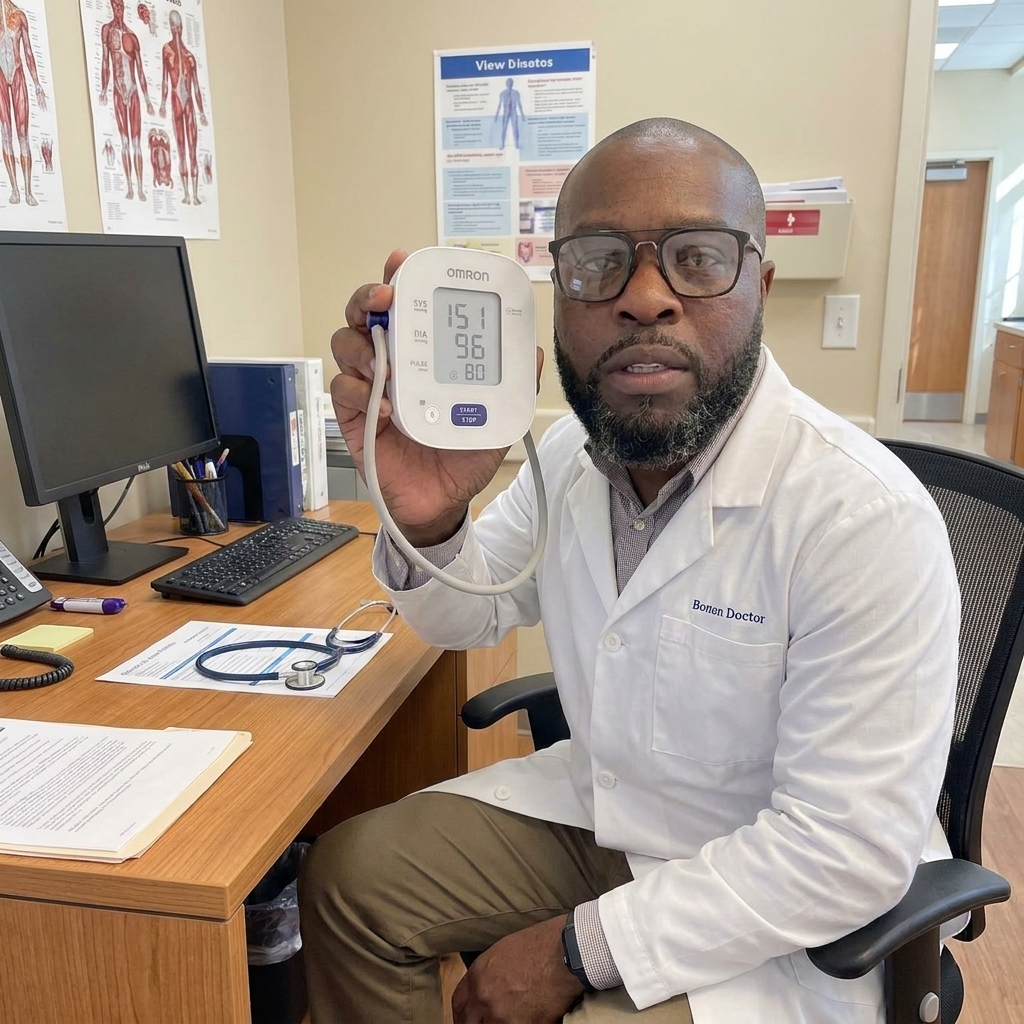
Everybody in my family in Atlanta has high blood pressure. Last year I sat in a room in Ghana with forty of my own relatives who don't. My name is Malik Johnson. I'm 56. Born in Atlanta, lived here my whole life. My father came over from Ghana in 1971. He worked two jobs, raised four of us, and died at 61 of a stroke in his own driveway. I've been on blood pressure medication since I was 45. Lisinopril first. Then they added amlodipine. Then a water pill on top of that. Every doctor I have ever sat in front of has told me some version of the same sentence. It runs in your family. It's common in Black men. We'll manage it. And I believed them. I need you to understand that, because I'm not writing this as somebody who was looking for a fight. I was looking for a way to live. So I did the work. I cut the salt. Not a little. I mean I stopped buying it. My wife will tell you there has not been a salt shaker on our table since 2019. I walked four miles a day, five days a week, for two years straight. I lost 22 pounds. My top number went from 158 to 151. Seven points. In two years. I don't know how to explain what that does to a man. It doesn't make you angry. It makes you quiet. You start to accept that the number is just what you are, and there is nothing underneath it to go find. That was where I was last spring when my uncle Kofi died in Kumasi and I flew over for the funeral. If you've never been to a Ghanaian funeral, it isn't an hour in a church. It's three days. Hundreds of people. My father's entire side of the family in one place, most of whom I'd only ever seen in photographs. On the second day I'm sitting under a tent with my cousins. Somebody's talking about somebody's health, and I said something like, well, you know how it is with our blood pressure. And my cousin Abena, who is 61 years old, looked at me like I'd said something strange. She asked me what I meant. I said the family thing. The pressure. What we all have. She said, Malik, what are you talking about? So I went around that tent. Not in a rude way. Just talking, the way you do at a funeral when everybody wants to tell you about their life. Abena is 61 and takes nothing. Her brother is 58, does construction work, takes nothing. Their mother is 84 years old. Eighty-four. She takes something for her knee. Out of maybe forty people I found two with anything at all, and both of them had moved to Accra years ago and worked office jobs. I want to be careful how I say this next part, because I did not fly home thinking I'd discovered something nobody in the world knew. I flew home with a question I could not put down. Because the people in that tent are my father's blood. Same family. Same everything. So what exactly did I inherit? I read for about four months after that. Some of it I barely understood. A few things I understood fine. There was a study that took around 10,000 adults, all of West African descent, and measured every one of them the same way, in seven different places. In West Africa, 16 out of every 100 had high blood pressure. In the Caribbean, 26. In the United States, 33. Same people. Three places. Then I found a bigger one. About 85,000 people across eleven countries. Rural Nigeria came in at 13.5 percent. Germany came in at 55.3 percent. I read that line twice. Germany. Where not one person's family came from Africa. Four times the rate of rural Nigeria. Then I found the one about Ghana, and that's the one that finished me off. Researchers measured almost 6,000 Ghanaians, some living in Ghana and some living in Europe. Ghanaian men in rural Ghana: 22 out of 100. Ghanaian men living in Berlin: 57 out of 100. Not distant relatives. The same population. In some cases the same families, split across two countries. Now I have to be honest with you here, because I'm not going to tell you something that isn't true just to make my story cleaner. There is research that finds a small genetic piece to this. One study of more than 300,000 people did find that West African ancestry tracks with blood pressure. But when I looked at how big that piece actually is, it comes out to a few points at most. And in study after study, once researchers account for income and education and where a person actually lives, that piece shrinks or disappears. And then there was one that stopped me cold. A team scanned the genomes of 29,000 Black Americans looking for exactly the thing I had been told about my whole life. Some genetic change that happened to us, here, that other people don't carry. They found nothing. They also looked at the one gene people point to most often. It turns out to be more common in Nigeria than it is in Black Americans. Nigeria has more of the gene and less of the disease. So the thing I was told was in my blood is most common in the people who don't have my problem. Then what is it? Because it is real. My father died at 61 in a driveway. My numbers are real. I am not telling you this is in your head. I got to the answer by thinking about food, and I got there because of eight days of eating in Ghana. Every day, twice a day, there were greens on the plate. Kontomire. Cocoyam leaves cooked down soft. Garden eggs. Okra. Real vegetables, in volume, at every single meal. Not as a side dish. As the meal. I came home to Atlanta and looked hard at what I actually eat. And understand, I think of myself as somebody who eats well. Baked instead of fried. Fish instead of beef. No salt in the house. But greens? Real greens, every day, in that kind of quantity? Maybe twice a week, if I was doing good. And that is when I found the thing that explained the entire trip. Your body makes a gas called nitric oxide. It's the signal that tells the walls of your blood vessels to relax and open up. When they open, the pressure inside them comes down. That is the top number on your cuff. Your body does not make that gas out of nothing. It builds it out of something called dietary nitrate. And dietary nitrate comes from vegetables. Leafy ones most of all. That's it. That is the whole thing. I had not been eating the thing my father's family eats twice a day, every day, their entire lives. Then I found the study that made me put the laptop down. It's called DASH. One of the biggest diet studies ever run in this country. They fed people directly, controlled everything, then split the results by race. The diet lowered the top number in African American participants by about 6.8 points. In white participants, about 3. Twice as much. In us. And here is the part that nobody in eleven years ever said to me. They got that result without anybody losing weight, and without cutting salt. I had spent two years at war with a salt shaker. The study that mattered most for people who look like me had already shown that salt was not the lever. Now, I tried to fix this the obvious way first. I tried to just eat it. I bought greens. I bought beets, which I had never eaten once in my life. Two problems, and I'll be straight with you about both. The first is that I couldn't keep it up. Nobody is cooking kontomire for one man in Atlanta on a Wednesday night after work. I lasted about three weeks. The second problem is the one I didn't know about. Heat destroys the nitrate. The thing that actually does the work cooks right out of it. So the beets I was boiling were mostly just beets by the time they got to my plate. That sent me looking for something more reliable, and I'll tell you plainly I was skeptical, because I have bought things off the internet before that did nothing. I was looking for three specific things. Something that gets the nitrate out of the beet without heat, so it survives. Something that tells you on the label how much dietary nitrate is in it, in milligrams, not just how much beetroot. Because beetroot weight tells you nothing. And something an outside lab checks, because I'm not taking a company's word about what's inside its own bottle. Most of what I looked at failed on the second one before I got to the third. Big numbers on the front. Nothing about nitrate anywhere. I found one that met all three. I'm not going to spend paragraphs on it here. The link is at the bottom and you can read it the same way I did. I've taken it every morning since June. I want to be careful about what I claim, because I'm a man who moved seven points in two years and I'm not going to insult you with a miracle. It wasn't dramatic. It was slow. My readings started coming in lower than they used to, and then they kept coming in lower, and at some point I noticed I had stopped bracing before I took them. I am still on my medication. I want to be very clear about that. I didn't stop anything and neither should you. That is a conversation for you and your doctor, not for a man on Facebook. What I'll tell you instead is what my wife said, because she noticed before I did. I take my reading Sunday mornings at the kitchen table. Done it for years. And apparently for years I would take the cuff off and just sit there a second before I said anything. One Sunday she said, you don't do that anymore. I asked what. She said, the thing where you go quiet after. I hadn't noticed I'd stopped. Here is what I actually want to say to you, and then I'll leave it alone. I spent eleven years believing the reason was in my blood, and believing that was just me being realistic about who I am. It wasn't realistic. It was wrong. And it cost me a decade of not looking. The people in that tent in Kumasi have my exact family standing behind them. What they have that I don't is greens on the plate twice a day since the day they were born. I can't move to Ghana. But I could put back the one thing that went missing when my father got on that plane in 1971. So here is what I'd do if you're sitting where I was sitting. Tap the link below and get yourself a bottle. It's the same page I sat and read before I ordered mine. Take it every morning. Don't change three other things at the same time, because then you won't know which one did anything. Then check your own number. Your own cuff, your own kitchen table, same time each week. Write it down. Give it ninety days. If it hasn't moved, send it back. They'll take it back empty. That's the only reason I was willing to find out in the first place. I'm not going to tell you it'll do for you what it did for me. I'm telling you what it did for me, and that ninety days is all it costs you to know. Go get a bottle. https://zenther.co/pages/tbh Malik Johnson Atlanta, Georgia
Where the ad sends people
zenther.co
read this if you have hypertension
Zenther Beetwise, 400mg verified nitrates per serving not 5mg like most brands. Cold-extracted beetroot supplement with published lab results. 90-day guarantee. Try BeetWise today.
Learn more: zenther.co(opens in a new tab)