Amazing Dog Transformations
Amazing Dog Transformations Facebook ad: “$3,204 and a $7,050 Quote, and He Still Couldn't Get on…”
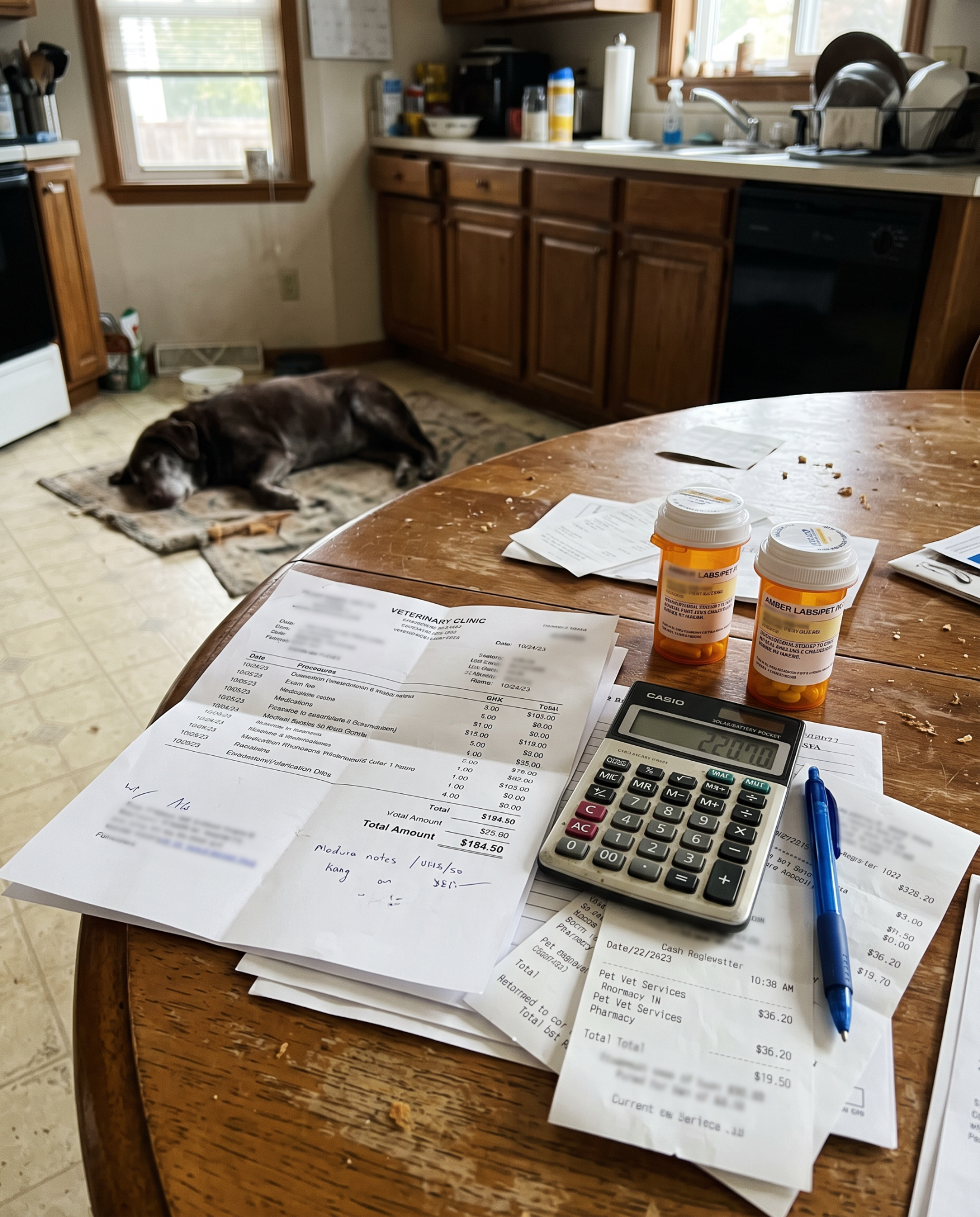
Ran for 17 days, from August 22 to September 8, 2026, the last day Crush saw it.
Run by Amazing Dog Transformations on Facebook. Crush is not the advertiser and does not verify its claims. See this ad in Meta's Ad Library(opens in a new tab)
Want an ad like this for your product?
Crush makes new ad images for your product from this ad: your logo, your product photo, your offer.
Trials from $19.95 USD, then $79.95 USD a month. Cancel anytime.
About this ad
- Meta Ad Library ID
- 1818022272897769
- Platforms
- Relaunches
- 2
Ad text
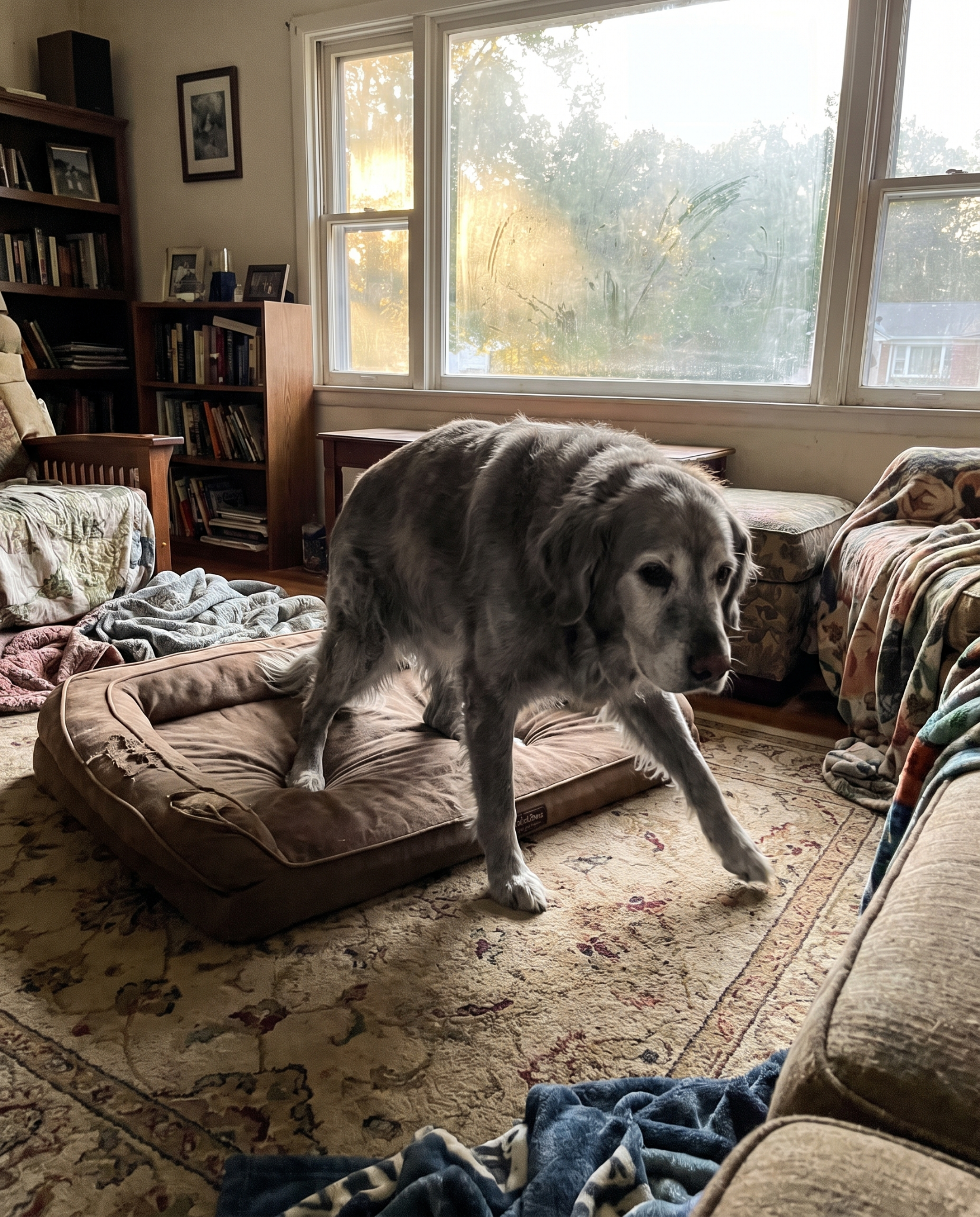
I am going to say something that nobody who owns a stiff, slowing-down dog wants to hear and I genuinely do not care if it upsets you. The next prescription is not going to fix your dog. Not Carprofen. Not Rimadyl. Not Galliprant. Not Meloxicam. Not Previcox. Not Adequan. Not Librela. Not the joint chews everybody in your Facebook group swears by. NONE OF IT IS GOING TO WORK. I know because I tried ALL of it. Every pill. Every injection. Every $33 tub of chews with a golden retriever on the label. For two and a half years. And my dog got so bad that a surgeon slid a piece of paper across a counter with a number on it that I still see when I close my eyes. And the worst part? My second dog started slowing down on the exact same timeline. Same stairs. Same hesitation. Same little pause before the jump into the back of the car. And I almost walked the whole spiral again, because I was still taking the same advice that emptied my savings account the first time. I'm done being polite about this. If your dog is limping and you are sitting in a parking lot right now deciding whether to increase the dose, switch to the other NSAID, or start the monthly injection, you are spending money your dog does not have time for you to waste. Read this entire post. Every word. Because the answer is in here and it is not another prescription. I live outside Columbus with my wife and two dogs. Moose was 9. A big blocky shepherd mix, 78 pounds, the kind of dog who leans his entire body weight into your knees and then looks up at you like he's doing you a favor. Pepper is 6. Half his size. Twice the opinions. Steals socks and hides them under the couch like she's running an operation. Two completely different dogs. But they ended up with the same problem. For Moose, it started with the stairs. He'd get to the bottom step and stop. Just stop. Gather himself. Then go up like the whole thing was a decision he had to make instead of a thing he just did. Then it was the couch. Then the car. Then the mornings, where he'd stand up from his bed in three separate movements — front, pause, back — and take about twenty steps looking like a rusted gate before he loosened up. I took him to the vet. Exam: $129. That is the top of the national range, and I know that now because CareCredit publishes it — a routine vet exam runs $56 to $129 in this country. X-rays. Two views. $172. That number is also published, and I paid it, and I paid it again eight months later. "Arthritis. Very common at his age. Let's start him on an anti-inflammatory." Carprofen. About $36 a month, which is the national average for NSAIDs and steroids for dogs, and honestly, at the time, $36 sounded like nothing. And it worked. For about five months it was a miracle. He went up the stairs without the pause. He got in the car by himself. He brought me a ball in the kitchen one morning and I actually laughed out loud, because I hadn't seen him do that since spring. I thought we were done. Then it started coming back. Not all at once. Slowly. Like someone turning a dial one click at a time. A little stiffness after a long walk. A skipped stair. Then the three-part stand-up in the morning again. Then the pause at the bottom step. I told my vet. "Let's increase the dose." We increased it. Helped for maybe six weeks. Then it crept back. "Let's switch him to a different one." Switched. New name on the bottle. Same $36-ish a month. Helped for a while. Crept back. "Let's add the monthly injection." That's Librela. Depending on the size of your dog, that runs roughly $75 to $150 a month — that range comes from Forbes Advisor quoting practicing veterinarians, and Moose is a big dog, so guess which end I was on. Now I was paying for the injection, and the exams to get the injection, and the follow-ups, and the pills we hadn't fully stopped, and the joint supplement I'd been buying the entire time because the internet told me to. And Moose was still stiff. Still pausing at the stairs. Still standing up in three separate movements at 6 AM. I want you to sit with that. Hundreds of dollars a month, and my dog still could not get on the couch he had slept on his entire life. Here is what nobody handed me, and what I had to go find myself at midnight on a laptop, sitting in a dark kitchen with a dog snoring on the floor next to me. Go read the FDA's own page. It's called "Get the Facts about Pain Relievers for Pets." It is not a blog. It is not a competitor's landing page. It is the federal agency that approves these drugs, publishing what these drugs can do. The FDA writes that NSAIDs for dogs can cause gastrointestinal ulcers and perforations. Perforations. A hole. The FDA writes that these drugs can reduce blood flow to the kidneys, and that this can lead to kidney damage and sudden-onset kidney failure. The FDA writes that liver damage can occur, that it is not related to the dose, that it is idiosyncratic — meaning it happens to the dog it happens to, and you cannot predict which dog that is — and that most liver injury occurs within three weeks of starting the drug. And then the FDA lists the signs owners are supposed to watch for. Vomiting. Diarrhea. Bloody or black stool. Decreased appetite. Decreased activity. Yellowing of the whites of the eyes or gums. Read that list again. Bloody or black stool. Yellowing of the eyes or gums. Now answer me honestly: did anyone say those six words to you when they handed you the bottle? Did anyone tell you to check your dog's gums? Did anyone hand you a printout? Nobody handed me one. Twice. Two different drugs. Two different clinics. I found that list myself, on a government website, at 12:40 in the morning, eleven months in. I'm not telling you those drugs hurt my dog. I'm telling you the warnings exist, in the FDA's own words, and that I was never shown them. And then it got worse, because I kept reading. On 16 December 2024 the FDA issued something called a "Dear Veterinarian Letter" about Librela. That's a formal communication the agency sends to the veterinary profession. It concerned adverse events that had been reported in treated dogs — including ataxia, seizures and other neurologic signs such as paresis and recumbency, urinary incontinence, increased urination and increased thirst, with some reports involving death or euthanasia. Zoetis, the manufacturer, updated the US label on 4 February 2025. And the FDA has received 12,234 adverse event reports for that product between 5 May 2023 and 31 March 2025. Now I want to be extremely precise here, because precision is the only thing that separates me from every other person yelling on the internet. I am not telling you that drug caused a single one of those events. The FDA states plainly that there is no certainty the reported drug caused the reported event, and that these numbers must not be used to calculate incidence rates. So I won't. I'm not going to do the math for you, because the math is not valid, and anyone who does it for you is lying to you. Here is my entire point, and it is smaller and angrier than that: The letter exists. The reports exist. The label was updated. And nobody told me. I was injecting my dog every month, writing the check every month, and the first I heard of any of it was from a search engine, months after the fact, at a kitchen table, alone. That is the part I cannot forgive. Not that the risk exists — every intervention has risk, that's medicine. It's that the conversation never happened. I was sold a monthly subscription to a decision I was never given enough information to actually make. And underneath all of it, the joint kept getting worse. Because here is the thing nobody says out loud in that exam room: Every single one of those products is aimed at the signal. Not the joint. An NSAID interrupts inflammatory signaling. That's what it does. That's what it's for. It is a very effective way to make a dog feel less of something. It does not do one thing for the tissue underneath. The joint keeps changing while the signal is turned down. So the signal gets louder. So you raise the dose. So the signal gets louder. So you switch drugs. So the signal gets louder. So you add the injection. More volume knobs. Same joint. The knobs will never catch up, because nothing in that stack was ever aimed at the joint in the first place. That's why the five-month honeymoon happens to everybody. It is not that the drug "stopped working." It is that you were never treating the thing that was changing. Fourteen months in, Moose came up lame on a back leg and could not put weight on it. Torn cruciate. We went to a surgical practice. Exam. More imaging. The number on the paper was $3,525. Per knee. That is the national average for a TPLO. Per knee. And the surgeon told me what every surgeon tells you, which is that a significant number of dogs eventually blow the other one, so mentally prepare for $7,050. I sat in the truck in the parking lot with that piece of paper on the passenger seat and I did something I had been avoiding for over a year. I added it up. Eight vet exams: about $1,000. Two sets of X-rays at $172: $344. NSAIDs, roughly eighteen months at $36: $648. Librela, six months, big dog, high end of that $75–$150 range: about $750. Joint supplements, fourteen months at the $33 national average: $462. $3,204. Plus a $7,050 quote sitting on my passenger seat. $3,204 spent. And my dog could not get on the couch. Not one dollar of that $3,204 went toward the joint. Every dollar went toward the signal coming out of the joint. And the $462? The supplements? That's the part that actually made me sick, and I need to explain it properly, because it is the single most important thing in this post. I had been buying glucosamine and chondroitin chews for over a year. Every joint supplement in the pet aisle is glucosamine and chondroitin. Every one. It's the default. It's what the vet tech mentions on your way out. It's what your neighbor gives her lab. In 2022, researchers published a systematic review and meta-analysis in the International Journal of Molecular Sciences. Barbeau-Grégoire and colleagues. Fifty-seven articles. Seventy-two trials. Their finding on glucosamine and chondroitin was a "very marked non-effect." 88.9% of the trials showed no effect. Zero percent demonstrated an effect. Zero. The authors wrote that these products "should no longer be recommended." And this isn't one rogue paper. The Merck Veterinary Manual — the reference text sitting on the shelf in your vet's office — independently states that the evidence "did not support the use of" glucosamine and chondroitin. I had spent $462 on the most popular joint ingredient on earth, and 72 trials say it does nothing, and the manual on my own vet's shelf agrees, and I found this out on a phone in a parking lot next to a $7,050 surgical quote. I wanted to put my fist through the windshield. So I did the only thing I had left. I stopped asking what to try next and started asking what actually has evidence behind it. Not marketing. Evidence. Randomized. Placebo-controlled. Published. And here's what I found, and it's three things, and Zoomies is the only chew I found in this country that is built out of all three and nothing else. Not glucosamine. Not chondroitin. Zoomies contains neither. That is not an accident and that is not a shortcut — it is the entire point. Three ingredients. Natural Eggshell Membrane. Boswellia Serrata. Hyaluronic Acid. That's it. No seed oils. No cheap fillers. 100% made and sourced in the United States. Here's the part that got my attention, and here's the part I want you to check yourself. Ruff and colleagues, 2016, published in Veterinary Medicine: Research and Reports, volume 7, pages 113–121. Randomized. Double-blind. Placebo-controlled. Fifty-one dogs. At one week — one week — the dogs on natural eggshell membrane showed a 19.4% improvement in owner-assessed joint pain versus placebo (P=0.010), and a 20.5% improvement in owner-assessed function (P=0.028). At six weeks, veterinarian-assessed pain improved 23.6% (P=0.012) and owner-assessed quality of life improved 26.8% (P=0.033). I want to be as careful here as I was about the FDA reports, because I'm not going to become the thing I'm angry at. That is one trial in 51 dogs. It is not "clinically proven." It is a randomized, double-blind, placebo-controlled trial with real numbers and real P-values, which is 51 more dogs than most of the pet aisle can show you, and it is 72 trials better than glucosamine. And it's the reason the seven-day thing isn't marketing fluff. The one-week improvement is in the published data. Here's how the three ingredients stack, and the brand calls it the 3-Stage Mobility System. Stage 1, days 3 to 7. Boswellia Serrata works on stiffness. This is the stage you notice first. It's the morning stand-up. It's the twenty rusty steps that stop being twenty rusty steps. Stage 2, weeks 2 to 4. The eggshell membrane supports cartilage. This is the slow one. This is the part that is actually aimed at the joint instead of the signal coming out of it. Stage 3, weeks 4 to 6 and beyond. Hyaluronic acid supports joint fluid. Three ingredients. Three jobs. Sequenced. Compare that to what I'd been doing, which was paying hundreds of dollars a month to make a dog feel less of something while the joint did whatever it was going to do anyway. I started Moose on it. I did not stop anything. Let me say that clearly, because I'm not going to be responsible for somebody yanking their dog off a prescribed medication because they read a Facebook post: do not stop anything your vet has prescribed. Talk to your vet. I added the chews on top of everything and let the vet make the calls from there. Week 1: Honestly? I wasn't sure. I thought I saw something on day five and told myself I was imagining it because I wanted it so badly. Week 2: The morning stand-up became one movement instead of three. My wife noticed before I did. She said it from the kitchen without looking up — "he just got up normal." Week 4: The stairs. No pause at the bottom step. He just went up them, the way he used to, like it wasn't a decision. Week 6: He got on the couch. By himself. At 10 PM on a Thursday, with no run-up and no whining and no help from me. He turned around twice and flopped down and sighed like he'd been doing it every night for nine years. I stood in my own living room and cried at a dog on a couch. Month 3: We had the conversation with our vet about what he actually still needed, and that conversation went in a direction it had never once gone before — down instead of up. That was the first time in two and a half years that a vet visit ended with less instead of more. And Pepper — my six-year-old, the sock thief, the one who had just started hesitating before jumping into the car? I put her on it the same day. She never got the exams. Never got the X-rays. Never got the $36 a month. Never got a monthly injection. Never got a $3,525 quote. She jumps into the car. That's the whole story. One dog got there after $3,204 and a surgical quote. The other got there before any of it. So here it is. Zoomies Extra Strength Joint Chews. Soft chews — you hand it to your dog, they think they got a treat, that's the entire administration process. Three ingredients: Natural Eggshell Membrane, Boswellia Serrata, Hyaluronic Acid. No glucosamine. No chondroitin. No seed oils. No cheap fillers. 100% made and sourced in the United States. Hundreds of success stories. The national average for a dog joint supplement is $33 a month. Zoomies is running up to 40% off right now, which puts it under that, which puts it under a single vet exam, and roughly a rounding error next to what I was spending. And every order comes with a 90-day money-back guarantee. Ninety days. That is longer than the entire 3-Stage system takes to run. Worst case, you get your money back. Best case, your dog gets better. There is genuinely no risk to you. There was enormous risk in every single thing I did before this, and none of those came with a refund. Click LEARN MORE. Do it tonight. Not because of a countdown timer — there isn't one. Do it tonight because the joint is doing something right now, while you read this, and every month you spend turning the volume down is a month the thing making the noise had to itself. You'll know before you can prove it. It'll be a Tuesday morning and your dog will stand up in one movement. And you'll stand there in your kitchen holding a coffee cup, watching a dog do something completely unremarkable, and your throat will close up. I wish I'd had that morning $3,204 ago. P.S. Read this part if you read nothing else. I spent $3,204 and got handed a $7,050 quote, and the entire time, every product in that stack was aimed at the signal instead of the joint. There is no recurring revenue in a joint that stops sending the signal. There is enormous recurring revenue in $36-a-month refills and $75-to-$150-a-month injections and the exams required to keep both going, forever. That's not a conspiracy, that's just a business model, and it is the reason nobody ever handed me the FDA's own warning list — the ulcers and perforations, the reduced kidney blood flow and sudden-onset kidney failure, the idiosyncratic liver injury usually inside three weeks, the bloody or black stool, the yellowing of the eyes or gums. And it is the reason nobody mentioned that the FDA issued a Dear Veterinarian Letter on 16 December 2024, or that the agency has received 12,234 adverse event reports through 31 March 2025. I am not telling you any drug caused any harm. FDA says causation is not established and I'm not going to pretend otherwise. I am telling you those documents are public, they are free, they took me four minutes to find, and I paid thousands of dollars over two and a half years to people whose job it was to mention them, and not one of them ever did. P.P.S. If your dog is 5, 6, 7 and just started pausing at the bottom of the stairs — you are in the single best position anybody reading this is in. Nothing has spiraled yet. There's no bottle. There's no monthly injection. There's no quote on your counter. Pepper is my proof: same house, same food, same floors, one dog started before the spiral and one started after $3,204. The difference was catching it early and aiming at the joint instead of the signal. Ninety-day guarantee, up to 40% off, and the published data on that eggshell membrane shows improvement at one week. Don't wait for the limp. Click LEARN MORE.
Where the ad sends people
nancygriffithblog.com
$3,204 and a $7,050 Quote — and He Still Couldn't Get on the Couch
Insider Picks𝕏fDo You Wish Your Dog Could Move Like A Puppy Again? Published Veterinary Discovery Is Proven To Restore Joint Function In Just 7 DaysPWI Editorial Team, Insider Picks • Thursday, June 25, 2026, 8:27 AM 357,028Recently published veterinary research revealed a natural compound that...
See details: usa.zoomiespethealth.com(opens in a new tab)