
Inactive· since Aug 31, 2026
- 9
- days it ran
- 0
- relaunches
Ad copy
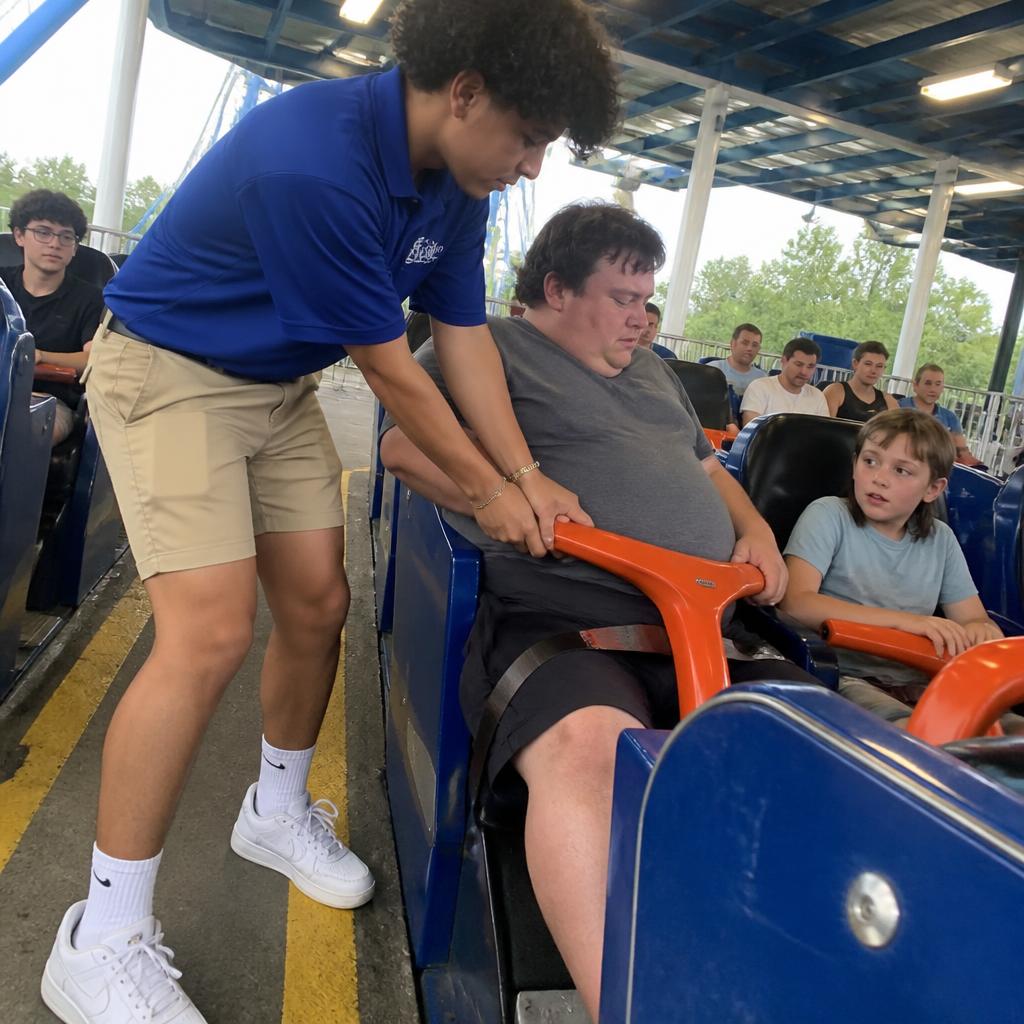
I'm done disappointing my son. That's what I said to myself — out loud, in a bathroom stall at Six Flags — and I meant it the way you mean something when you're too tired to lie about it anymore. The line for the ride was forty minutes. My son talked the whole time. Which drop is the worst. How fast it goes. What his friend Dylan said about the last hill. He'd been talking about this ride since he made the deal with himself to get four A's on his report card. He got four. Set the report card face-up on the dinner table without saying a word. He'd done his part. At twenty-five I'd have ridden this thing six times and eaten a funnel cake between each one. I kept wiping my forehead and telling myself it was the heat. We got to the front. He sat down. Pulled his bar. It clicked on the first try. I sat down. Pulled mine. It stopped two inches from the latch. I pushed harder. Nothing. A seventeen-year-old running the ride walked over and put both hands on the bar and leaned his full weight into it. The bar moved half an inch and stopped. People in the car behind us were watching. A woman in the next row looked away fast, the way you look away from someone's open fly. My son was staring at the bar. "Dad, can you just suck in?" I sucked in until my ribs ached. The kid pushed again. The bar didn't move. "Sorry sir, I'm gonna need you to step off." He said it quietly. Not unkind. Like he'd done it before and knew exactly how loud to say it so the rest of the line wouldn't hear. I unclipped. Stood up. Walked down the exit stairs while the rest of the train sat buckled in, waiting. My son rode the roller coaster alone. Third row, left seat. The seat next to him was empty. I stood at the fence holding a dinosaur backpack and two cotton candies and watched the train climb the first hill. Found him — hands up, screaming. I hated that seventeen-year-old kid for doing his job. I hated him for a full week after. I googled the bar dimensions that night to prove they were designed for a smaller average. They weren't. When the ride stopped, my son came through the exit gate scanning the crowd. I was already smiling. The kind of smile you build before they can see you so they don't know what's underneath it. "Bar was broken on my side, buddy. Happens." He looked at me. Then he looked back at the ride. Watched the next train load. Watched a guy about my height sit down and pull the bar. It clicked on the first try. My son didn't say anything. He just turned and started walking toward the next ride. We spent eight hours at that park. He rode the real rides. I rode the ones with bench seats and no lap bars — the spinning teacups, the log flume, the train around the lake. At one point he ran ahead to get in line and handed his backpack to a stranger's dad at the gate because he'd stopped handing it to me. My wife was there. She saw all of it. She didn't say a word. I went to the bathroom and sat in a stall for ten minutes. I didn't cry. I just sat there with my elbows on my knees and said it like a promise: I'm done disappointing my son. I didn't know how yet. But I knew the sentence was true. That night, after my son went to bed, I sat at the kitchen table and opened Amazon on my laptop. I typed "weight loss supplements for men" and I started buying. A fat burner with green tea extract and caffeine. $34. A CLA supplement that promised to target belly fat. $28. A metabolism booster with B-vitamins and chromium. $22. Apple cider vinegar capsules because I'd seen them on a YouTube video. $19. A greens powder in a black container with a muscular man on the label. $45. A fiber supplement someone in a Facebook group swore by. $16. $164 in one cart. I clicked Buy Now at 11:40 PM. I noticed I was breathing hard just from sitting and leaning forward to type. I didn't used to notice that. My wife was asleep upstairs. She'd watched me at the park — watched me walk down the exit stairs, watched me hold the backpack, watched me smile at our son when I wanted to disappear. She hadn't said a word about it. That was worse than if she'd said something, because it meant she'd already made peace with this version of me. It meant she'd stopped expecting it to change. Somewhere in the last year she'd stopped putting her hand on my stomach when we watched TV at night. I couldn't remember exactly when. I just knew it used to happen and then it didn't. Three days later, a pile of boxes arrived. I lined them up on my kitchen counter — six bottles, six promises, six labels I didn't fully understand — and I took photos of all of them and posted it in a men's weight loss group on Facebook with the caption: "Day 1. Let's go." My wife saw the boxes on the counter. She didn't say anything about those either. But that night she made chicken breast and broccoli for dinner without me asking. She just made it. Like she was saying: if you're doing this, I'll do it with you. Fourteen likes on the Facebook post. Three fire emojis. One guy who said "Get it brother." I went back to Amazon and bought a 40-ounce water bottle with time markers on the side. $17. New gym shorts. $24. Two dry-fit shirts that didn't cling to my stomach. $38. A food scale. $19. A journal somebody recommended for tracking meals. $13. $111 more. Total investment: $275, plus the gym membership I'd been paying for since January and used maybe eleven times. I downloaded MyFitnessPal. Set my calories at 1,800. Logged everything. Chicken breast, rice, broccoli. Chicken breast, sweet potato, green beans. Chicken breast, quinoa, spinach. Same rotation. Same discipline. My wife ate every dinner with me without complaining. She never asked for pasta. She never brought home takeout. She just quietly ate what I ate, like she was holding a door open for me to walk through. I was a machine. Monday morning I woke up at 5:30 and went to the gym. First time since February. I did the treadmill for thirty minutes — walked at 3.5 because I couldn't run without my knees screaming. Then I did the belly fat routine from YouTube. Planks. Crunches. Mountain climbers that looked nothing like the video because I couldn't hold the position for more than ten seconds. The gym at 5:30 AM is mostly empty. But there are regulars. And I was the biggest guy in the room every single morning, and the only one who used a towel to cover his stomach walking to the showers. Nobody said anything. Nobody had to. I went home, showered, took three of my six supplements with breakfast, logged my calories, and drove to work feeling like I'd finally started. I did this for two months. I want you to hear that. Not two days. Not two weeks when things were exciting. Two months. Sixty-one days of waking up early. Sixty-one days of logging food. Sixty-one days of gym sessions where I went anyway. Sixty-one days of reaching for the seatbelt on the drive to work and doing the small lean forward to click it that I'd been doing so long I forgot it used to just click. Sixty-one days of asking for a table instead of a booth when we went out on Fridays because I didn't want to wedge myself into the seat in front of my wife. The supplements ran out after six weeks. I reordered two of them — the fat burner and the greens powder — because those were the ones the Facebook group said mattered. Another $79. I posted progress photos at thirty days. A bathroom mirror selfie, shirtless, because that's what the group did. The comments said I looked leaner. I didn't see it. But I trusted them because I wanted to trust them. I posted a shirtless photo to four hundred strangers on Facebook and I still got dressed in the bathroom so my wife wouldn't see me. At sixty days, I got on the scale. Down nine pounds. Nine pounds in two months of perfect discipline. Okay. Fine. Nine pounds is nine pounds. I'll take it. But here's the part that made me sit on the edge of the bathtub and stare at the floor. I lifted my shirt and looked in the mirror. The belly was the same. Not similar. The same. The same shape. The same roundness. The same dense, heavy, pressurized feeling that starts below my chest and pushes outward like it's inflated from the inside. The nine pounds had come off my face, my arms, my legs — everywhere except the place I was trying to lose it. I'd lost nine pounds and my belt was on the same notch. My wife saw me standing there. She came in to brush her teeth and I was just standing in front of the mirror with my shirt up, staring at the same belly I'd started with. She touched my shoulder and said, "You look good, Jay," and I could tell she knew I didn't believe it and I could tell she didn't know what else to say. That evening my son came into the kitchen while I was cleaning up dinner. He walked past me to where my wife was sitting at the table and said, "Mom, can you take me to the pool Saturday?" Not Dad. Mom. Didn't even look at me. My wife glanced at me over his head. Just for a second. We both understood what had happened. He'd learned which parent to ask for physical things. Nine years old and he'd already built a system. Pool, bike ride, trampoline park — ask Mom. Dad's the one who stands at the fence. Nobody said anything. He went back to the couch. I finished the dishes. That night he was flipping through a photo album on the couch — one of those old ones with the plastic sleeves, the kind nobody makes anymore. My wife's family had dropped it off at Thanksgiving. He was looking at pictures of our wedding. Of the vacation in Destin. Of a Fourth of July where I was holding him on my shoulders at a fireworks show — he was two, and I was thirty-eight, and in that photo I was wearing a tank top and you could see my arms and my chest and my stomach was flat without trying and my jaw had an edge to it and I looked like a man who'd never once thought about the shape of his own body because there was nothing to think about. He held the album up and said, "Dad, is that you?" Not "you looked different." Not "you were skinnier." Just: is that you? Like it might be someone else. "Yeah, buddy. That's me." He looked at the photo. Looked at me. Looked at the photo again. Then he turned the page and kept going. That's the part nobody talks about. Not "I'm fat." Lots of guys are fat and they're fine with it. The wound isn't the weight. The wound is: I used to be lean without trying. I could eat whatever I wanted. I could drink beer on Saturdays and eat pizza at midnight and skip the gym for a month and nothing changed. And then it changed, and I don't know when, and I don't know why, and now I'm doing more than I've ever done and it's not enough. Six months before that evening on the couch, I'd been sitting in Dr. Ramos's office listening to the speech every man my age dreads. "Jay, we need to talk about your numbers." My fasting glucose was in the pre-diabetic range. My weight was climbing. My blood pressure was borderline. He'd printed the labs and set the paper on the exam table between us. "I want to start you on a statin. And I think it's time to talk about one of the GLP-1 medications. The injectable. Insurance might cover part of it." I knew what he was talking about. Half the guys at my office had talked about it. Two of them had done it. One looked like he'd aged ten years in six months — gaunt face, loose skin, no energy. He'd lost the weight and he looked worse. The other one lost thirty pounds in four months, stopped the shots, and gained back forty by Christmas. The cost. The insurance fight. Injecting myself once a week to fix something I used to do for free at twenty-five. And the stories — always the same ending. You stop, it comes back. All of it. Sometimes more. I didn't want to rent a smaller body. I wanted mine back. "I want to try diet and exercise first," I said. He'd looked at me the way doctors look at you when they've heard that sentence a hundred times and been proven right ninety-five of them. "You have six months." That was the visit I was trying to make good on. And I'd done everything right. And the belly hadn't moved. I went on the Facebook group and typed: "Two months in. Nine pounds. Belly hasn't moved. What am I doing wrong?" Forty-three comments. "Cut the carbs." I was eating 120g a day — already low. "Are you doing enough cardio?" I was doing thirty minutes, five days a week. "Try intermittent fasting." I'd done 16:8 for three weeks and felt lightheaded by noon. "You might be building muscle and losing fat at the same time." I wasn't. The belly was the same circumference — I'd measured. "Give it time." Give it time. That's the sentence that keeps people spending and suffering and blaming themselves for biology they were never told about. I almost quit. I want to be honest about that. I almost threw the bottles away, cancelled the gym membership, and went back to eating whatever I wanted, because at least that way the failure would match the effort. Then I called Marcus. Marcus Ellington. We played ball together in college — twenty-three years ago. Same dorm, same dining hall, same 2 AM pizza runs after Saturday games. Back then, we both ate whatever we wanted and neither of us owned a scale. We didn't need one. We were twenty-two and the engine was running and we never thought about it because you never think about something that works. He went into kinesiology, got certified, opened a training studio, spent twenty years working with people on body composition — not Instagram guys, regular people. Dads. Office workers. Men in their forties and fifties who showed up with the same belly I had and left looking different. He's fifty. He looks forty. Not in a cosmetic, Botox kind of way — in a structural way. Lean. Dense. The kind of body that says the engine runs clean. I called him. Not about football. Not to catch up. I told him I needed help and I told him why. I told him about Six Flags. About the bar. About my son riding alone. About the $275 in supplements and the 5:30 AM gym sessions and the sixty-one days of logging every bite and the nine pounds that came off everywhere except the one place that mattered. He was quiet for a while. "Can you come by the studio this week?" I drove there Thursday. Marcus has a whiteboard in his office the size of a wall. It's covered in client notes, programming charts, metabolic rate calculations. He wiped a section clean with the side of his fist and picked up a blue marker. "How many calories are you eating?" "Eighteen hundred." "And you were maintaining your weight at roughly what before — twenty-four, twenty-five hundred?" "About that." "So you created a six- to seven-hundred-calorie deficit every day for two months." "Yes." "And the belly didn't move." "Not a centimeter." He wrote two numbers on the board in big block letters. Calories In: 1,800 Calories Burned: ? He underlined the question mark three times. "You know your intake," he said. "You logged it. But do you know what you're actually burning?" "I mean — the treadmill says three hundred calories, and then—" "Not the treadmill. Not the workout. I'm talking about the other twenty-three hours. The calories your body burns just being alive. Sitting at your desk. Sleeping. Digesting food. Breathing. That's your burn rate. That's where seventy to eighty percent of your daily calorie expenditure happens — not at the gym. At rest." He drew a long horizontal line across the middle of the board. Wrote BURN RATE above it. "Your burn rate is set by your metabolism. And your metabolism is set by your mitochondria." He wrote the word in all caps. Circled it. "Every cell in your body has mitochondria. Power plants. Hundreds of them per cell. Their job is to take the food you eat and convert it to energy — ATP. That's the burn. That's the furnace. That's what decides whether a calorie gets used or stored." He tapped the circled word with the marker so hard it left a blue dot. "Remember college? Remember how we'd eat a whole pizza at Gino's after a game and wake up the next morning and look exactly the same?" I remembered. I remembered it the way you remember being able to run without thinking about your knees. Like a language I used to speak. "That was your engine at full capacity," he said. "Every calorie you took in was processed by machinery running at a hundred percent. You didn't count calories because you didn't need to. The math worked by itself." He drew a downward line on the board. A steep one. "I've tested resting metabolic rate on over three hundred clients in twenty years. The pattern is always the same. Guys in their mid-twenties — their engines are running clean, burning everything they take in. By thirty-five, I'm seeing a measurable drop. By forty, it drops harder. By forty-five — where you are — the engine is running at closer to sixty percent of what it was." "These aren't textbook numbers. These are from my own assessments. Twenty years of metabolic testing on real guys — tradesmen, office workers, dads. The exact number varies, but the pattern doesn't." I stared at the board. Sixty percent. I thought about the sixty-one mornings I'd dragged myself out of bed at 5:30. I thought about every chicken breast. Every logged calorie. Every plank I'd held while shaking. I'd been running on a treadmill — literally and figuratively — inside a body that could only process sixty percent of what it used to. I never had a chance. "What happened to the other forty percent?" "Good question." He picked up a red marker. "A molecule your body produces called the hydroxyl radical." He wrote it on the board in red. Drew a circle around it. Then drew arrows pointing outward from the circle in every direction — aggressive, jagged arrows, like the word was exploding. "The most destructive free radical in human biology. Your mitochondria generate it as a byproduct of making energy — like exhaust from an engine. When you're young, the exhaust is manageable. As you age, and the load increases — stress, processed food, environmental toxins, inflammation from the extra weight itself — the exhaust production goes up. And here's the trap." He drew a new circle — the mitochondria — and then drew the jagged arrows from the hydroxyl radical pointing back at it. He drew it hard. The marker squeaked. "The exhaust attacks the engine that produces it. The hydroxyl radical damages the membranes of the mitochondria themselves. Damaged mitochondria produce less energy AND more radicals. Less burn, more damage. Less burn, more damage." He drew the loop — radical damages mitochondria, damaged mitochondria produce more radical, more radical damages more mitochondria — going around and around, each arrow thicker than the last. "It's a loop, Jay. A cycle that accelerates year over year." I looked at the loop on the board and I felt something I didn't expect. Not confusion. Not curiosity. Anger. A slow, pressurized anger that started in my chest and spread outward. Because I was looking at a diagram of why sixty-one days of discipline hadn't worked. I was looking at the reason my belly hadn't moved. And the reason wasn't effort. The reason wasn't discipline. The reason wasn't the supplements or the food scale or the 5:30 AM alarm. The reason was a molecule I'd never heard of, eating my engine alive, and nobody — not the YouTube guys, not the Facebook group, not the labels on any of the six bottles I'd bought — had ever mentioned it. "Why doesn't anyone know this?" I said. And I could hear the anger in my own voice. He set the marker down and leaned against the whiteboard. "You want the honest answer? The weight loss industry does sixty billion dollars a year in the US alone. Sixty billion — selling fuel to people with broken engines. New fuel. Better fuel. Premium fuel. Fat burners, meal replacements, appetite suppressants, metabolic boosters. Every one of them assumes the engine works and the problem is what you're putting in it. That's the business model. You don't make sixty billion a year telling people to fix the engine — because fixing the engine means they stop buying fuel." He rubbed his forehead. "The research on molecular hydrogen and mitochondria has been published since the mid-2000s. Over a thousand peer-reviewed papers. It's not hidden. It's just not profitable for anyone in the supply chain to talk about. And my own certification — four hundred hours of coursework — never mentioned mitochondrial damage once. Not once. I learned about macros, periodization, progressive overload, caloric deficit. Nobody taught me what happens when the machinery processing those calories is corroded. I had to learn that from a client who happened to be a doctor." He picked up the blue marker again and drew an X through the supplement bottles I'd described. One at a time. Green tea extract. X. CLA. X. Metabolism booster. X. Apple cider vinegar. X. Greens powder. X. Fiber supplement. X. "None of them touch the hydroxyl radical. None of them repair mitochondrial membranes. They're like putting premium gas in a car with a corroded engine — the fuel doesn't matter if the cylinders can't fire." He pointed at me with the marker. "The water bottle with the time markers. The food scale. The YouTube workouts. You did everything right, Jay. Everything. And it didn't work because nobody told you the engine was broken." I sat with that. The anger wasn't fading. It was clarifying. "So why didn't the belly move? I was in a deficit. Nine pounds came off." "Because of where the nine pounds came off." He tapped the belly region on a body chart pinned to the wall beside the whiteboard. "Here's what every diet gets wrong about visceral fat. When your engine is running at sixty percent, visceral fat is the LAST thing your body will burn. It's deep. It's hormonally locked in place — cortisol holds it there, insulin keeps the door shut. Your body treats it like a strategic reserve." I thought about the tape measure. Sixty-one days. Same number. Every time. "So when you diet," he said, "you burn the easy stuff first — face, arms, legs, the subcutaneous fat under the skin. That's your nine pounds. The visceral fat sits behind a hormonal lock that a calorie deficit alone can't pick. You'd have to eat eight hundred calories a day to override it, and at that point your body downshifts to protect itself. Metabolism drops to match. You plateau. You quit. You regain." "Every time," I said. "Every time." He set the marker down. He wasn't looking at the whiteboard anymore. He was looking at the floor. "I had a client named Derek. Forty-seven. Electrician. Two kids. He came to me because his wife had given him a six-month training package for Christmas — not a hint, she just wanted to do something nice for him. He showed up every session. Never missed. Did everything I programmed. Tracked every meal. Four months in, he'd lost fourteen pounds and his belly hadn't moved a centimeter." Marcus rubbed the back of his neck. "I told him to be patient. I told him to trust the process. I adjusted his macros. I changed his programming. I did everything I knew how to do, and the belly sat there. Month five, he sat down in my office and said, 'Marcus, I think you're a good trainer, but I don't think you can fix this.' He cancelled. Walked out. He was right to fire me. Because I didn't know what I was looking at. I was fine-tuning the fuel delivery on a corroded engine and telling a good man to be patient while the engine ate itself." He looked up at me. "I had a hundred Dereks before I understood what was actually happening." "Is there something that fixes the engine?" He paused. Set the marker down. Sat on the edge of his desk. "Three years ago, a client of mine — a doctor, actually — handed me a research paper from a Japanese medical university. I almost didn't read it. But he was the best-read person I'd ever trained, and he said read it, so I read it." He pulled up the paper on his tablet. Turned the screen toward me. "Molecular hydrogen. H2. The smallest molecule that exists. Two atoms. So small it passes through cell membranes like they aren't there — directly into the mitochondria, into the exact place where the damage is happening." He scrolled to a diagram that looked like a simplified version of what he'd drawn on the whiteboard. "The hydroxyl radical — the exhaust destroying your engine — has one weakness. Molecular hydrogen converts it to water. H2O. The most harmless substance on earth. Hydrogen finds the radical, neutralizes it, and the byproduct is water. Your body flushes it. The attack on the mitochondria stops." "And when it stops?" "The membranes repair. The mitochondria regenerate. The burn rate comes back up. Not overnight. Week by week, as the engine rebuilds, your resting metabolism increases. Same food. Same activity. More burn. The deficit you couldn't create through dieting alone gets created by the machinery finally working." "And here's the part that reverses the belly problem specifically," he said. "When the mitochondria come back to full capacity, the hormones that were locking visceral fat in place — cortisol, insulin — normalize. The lock opens. And visceral fat turns out to be the most metabolically ACTIVE fat in your body. It's surrounded by blood vessels. Packed with receptors. Once the hormonal block clears, it mobilizes faster than any other fat. It's the last to go on a broken engine and the FIRST to go on a repaired one." He pulled up another study. "A 2020 controlled trial out of Nagoya University — twenty-six overweight adults, ten weeks — showed hydrogen consumption produced metabolic improvements equivalent to cutting food intake by twenty percent. Same diet. Same portions. The hydrogen group burned more." He let that sit. "There's another piece I didn't expect. When I started looking into this, I found that the same radical damage happening in the mitochondria throughout your body is also happening in the cells that line your gut. The cells that produce your satiety hormones — GLP-1, peptide YY, the signals that tell your brain you've had enough. When those cells are damaged, the signals weaken. That's part of why the hunger gets relentless after forty — it's not lack of willpower. It's a broken signal. Repair the mitochondria in the gut lining and the signal comes back. The appetite quiets down on its own." He picked up the blue marker again and wrote one more word on the board: MAGNESIUM. "There's a second piece nobody connects," he said. "Hydrogen neutralizes the radical. That's the repair. But ATP — the energy your mitochondria actually produce — requires magnesium to catalyze the reaction. Magnesium is the spark plug. You can rebuild the entire engine, clean every cylinder, replace every membrane — and if the spark plug is missing, it won't fire." He tapped the word. "Seventy-five percent of Americans are deficient. Not low — deficient. And the men I test who carry the most visceral fat are almost always in the bottom quartile. They've been running on a corroded engine with a missing spark plug. The engine can't burn, and even when it repairs, it can't produce energy efficiently without the cofactor that makes the reaction go." "So you need both," I said. "You need both. Hydrogen to stop the damage and rebuild the membranes. Magnesium to make sure the rebuilt engine can actually produce ATP. One without the other is half a repair." "Can't I just take a magnesium supplement from the drugstore?" "You can. Most people do. And most of it passes through unabsorbed — magnesium oxide, the cheap kind in every bottle on the shelf, has about a four percent absorption rate. You're swallowing a rock and hoping your body figures it out." He pointed at the whiteboard where he'd drawn the effervescent reaction earlier. "The reason this matters is that the best delivery method for molecular hydrogen — an effervescent tablet — actually produces the magnesium as part of the same chemical reaction. The tablet contains elemental magnesium. When it hits water, the magnesium reacts with the water to release hydrogen gas. The byproduct of that reaction is magnesium in ionic form — already dissolved, already bioavailable. You're not combining two separate supplements. The chemistry that creates the hydrogen also creates the magnesium your mitochondria need to use it. One reaction, both pieces." That clicked something into place for me. It wasn't two things bolted together. It was one process that produced both. Then he said something I want to be clear about. "I've tested hydrogen on myself and on clients. It works. The mechanism is real and the research is solid. But here's the problem — most of the hydrogen products on the market don't work. I went through three different brands before I found one that actually moved the numbers. The pouches, the bottles, the machines — they deliver two, maybe three parts per million. The clinical studies use ten to twelve. It's the difference between a dose and a trace. You need an effervescent tablet at clinical concentration, and you need to drink it while it's still fizzing before the hydrogen escapes. That's non-negotiable. Don't waste your money on the Amazon stuff." He didn't give me a brand. He didn't hand me a bottle. He gave me the mechanism, the criteria, and a warning about what doesn't work. The rest was on me. I drove home in silence. My head was full. I walked in the door and my wife was sitting at the kitchen table with her laptop open — she works from home on Thursdays — and she looked up and said, "How was Marcus?" "Good," I said. "He explained some things." I went upstairs and sat on the bed and stared at the wall for twenty minutes. Not sad. Processing. Trying to figure out where to even start. Then I came back downstairs. She was still at the table. I sat across from her and I said more than I'd planned to. "Marcus says the problem isn't the food. It's the engine — something inside every cell called mitochondria. They're corroded. A molecule called a hydroxyl radical is destroying them, and that's why my metabolism is running at sixty percent. Nothing I've been taking fixes that. He said the only thing that does is molecular hydrogen — but it has to be a specific kind. An effervescent tablet. And the concentration has to be above ten parts per million or it's useless. Most products don't come close." She didn't interrupt. She didn't ask questions. She just listened the way she'd been listening for two months — carefully, quietly, filing it away somewhere I couldn't see. "I need to figure out what to buy," I said. "I just don't know where to start." She nodded. "You'll figure it out." That night I opened my laptop and searched "molecular hydrogen effervescent tablets." I found a brand on the second page — HydroTab, $24 for a month's supply. Effervescent. Good reviews. I added it to my cart. My finger was on the trackpad, hovering over Buy Now, when Marcus's voice came back: ten to twelve parts per million. That's the clinical range. Anything below that is a trace. I went back to the product page and scrolled until I found the concentration. 4 parts per million. One-third of the clinical threshold. I closed the tab. I searched for another hour. Read three studies I only half understood. Couldn't figure out which brands hit clinical concentration because most of them didn't publish their PPM. I closed the laptop at midnight, exhausted, and went to bed without ordering anything. Three days passed. I was still thinking about it — the whiteboard, the loop, the sixty-percent engine — but I hadn't done anything about it. The gap between understanding a problem and knowing what to actually buy was wider than I expected. I almost went back to the HydroTab at 4 PPM just to do something. Then my wife texted me at work on a Tuesday afternoon. One link. No message above it. Just the link. I clicked it. It was a product page. PrimeCell. Made by a company called Amala Health. An effervescent tablet — drop it in water, it fizzes, generates molecular hydrogen at 12 parts per million directly in the glass. Plus 80 milligrams of bioavailable magnesium through the reaction itself. The magnesium Marcus had mentioned. I texted back: Where did you find this? Three dots. Then: I've been reading since Thursday. After you came home from Marcus and said "he explained some things" and then didn't say anything else for two hours, I started looking into it. I didn't want to say anything until I found one that matched what you told me about — the concentration has to be above 10, right? Most of them aren't even close. This one publishes their testing for every batch. 12 parts per million. I read the studies too. I read all of them. I sat at my desk and read that text three times. She'd been researching for five days. Quietly. On her own. While I was stalling and second-guessing and almost buying the wrong thing again, she'd been doing what she'd been doing since the night of Six Flags — holding the door open without making a sound. Chicken breast and broccoli without being asked. Eating what I ate without complaining. And now this: five days of reading studies and checking concentrations and comparing products, and she didn't say a word about it until she found the right one. I looked at the product page. Third-party tested. Made in the USA. Certificate of analysis published for every batch. I read the reviews — read the skeptical ones first, because that's where the truth lives. The negative reviews were mostly about taste (neutral — it's water) and speed of results (people expecting overnight miracles). The positive reviews had a pattern I recognized: men in their forties and fifties mentioning belly fat specifically. Mentioning energy. Mentioning that the hunger had changed. The same things Marcus had described. I texted her back: I'm ordering it right now. She sent back one word: Good. I ordered it at 2:13 PM sitting at my desk at work. Not at midnight. Not in shame. Not in a pile of six bottles bought by desperation. One bottle, chosen by the woman who'd been quietly watching me try for two months and never once told me I was doing it wrong — she just waited until she could show me what might be right. The bottle arrived three days later. One bottle, one label, no muscular man on the packaging. The next morning I dropped a tablet in my gym water bottle — the one with the time markers on the side, the one I'd been filling with plain water for two months. Watched it fizz. Ninety seconds. The water turned slightly cloudy, then clear. I drank it on the drive to the gym. I'm not going to tell you I felt a miracle. But I'll tell you what I felt at about the twenty-minute mark, halfway through my treadmill warmup: something shifted behind my eyes. Not caffeine — I'd already had coffee. Something quieter. Like a gear engaging. A sharpness in my peripheral vision. A focus that usually didn't show up until noon. I remembered what Marcus had said about hydrogen crossing the blood-brain barrier — the brain is the most energy-hungry organ you have, so it responds first. He'd also said: don't judge by feelings. Judge by measurements. The engine repairs on a timeline of weeks, not minutes. So I kept judging by measurements. Week one. Same routine. Same calories. Same gym. Same treadmill, same YouTube floor routine. One tablet in my water bottle every morning. The only change. The clarity held. Every day. Not a spike — a floor that rose. Week two. I started taking a second tablet in the afternoon. The hunger changed. Not gone — changed. The 3 PM vending machine pull, the nightly kitchen loop, the constant background hum of wanting something — it went from a shout to a whisper. I didn't fight it. It just softened. I ate the same food. I just stopped reaching for the extras. My wife noticed before I did. "You didn't go back to the kitchen after dinner," she said one night. I hadn't even realized. I thought about Dr. Ramos offering me the shot. About the guys at work who'd taken it and what happened when they stopped. This was the thing the shot was supposed to do — quiet the signal, reduce the pull. Except this wasn't masking the signal. It was repairing the cells that make it. Week three. The scale said five pounds down. I'd heard that number before — could be water, could be anything. But this time, something made me reach for the tape measure. I stood in the bathroom. Door closed. Shirt off. I wrapped the tape around my waist at the navel — the same spot I'd measured every week for two months, the same number every time, the measurement that had become a kind of ritual humiliation I performed on myself every Sunday morning. I pulled the tape snug. Looked down. Read the number. Read it again. I unwrapped the tape, let it retract, wrapped it again. Pulled it snug. Held my breath without meaning to. One inch. Down one inch at the navel. One inch in a week when two months of deficit and supplements and 5:30 AM alarms had given me zero. My hands were shaking. Not dramatically — the small tremor you get when something you'd stopped believing in becomes real. I stood there in the bathroom holding a tape measure at nine o'clock on a Sunday morning and I felt something crack open in my chest that I didn't have a name for. Relief doesn't cover it. Vindication doesn't either. It was the feeling of: I wasn't wrong. The effort wasn't wasted. The engine was just broken and now it's coming back on. I called Marcus. "That's the visceral fat," he said. "The engine is coming back online. Remember — visceral fat is the most metabolically active fat you have. Once the hormonal lock clears, it's the first to go." Week four. I pulled a t-shirt out of the drawer — a gray one I'd been wearing untucked for two years because tucked in it looked like a sausage casing. I put it on. Out of habit, I reached for the hem to pull it down over my belt. Then I stopped. The shirt wasn't clinging to the belly the way it used to. The roundness, the inflation, the pressurized look — it was softening into something that just looked like a normal midsection. Not flat. Not finished. But changed. I tucked it in. My wife was in the bathroom doing her makeup. She saw me in the mirror and she stopped mid-mascara. She put the wand down. She looked at me — not at the shirt, not at the belly, at me — and she said two words. "There he is." And the way she said it — quiet, like she was talking to someone she'd been waiting for, like she was confirming something she'd seen coming but hadn't wanted to say out loud in case it went away — I understood that she hadn't just been watching me try to lose weight. She'd been watching me disappear. For years. Slowly. And now she was watching me come back. Belt: one notch tighter. Scale: eleven pounds down. By week eight I was down seventeen pounds and three inches off the waist. I went to Target and walked straight to the men's jeans — not the big and tall section, not the "relaxed fit" rack I'd been gravitating toward for four years. Regular jeans. I pulled a size I hadn't worn since 2020 off the shelf and walked to the fitting room. They went on. Buttoned. No sucking in. No shimmy. They just sat at my actual waist. I stood in front of the fitting room mirror — the three-panel kind where you can see yourself from every angle. I didn't turn sideways. I just stood there. A man in jeans that fit. Three versions of himself, all of them the same man, all of them a man whose body was no longer the first thing he thought about when he entered a room. I went home and pulled my son's Six Flags season pass out of the junk drawer where I'd buried it. Week ten. Twenty-one pounds down. I had the doctor's appointment — the one Dr. Ramos had given me six months to prepare for. The nurse took my vitals. Blood pressure: lower than last time. Weight: down twenty-one pounds from the number on file. She looked at the chart, looked at me, and wrote the number without comment. Dr. Ramos came in. He had my chart on his tablet. He sat down on his stool, crossed one ankle over his knee, and pulled up the new numbers next to the old ones. He didn't say anything for a while. He scrolled down. Scrolled back up. Looked at the weight. Looked at the waist measurement the nurse had taken. Looked at the blood pressure. "What happened?" Not "what changed." Not "good job." What happened. The way a man asks a question when the data in front of him contradicts the outcome he'd predicted. "I found something that repairs the mitochondria," I said. "Molecular hydrogen. An effervescent tablet." He put his glasses back on. He pulled up something on his tablet — I think he was searching it. He read for about thirty seconds. Then he closed the tab. "I'm not going to endorse a supplement," he said. "You know that." "I know." "But these numbers." He tapped the screen. "Whatever you're doing — keep doing it. I want to see you again in three months. If they hold, we're in a different conversation." He stood up. Shook my hand. And at the door he turned around and said, "Jay — I don't see numbers move like this without medication. I don't know what to do with that." He said it the way a scientist says something when the data doesn't fit the model. Not dismissive. Not endorsing. Processing. That was enough for me. By week twelve I was down twenty-six pounds and four and a half inches off the waist. I looked at myself in the bathroom mirror — not sideways, not sucking in, just looking — and the belly was flat. Not bodybuilder flat. Dad flat. The kind of flat where a tucked shirt looks right and a belt sits at your waist instead of under your gut and you don't think about the shape of your body every time you sit down in a booth at a restaurant. I called Marcus. "My burn rate's back, isn't it?" "Your burn rate is back." I took my son back to Six Flags on a Saturday in October. It was my wife's idea. Not in a big conversation — she just said it one morning while she was pouring coffee, almost like she was thinking out loud. "You should take him back." She didn't say why. She didn't mention the bar or June or the exit gate. She said it the way someone says something when they've been holding it for weeks, waiting until the evidence was strong enough to risk it. She'd been watching the shirts get tucked in. She'd been watching the jeans. She knew before I did that it was time. He didn't know we were going. I told him we were running errands. When I pulled into the parking lot, he saw the roller coasters above the tree line and went quiet. "For real?" "For real." I had him at thirty-six. Late start. Every year with him feels heavier because I know I got fewer of them than most dads get. He's nine, and I'm forty-five, and the math means I'll be sixty when he graduates college. I don't get to waste years standing at exit gates. He was quiet on the walk in. Not excited-quiet. Cautious-quiet. The kind of quiet a kid gets when the last time was bad and he doesn't want to set up another bad time by being too hopeful. We walked past the first ride. The small one. The one with bench seats and no lap bars, the kind I'd ridden in June while he did the real rides alone. "Let's start big," I said. His eyes went wide. We walked to the ride. The one. The one where the bar didn't close. The one where I'd lied to my son about a broken bar. The line was forty minutes. My son talked the entire time — which drop is the worst, how fast it goes, what his friend said about the last hill. He was animated in a way I hadn't seen since June. He was letting himself hope. We got to the front. He sat down. Pulled his bar. Clicked it. I sat down. I pulled my bar. It came down, and down, and it clicked. And then it clicked again — the double-click, the sound that means it's locked, the sound I hadn't heard in June. Nobody had to push on it. Nobody had to be kind about it. I didn't have to lie. My son looked at the bar. Looked at me. Looked at the bar again. He didn't say anything. He put his hands up. I put mine up. We screamed the whole way down. At the bottom, he looked at me with his hair messed up and his eyes electric and he said the word I'd been waiting four months to hear. "Again?" Again. It's been five months now. I'm down thirty-four pounds. I'm wearing jeans I bought in 2019. I still go to the gym — same 5:30 AM, same treadmill, same floor routine, except now I can do the mountain climbers like the YouTube guy and I actually run intervals instead of walking at 3.5. The difference is that now the exercise matters. The fuel is meeting machinery that can burn it. Every rep, every step, every calorie in deficit is being processed by an engine running at capacity instead of bleeding out as surplus to my belly. I still take two tablets a day. One in my gym water bottle in the morning. One at lunch in a glass at my desk. It takes ninety seconds and nobody at work has ever asked me about it. It costs me less per month than the six Amazon supplements that didn't do anything. The water bottle with the time markers is still the same one. The gym shorts are the same. The food scale is the same. Everything I bought in that $275 shame-shopping spree still gets used — the tools were never the problem. The engine was the problem. And nobody selling me supplements or filming YouTube workouts or posting in that Facebook group ever once mentioned the engine. My wife bought me a new shirt last week. Not for a birthday. Not for a holiday. She just saw it in a store and thought it would look good on me and bought it. She hadn't done that in years. She handed it to me and said, "Try this on," and I put it on and it fit the way clothes are supposed to fit on a man whose body isn't fighting him anymore. She looked at me the way she used to look at me before the belly and the fog and the slow retreat into a version of myself that neither of us had signed up for. I think about the dad I was in June. Standing at the fence. Holding a dinosaur backpack. Smiling so my son wouldn't see me breaking. I think about a bar that wouldn't close and a lie I told to cover it. I think about that photo album. My son holding up a picture of a man he didn't recognize. "Dad, is that you?" Yeah, buddy. That's me. And it's me again. I think about a text with no message above it. Just a link. From a woman who spent five days reading studies she didn't have to read, for a man she never once told was failing. I think about every morning I woke up at 5:30 and went to a gym and worked harder than most people will ever work and came home and logged every calorie and took every supplement and watched the belly sit there unchanged — and blamed myself. Called myself lazy. Called myself undisciplined. In a Facebook group full of men doing the same thing and hearing the same advice: give it time, trust the process, keep going. The process was broken. The engine was corroded. No amount of process fixes a machine that can't burn. Maybe you're reading this because your belly doesn't match your effort. You've done the work. You've bought the supplements. You've watched the videos. You've joined the groups. You've tracked every calorie and earned every ounce of discipline and the scale moves but the belt doesn't. Maybe your wife sees you try. Maybe she watches you wake up early and eat chicken and broccoli for the eighty-seventh time and she doesn't say anything because she doesn't want to add pressure to a man who's clearly already under it. Maybe she stopped buying you clothes because she didn't want to remind you of sizes. Maybe she says "you look fine" in a voice that means she loves you and it kills her to watch you disappear into this. Maybe she's already looking for answers you haven't found yet. Maybe your kids have already started adjusting. Not asking you to swim. Not asking you to ride. Not asking you to play because they've learned that asking leads to the face you make when you have to say no. Maybe you stood at an exit gate somewhere. Maybe it wasn't a roller coaster — maybe it was a plane seat, or a restaurant booth, or a pair of pants in a fitting room, or a photo you looked at and deleted. Maybe you remember being lean without trying. Maybe you remember eating whatever you wanted and waking up the same. And you don't know when it changed or why, and now you're doing ten times the work for a fraction of the result, and nobody can tell you why. You're not undisciplined. You're not lazy. You're not failing. Your engine is running at sixty percent and nobody told you. And if you're his wife — if you're reading this because you've watched him try and you don't know how to say anything without making it worse — he isn't lazy. He isn't undisciplined. His engine is running at sixty percent and nobody told either of you. You can send him this. It's not about his weight. It's about why the work stopped working. PrimeCell. Made by Amala Health. One effervescent tablet in a glass of water — or in the water bottle you already own. 12 parts per million of molecular hydrogen — the concentration used in clinical studies, not the trace amounts in the Amazon bottles and pouches that showed nothing on my trainer's metabolic testing and showed nothing for me. Plus 80 milligrams of bioavailable magnesium — the co-factor your mitochondria need to produce ATP once the engine is repaired. Drop it in water. Drink it while it fizzes. That's when the concentration peaks. That's when the molecule is alive and ready to cross every cell membrane in your body — including the membranes of the mitochondria where the damage is actually happening. Third-party tested. Made in the USA. Certificate of analysis published for every batch. 90-day money-back guarantee. If the belly doesn't move, you pay nothing. I spent more than that on six bottles of Amazon supplements that are still in my cabinet. https://track.getamalahealth.com/5548c06d-d9c3-4785-b466-fec64a6fdb28 P.S. — Drop the tablet in water and set a timer for twenty minutes. You'll feel a clarity shift — not caffeine, something underneath, like a window opened in a room you forgot was closed. That's hydrogen crossing your blood-brain barrier. It does NOT mean the belly is disappearing. The brain responds first because it's the most energy-hungry organ you have. The belly responds between weeks three and six. Don't judge by feelings. Judge by the tape measure — and don't do what I did and measure every day. Sunday mornings. Same spot. Same tension on the tape. You'll see it. P.P.S. — My son found that photo album again last week. He flipped to the same picture — me at the Fourth of July, holding him on my shoulders, tank top, flat stomach, thirty-eight years old. He looked at it. Looked at me. This time he didn't ask if it was me. He said, "Dad, you look like that again." I don't — not exactly. I'm forty-five, not thirty-eight. But the engine is running like it did at thirty-eight. And that's what he sees. Not the age. The man. P.P.P.S. — PrimeCell is a small company and they sell out. The effervescent manufacturing process is specialized — not every facility can produce at 12 parts per million — and third-party testing adds time to every batch. They have a Buy 3 + Get 3 Free right now. That's six months. I'm on month five. The first three months changed my body. The last two have been maintenance — the engine running clean, the burn rate holding, the weight staying off because this time it wasn't a diet that ended. It was a repair that lasted. My son asks me to go on rides now. Not carefully. Not with the logistics voice he used when he asked his mom to take him to the pool instead of me. He asks the way a kid is supposed to ask — loud, excited, assuming the answer is yes. And my wife — the woman who made chicken and broccoli without being asked, who ate what I ate without complaining, who researched for five days before she sent me one link with no message above it — she bought herself a bottle last month. Didn't tell me. I found it in the kitchen cabinet next to the coffee mugs. She's forty-four. She has her own engine. The 90-day guarantee holds either way. https://track.getamalahealth.com/5548c06d-d9c3-4785-b466-fec64a6fdb28
Fix Yourself at the Cellular Level
PrimeCell H2 is a next-generation molecular hydrogen tablet formulated to support your body's natural antioxidant defenses — helping you feel sharper, more energized, and more like yourself.
LEARN MORELike this ad? Make it yours.
Crush rebuilds this exact creative around your product — your brand, your colors, your offer — in about a minute.