
Active· since Jun 6, 2026
- 102
- days running
- 0
- relaunches
Ad copy
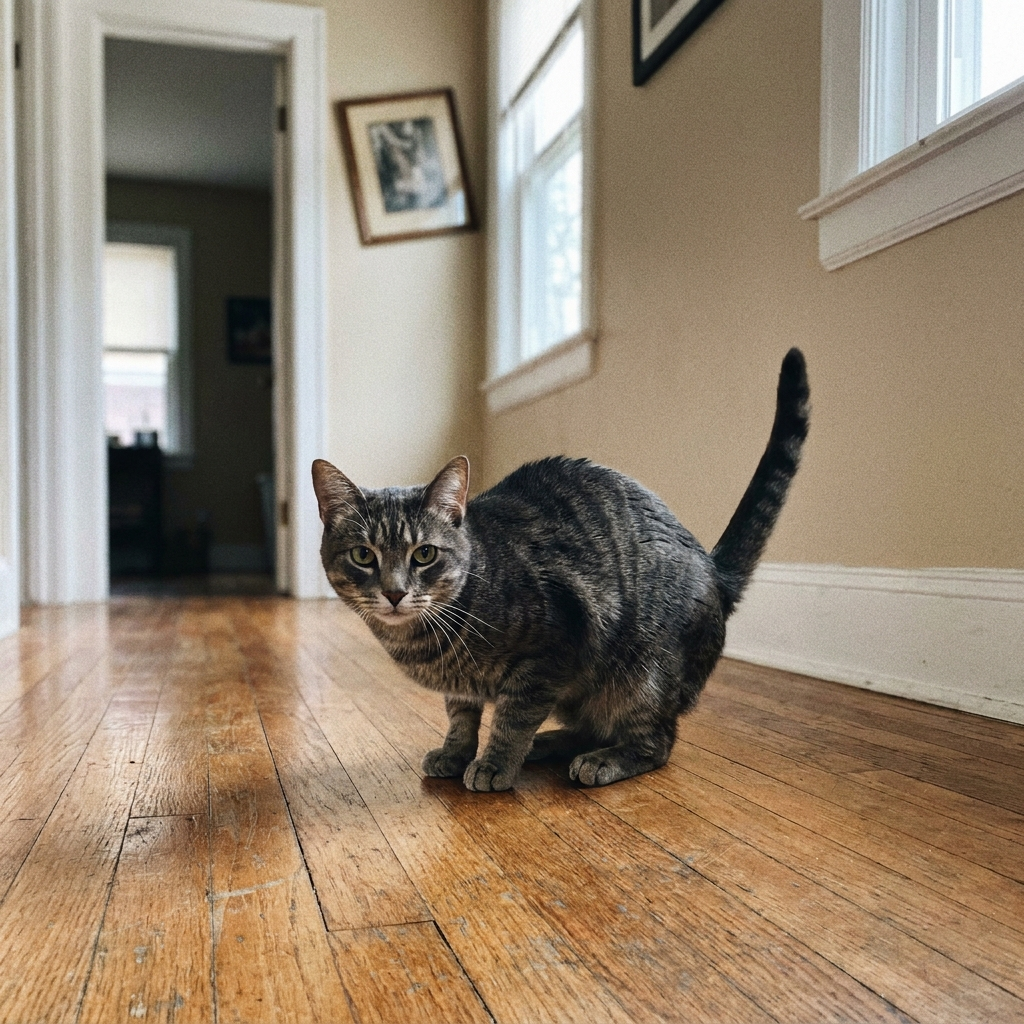
My house smelled like cat urine for 9 months. I'd ruled out a UTI three times. The answer was in a 1962 book that no veterinarian has read. I'm going to tell you what was in that book, and what it did for my cat, and why no vet I've ever spoken to has told me about it. But before any of that… I need you to know I see you. If you're reading this, I'd bet money I can describe your kitchen. There's a bottle of Nature's Miracle on top of your dryer. Or maybe two. You buy it by the gallon now. There's a black light flashlight in a drawer somewhere because you read on Reddit that it makes the spots glow. You've used it. You wish you hadn't. You don't sit on your own couch anymore. You sit in the armchair, the one she hasn't gotten to yet, and you've started thinking of it as your chair the way prisoners think of their bunk. When your sister or your mother or your friend from work says they're coming over, you light a candle forty minutes before they arrive. But you’re scared they can smell it still… Your partner doesn't talk about it the way he used to. He used to make jokes. Then the jokes stopped. Now it's quiet, and the quiet is worse than the jokes were. You've thrown out furniture. Maybe one piece, maybe three. I know this because I have been through the exact same thing! My name is Julia Williams. I'm 47. I live in Phoenix with my husband Lucas. We have two cats: a long-haired calico named Margot, who's eight, and a gray tabby named Henry, who's six. I had Margot since she was four months old. She was a rescue. She slept on my pillow for the first four years of her life. She is, by any measure I know how to use, the love of my life on four legs. And starting in March of last year, she began destroying my house. (I’m ashamed to admit, but before I found that book from 1962, I genuinely resented her). It started small. I came downstairs one Tuesday morning and there was a dark stain on the corner of the couch cushion. I thought a glass had spilled. I leaned in and almost vomitted. It was NOT water… I called the vet that afternoon. We ran the standard UTI workup. Urinalysis. Bacterial culture. Imaging to rule out crystals. Margot's results came back clean. The vet, who I'd been seeing for eleven years and who I trusted completely, said it was probably stress and to try Feliway. I bought a Feliway diffuser on the way home and plugged it into the wall by the couch. Three weeks later there were two new spots, both on the loveseat. Back to the vet. We re-ran the urinalysis. We added bloodwork. Everything came back clean. The vet recommended a second diffuser, suggested I try Composure chews, and said “It usually resolves on it’s own, give it time”. No amount of time would have helped… By month three I had four litter boxes for two cats. I'd switched from clumping clay to silica crystal to walnut shell to pine pellets and back to clumping clay. I had a friend from college who swore by a specific brand of unscented clumping litter shipped from Vermont. I ordered three forty-pound bags ($160) because at that point, I would have shipped litter from Iceland if someone told me it would work. I'd tried Composure. I'd tried Zylkene. I'd tried the prescription Hill's c/d the vet gave me, which cost $86 a case. Margot wouldn’t touch them with an outstretched paw. I went back to the vet for a third UTI workup. Clean again. The vet — gently, kindly, in the way doctors do when they've run out of ideas — said it might be time to talk about fluoxetine. I told her I'd think about it. I went home and sat in my car in the driveway for twenty minutes (all I could think about is how I would feel having to medicate the love of my life) before I went inside. By month six I had thrown out the couch. By month seven the loveseat. By month nine the big upholstered armchair in the corner of the living room. I told Lucas I wanted a new look. He nodded and didn't ask anything else. We took the chair to the curb at 11 PM so the neighbors wouldn't see us doing it. That was the night the word rehome came out of his mouth for the first time. He said it quietly. “I love her too, but have you thought about finding her a new place?” I told him I needed a few days. I went into the bathroom and closed the door and sat on the floor and cried for forty minutes. At 2:14 AM I was in the office downstairs with my laptop open and a notebook on the desk. I had been Googling the same six search terms in different orders for nine months and I had run out of Reddit threads. I had read every cat-behavior blog written in English. I had watched eleven YouTube videos by Jackson Galaxy. So I did the only thing I hadn't done. I stopped reading what was current and started reading what was old. I went into Google Scholar and changed the date filter. Everything before 1990. I started reading veterinary papers I'd never seen referenced anywhere. That's where I found the footnote. A 1972 study by a veterinary behaviorist named Dr. Paul Leyhausen. Then I saw a footnote from 2008: Leyhausen's framework had "fallen out of clinical use" but that "his observations on territorial scent-marking remain among the most detailed in the literature." I'd never heard the name. I clicked through three more papers before I found a book published in 1962 called Cat Behavior: The Predatory and Social Behavior of Domestic and Wild Cats. Have you heard of it? I read until 5 AM. What I'm about to tell you is in that book; you can go read it for yourself. It is also in the work of half a dozen veterinary behaviorists who followed Leyhausen and who built on what he found. It is what was understood about cat territorial behavior before the pharmaceutical model of veterinary medicine pushed it aside. In the 1980s and 1990s, behavioral causes of feline symptoms got swept off the table to make room for drug protocols that could be prescribed in a fifteen-minute appointment. The older science wasn't disproven. It was just forgotten, because nobody could write a prescription for it. Here is what they understood. Cats are not pack animals. They are solitary territorial predators. The single most important fact about a cat's nervous system is that she evolved to defend against intruders, and the primary tool she uses to verify and maintain that home range… Is scent! She marks her territorial boundary with urine: In a stable wild territory, she marks once, the scent persists, her nervous system reads the scent and registers safe. Her cortisol stays low. Marking is rare. Now think about what your house actually looks like to your cat. You vacuum. You mop. You spray Lysol. You wash your sheets. You bring home groceries that smell like the store. Your husband comes home smelling like a coworker's perfume. The neighbor's dog walks past the window. A delivery driver drops a package on the porch. To you, it’s nothing… To her, every single one of those things gets rid of her scent and her territory. Her pheromones are gone. Her safe-zone signals have been wiped. The chemical evidence that this is her house, that she controls this space, that she is safe here, has been erased. It’s the exact same thing as if you came home and all your doors were unlocked. Her cortisol spikes and never goes back down. Because you mop again the next day. And the next. When a cat's cortisol stays elevated long enough, her nervous system reaches for the one tool her biology gave her to reassert her territory and self-soothe in a single act. She marks. The marking is not bad behavior. The marking is not a litter box failure. The marking is your cat trying to make her house feel like her house again, using the only language her body knows how to speak. And here is the part that broke me when I read it at 4:30 in the morning at my kitchen table. You cannot Feliway your way out of this. Feliway addresses the surface — it deposits a synthetic version of the safe-zone pheromone she's lost. But it’s not her pheromones. And it does nothing to make her less stressed… You cannot litter-box your way out of this. The marking has nothing to do with the box. It has to do with her nervous system… You cannot prescription-food your way out of this. The food isn't the problem… And — and this is the one that mattered most to me — you cannot fluoxetine your way out of this! SSRIs sedate the cat. They suppress the marking behavior by suppressing the cat. The cortisol stays elevated. The nervous system stays in the same state. The marking stops because the animal is too chemically dulled to do it, not because the underlying problem has been resolved. The instant you stop the drug, the marking returns. The only thing that permanently resolves marking is lowering the underlying cortisol levels, so the nervous system no longer needs to mark to self-regulate. That's it. And once I understood that, I knew exactly what I had to do, because the science of lowering cortisol already exists. There are exactly four compounds that, used together at the right doses, recalibrate a chronically stressed feline nervous system. And they’ve been used for thousands of years… But big pharma can’t send you a bill for them. The first one is ashwagandha. Ashwagandha is what's called an adaptogen. All that means is that with consistent use, it lowers cortisol. Ashwaghnda makes it so that your cats MOST stressed state, after a few weeks of using it, is equivalent to your cats LEAST stressed state before. The second is L-theanine. This is the amino acid found in green tea. It produces alpha-wave brain activity — the state your brain is in when you are calm but alert, when you're reading a book in a quiet room. L-theanine puts a cat into that state so she can know what it's like to read a good book on a rainy day. She doesn't get sedated. She gets relief from her ancestors' hunting instincts. The third is valerian root. Used as a calming herb for over a thousand years across Europe, the Middle East, and parts of Asia. Valerian modulates GABA, which is the brain's "stand down" neurotransmitter. A cat with chronically elevated cortisol has a nervous system that has forgotten how to stand down on its own. Valerian gives her the signal back. The fourth is melatonin. But why melatonin? Chronically stressed cats sleep poorly. Poor sleep further elevates cortisol the following day, which drives more marking, which raises stress, which damages sleep further. It's a loop. Melatonin breaks the loop by anchoring the circadian rhythm, which lets the nervous system actually rest at night. Four compounds. Four jobs. Each one addressing a specific failure point in a chronically stressed cat. I knew exactly what the protocol had to be. What I didn't have was a product that delivered it. Here's what's on the calming supplement shelf at PetSmart. (I've now spent more hours in it than I'd like to admit.) Composure pulls one of the four levers — alpha-casozepine. But after they reformulated in 2024, it lost all it’s potency. It addresses ¼ of the problem at 10% effectiveness. Zesty Paws and the dozen Amazon brands that look like it are essentially flavored chews. The valerian content, when present, is dosed at roughly one-tenth of the levels used in any clinical study I could find. None of them have ashwagandha. None of them. I checked the top fifteen Amazon results and the top six PetSmart shelf products. Zero ashwagandha Which means none of the leading products in this category address the actual cortisol dysfunction that is causing the marking. I read this and I sat at my kitchen table at six in the morning and I almost laughed. The thing that nine months of my life and three pieces of furniture had been about — the thing every product on the shelf was supposed to address — was the one ingredient nobody in the category was including. I bought raw ashwagandha powder, L-theanine capsules, valerian root tincture, and a low-dose melatonin liquid, and I mixed them in my kitchen. I'd done the dose math from the studies. I cut everything for Margot's body weight. I gave it to her in her dinner that night, mixed into the wet food, four drops of each. Three weeks later I told my sister, who works in operations for a supplement manufacturer, what I'd been doing. She told me the formulation I'd built was not stable when mixed like that, and that L-theanine, in particular, degrades quickly in solution without the right preservation. She introduced me to a formulator. That’s what turned into Kitly Calm. The formulation is the four-lever protocol — ashwagandha, L-theanine, valerian root, melatonin — in a liquid dropper format, dosed at clinical levels for a cat's body weight. Four drops in her food. Twice a day. Here's what happened with Margot. Week one: she marked twice. Once on the rug under the dining table, once in the corner of the laundry room. I almost stopped the protocol on day five because I thought it wasn't working. Week two: once. The corner of the laundry room again. By Friday she hadn't marked in four days. Week three: zero. Three consecutive days, then five, then seven. I kept walking into the living room and checking the corners. The corners stayed clean. Week four: I bought a new throw pillow. Cream colored. The exact one I'd been afraid to buy for a year. I put it on the couch and waited. Margot walked past it, sniffed it, jumped up next to it, and went to sleep. I stood in the doorway and cried. Week six: my sister came over for dinner. She didn't say anything about the house smelling. She didn't light a candle when she walked past the bathroom. When she left she said your house feels nice tonight. She didn't know why she'd said it. I did. Week eight: Lucas and I were watching TV on the couch and he reached over and put his hand on my knee in a way he hadn't done in close to a year. He didn't say anything. He didn't have to. It's been seven months. Margot has not marked once since week three of using this. She sleeps on my pillow again. I have not bought a new bottle of Nature's Miracle since March. I don't know where the black light flashlight is anymore. If you're reading this, you are probably the woman I was a year ago. You probably have a Nature's Miracle bottle on top of your dryer right now. You probably can name the three corners of your living room where the spots are. You probably have a partner who has stopped making jokes about it. You probably have a vet who has been kind to you for a year and a half and who has, in the last visit or the one before, used the word fluoxetine. You do not have a behavior problem. You do not have a bad cat. You have a cat whose nervous system is chronically stressed and whose body is doing the one thing her biology gave her to do about it. The understanding of this has existed for over sixty years. The pharmaceutical model of veterinary medicine pushed it off the table. The science is already there. If you want the protocol, it's here: https://kitlypet.com/pages/spray-adv-1 90-day money-back guarantee. If it doesn't work for your cat, send back what's left of the bottle and we refund you. I built that guarantee in because I know what it is to have spent a year of your life and three pieces of furniture on things that didn't work, and I am not going to ask you to take a risk I would not have taken when I was in your position. The first noticeable change usually shows up around week two. The full shift takes three to four weeks because that's how long the ashwagandha needs to lower the cortisol. Do not quit at day five. The cats whose owners give up at day five are the cats whose owners write to us six months later asking if they can start again. — Julia Williams P.S. Every week your cat's cortisol stays elevated, the marking behavior is being reinforced as her go-to coping response. Cats are habit-forming animals. The cat who has been marking for three months will recalibrate faster than the cat who has been marking for a year. The cat who has been marking for two years recalibrates slowest. Time is not on your side. If you are going to do this, the cheapest version of it is the one you start today. https://kitlypet.com/pages/spray-adv-1 P.P.S. We do not sell on Amazon. The formulation contains L-theanine and valerian, both of which degrade in storage conditions Amazon's warehouses can't control. If you find Kitly Calm listed on Amazon, it isn't us — it's resellers offloading old stock, and the formulation will have lost potency by the time it reaches you. Buy directly from the site. That's the only place the product is guaranteed to be fresh and dosed correctly. https://kitlypet.com/pages/spray-adv-1
My House Smelled Like Cat Urine For 9 Months…
Home › Cat Health › Calming Top Vet Warns: Put These 4 “Kitchen” Ingredients in Your Cat’s Food to Stop Stress Spraying — Without a Prescription? Written by Dr. Patricia Demitro, DVMReviewed & published June 5, 2026 I’m about to piss off every cat-diffuser company, every calming-chew b...
LEARN MORELike this ad? Make it yours.
Crush rebuilds this exact creative around your product — your brand, your colors, your offer — in about a minute.