Amazing Dog Transformations
Amazing Dog Transformations Facebook ad: “Labradors Are 2-5× More Likely to Blow Their Knee Out”
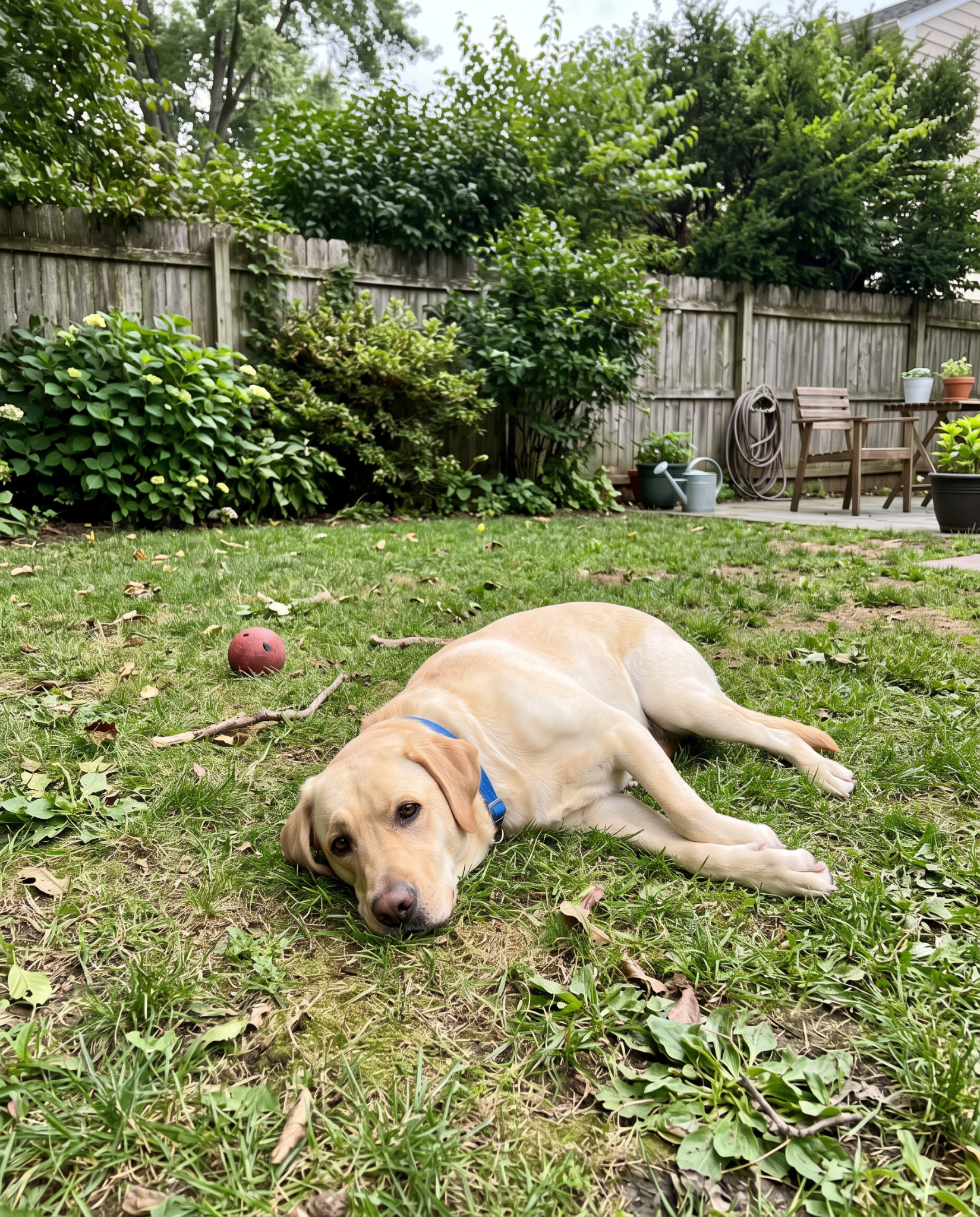
Ran for 17 days, from August 22 to September 8, 2026, the last day Crush saw it.
Run by Amazing Dog Transformations on Facebook. Crush is not the advertiser and does not verify its claims. See this ad in Meta's Ad Library(opens in a new tab)
Want an ad like this for your product?
Crush makes new ad images for your product from this ad: your logo, your product photo, your offer.
Trials from $19.95 USD, then $79.95 USD a month. Cancel anytime.
About this ad
- Meta Ad Library ID
- 4513077532260757
- Platforms
- Relaunches
- 0
Ad text
My first Labrador had both knees rebuilt before he turned nine. It cost me a little over seven thousand dollars. He never really ran again. My second Lab is six now. Same breed. Same knee. Same first sign. I swore I'd do it differently this time. His name was Duke. Yellow. Ninety-one pounds at his heaviest, which I now understand was the whole problem and which I did not understand then. He came up lame on a Sunday in March, on the left rear, after nothing in particular. He'd been chasing a bumper in the yard the way he'd chased a bumper in that yard for six years. By Wednesday he was toe-touching. By the following Monday he wasn't putting the foot down at all. The surgeon was good. I want to say that clearly and up front, because none of what follows is about her. She was thorough, she was honest, she showed me the drawer test on his knee with her own hands and had me feel it, and she told me exactly what she was going to do and what it would cost. Cranial cruciate ligament rupture. The ligament in the knee that keeps the joint from sliding. It's the most common orthopedic injury in dogs — in one study of dogs presented for lameness at university hospitals, just under 20% of them had a cruciate rupture. And Labradors are two to five times more likely to have it than the average dog. Two to five times. My breed. The breed on the front of every dog-food bag in America. Nobody told me that when I picked him up at nine weeks. The surgery — a TPLO — was textbook. She said so at the discharge. Eight weeks of confinement, a sling to get him outside, a rehab schedule I followed like scripture. He came back about eighty percent. I told myself eighty percent was fine. Then, five months later, he blew the other one. I remember standing in that exam room saying "how does that happen" like it was an insult, and the surgeon pulled up a paper and turned the monitor toward me. In Labradors who rupture one cruciate, roughly 48% go on to rupture the other side. The median time to the second one is between five and six months. Five to six months. He did it at five and a half. He was a statistic and I had never been shown the statistic. She wasn't hiding it from me. It just had never come up, because nobody sits a Labrador owner down at nine weeks and says: this breed, this knee, watch the weight, watch the first hitch. We did the second TPLO. National average on those runs about $3,525 per knee, and mine ran higher than average because of the second-side complications. Duke lived to twelve. He was a good dog for every one of those years and I don't want a word of this to sound like he wasn't. But he never ran again. Not once. He walked, and he swam, and he lay in the sun, and when a squirrel came into that yard he'd lift his head and put it back down. The last year, my wife Dana said something to me in the kitchen that I've never gotten out of my head. She said, "I keep thinking about that March. About the week he was just a little off and we watched to see if it would settle." Then she said: "Don't let anybody tell you the limp is the beginning. The limp is the end of something that started way earlier." I was forty-six when Duke died. For the next four years I carried that with me like a warning. We got Baxter at ten weeks. Chocolate, out of a hunting line, and from the day we brought him home I was a different owner than I'd been with Duke. I kept him lean. I weighed his food on a kitchen scale like a lunatic. I walked him every single day instead of nothing all week and four miles on Saturday, because I'd read by then that the weekend-warrior pattern is exactly how a knee gets loaded wrong. I put runners down on the hardwood. I stopped letting him launch off the tailgate. I did everything I knew how to do. And about eighteen months ago, at four and a half, he started doing the thing. Not a limp. Not yet. A hitch. Getting up off the floor in two parts — front end first, hold, then bring the back end after. Sitting down slightly sideways, with the left leg kicked out, which I now know has a name and is one of the classic tells. Dana never said anything. But I'd catch her watching him get up. I told myself it was nothing. He's a big dog. He plays hard. Everybody's stiff on a cold morning. But I knew exactly what I was looking at. I'd seen it in March four years earlier and called it nothing then too. Ten months ago I finally took him in. Not for an annual. I made a specific appointment and I told them the reason on the phone so it would be in the chart before we got there. That's the one thing I did right the first time around that I did again. The vet spent a long time on the floor with him. She had him walk the hallway four times and watched him get up twice. She palpated both stifles carefully and had me put my hand where hers was. "No drawer," she said. "The ligament's intact on both sides. That's the good news, and it's real good news." She pulled up a diagram on her screen and showed me what a cruciate does and how it fails — usually not in one dramatic tear, she said, but as a slow degeneration under load, months to years of micro-damage before the day it finally goes. "So what am I looking at," I said. "Early osteoarthritic change in both stifles and some in the hips. He's carrying inflammation. He's compensating. And in a Labrador at his age, that's exactly the picture I want to catch." "What do we do." "Weight first. He's four pounds over where I want him and four pounds is a lot on a knee. Controlled daily movement, on lead, not sprints. And time." "Do we medicate?" "Not today. If we get there, we will, and I'll tell you exactly what to watch for. I'd rather not put a dog this age on a daily anti-inflammatory if we don't have to." "And if it keeps going?" She was quiet for a second. "Then we're having a different conversation. And you know what that conversation is." I did. I drove home with my hand on the wheel doing the same math I'd done in that parking lot four years earlier. That night I sat at my kitchen table and made a decision. I would do everything she said. The weight, the walking, all of it. But I wasn't going to stop there. Because I'd done "watch and see" once and it cost me seven thousand dollars and a dog who never ran again. I needed to understand what was actually happening. Why does this breed do this. Why does the second one go. And why, after six and a half years of dumping a joint supplement into Duke's bowl every single morning, did none of it make one bit of difference. That last question kept me up until four in the morning. Because I *had* given Duke a joint supplement. From eighteen months old. The good one. The one the pet store guy recommended and then the one the clinic sold. Glucosamine and chondroitin, every day, for six and a half years, and he still blew both knees. I'd assumed it hadn't been enough. It had never occurred to me it might not have been anything. I started reading. And then I found it. A systematic review and meta-analysis published in 2022 in the *International Journal of Molecular Sciences*. Not a blog. Not a brand. Fifty-seven published articles, covering 72 separate trials, on joint supplements in dogs and horses, analyzed together. Here is what it found about glucosamine and chondroitin. **88.9% of trials showed no effect.** **0% demonstrated an effect.** Zero out of seventy-two. The authors described it as a "very marked non-effect" and concluded that glucosamine and chondroitin **"should no longer be recommended."** I read it three times. Then I went looking for someone to tell me it was wrong, and instead I found the *Merck Veterinary Manual* — the standard reference, the one sitting in the back of every clinic in this country — stating independently that the evidence "did not support the use of" them. I sat there and did the arithmetic on six and a half years of Duke's mornings. That's roughly $2,600 of it. Every morning, in his bowl, at seven o'clock, while I felt like I was doing something. Nobody told me. Nobody told Duke. Here's why, and it isn't a conspiracy, which somehow made it worse. Glucosamine is a commodity. Every contract manufacturer in America can buy it by the drum for almost nothing. It's the word every shopper scans for on the front of a bag. There is no version of this business where the safe move is to leave it out. You can't build a brand on it — but you can't build one without it either, because the shopper picks up the bag looking for that word. So everybody puts it in, first, by weight, and then decorates around it. That's not evil. It's just inertia. And my dog paid for it every morning for six and a half years. If the default ingredient does nothing, what does? I kept reading, and I found the other paper — the one the whole answer hangs on. Ruff and colleagues, 2016, *Veterinary Medicine: Research and Reports*, volume 7, pages 113 to 121. Fifty-one dogs. Randomized. Double-blind. Placebo-controlled. Meaning the dogs were assigned by chance and neither the owners doing the scoring nor the researchers running it knew who was getting the real thing. The ingredient was natural eggshell membrane — the thin film on the inside of an eggshell. The part you peel off a hard-boiled egg and throw away. At **one week**: owner-assessed pain improved **19.4%** over placebo (P=0.010). Owner-assessed function improved **20.5%** (P=0.028). At six weeks: veterinarian-assessed pain improved 23.6% (P=0.012), and quality of life 26.8% (P=0.033). One week. In the design that exists specifically to keep hope from contaminating the answer. I'm going to be straight with you about the limits, because I got sold a rounded-up version once already and it cost me a knee. Not every measure in that trial hit significance. The ones above did. That's the honest accounting and it is still, by a distance, the best evidence anybody in this category has. So I ordered eggshell membrane chews that night. Highest rated on Amazon. 4.6 stars, eleven thousand reviews. Nine weeks. Never missed a morning. Nothing. Same two-part stand. Same sideways sit. I tried a second brand — the one from the big pet chain with the endcap display. Seven weeks. Nothing. I was ready to give up. I figured that was it. Maybe this is just what this breed does. Maybe I was going to end up standing in the same exam room I'd stood in with Duke, hearing the same number, and there was nothing on earth I could do about it. Then I found out why it wasn't working. Three weeks before Baxter's recheck, I ran into Mike at a hardware store. College roommate. Hadn't seen him in probably eight years. He spent the last decade in operations at a contract manufacturer that co-packs supplements — the kind of place that actually makes the stuff other companies put their name on. We got coffee. "How's life," he said. "Honestly? Not great. Six-year-old Lab, early arthritis in both stifles, and I lost my last one to bilateral cruciates. I've been trying supplements. Nothing's working." He put his cup down. "Which ones?" "Eggshell membrane. Two different brands. Months on both." He shook his head. "Did you read the panel or the label?" "...What's the difference?" "The label's the front of the bag. The panel's the back. On the back, ingredients are listed in descending order by weight. Go look at both of those bags tonight and tell me where eggshell membrane falls." My stomach dropped. I went home and got them out of the cupboard. Both of them led with glucosamine. Then chondroitin. Then a run of things I couldn't pronounce. Eggshell membrane was fourth on one and sixth on the other. I called him. He said: "Right. That's the whole game. The 2022 review made 'no glucosamine' a selling point for about nine months, so everybody added a pinch of NEM to the existing formula so they could put it on the front of the bag. The formula didn't change. The artwork changed. You've been buying the ingredient that failed with a garnish on top." I thought about the sixteen weeks. "And the rest of it," he said, "is structure. Sunflower oil, soybean oil, glycerin, flavoring, binders. That's what makes a chew hold together and taste like bacon. You're paying by weight for the bag to keep its shape." "So I've been taking..." "You've been buying expensive placebos with a garnish." I asked him if anything out there was actually built right. He said there were a few, and that the tell was simple: count the actives. If the active panel is three ingredients and glucosamine isn't one of them, somebody made a real decision. If it's eighteen ingredients, somebody made a marketing decision. He wrote a name on a napkin. Zoomies. "That's the one I'd get for a Lab," he said. "Three actives, no glucosamine, no chondroitin, no seed oils, made and sourced here. There's nowhere for them to hide." I ordered it that afternoon. The bag came Thursday. Soft chews. Baxter took the first one out of my hand like it was a treat, which after four months of mixing powder into wet food felt almost like being made fun of. Three actives, and that's the whole list: **Natural Eggshell Membrane** — the ingredient with the 51-dog randomized, placebo-controlled trial behind it. **Boswellia Serrata** — frankincense resin, used in traditional practice for thousands of years, in there to support a normal inflammatory response. The company puts this at days three to seven. **Hyaluronic Acid** — something the body already makes on its own, and which is naturally present in the fluid inside a healthy joint. Nothing else. No glucosamine. No chondroitin. No seed oils, artificial fillers, or cheap ingredients. 100% made and sourced in the United States. And this time I tracked it. Every day, on a legal pad on the counter, because I had learned that "he seems better" is a sentence you can talk yourself into on any given morning, and I was not going to fool myself twice. **Week 1** — Day 4, he stood up off the kitchen floor in one motion instead of two. I made him do it three more times that day to be sure I wasn't seeing what I wanted to see. Day 6, same thing, twice. **Week 2** — The sideways sit was less consistent. Maybe half the time now instead of every time. Took the deck stairs down in a rhythm instead of one at a time. **Week 3** — Dana asked me, without knowing I'd changed anything, whether he'd gotten a second wind. That's the day I started believing it, because she wasn't looking for it. **Week 4** — He went up on the tailgate himself. He'd been waiting for the lift for about six months. I stood there holding the back of the truck like an idiot. **Week 6** — Evening walk went from eight-tenths of a mile to a mile and a half because he was the one out in front of the leash. Sideways sit essentially gone. **Week 9** — He brought the bumper back. All the way back. Four times in a row, in the yard, at six, in a breed where I'd already watched one dog stop doing exactly that at eight. I sat down on the back step and I'm not going to pretend I didn't get emotional about it. Three months in, we went back for the recheck. Same vet. Same hallway. She had him walk it out and back twice, then a third time, then she got down and went over both stifles again. "Still no drawer," she said. "Both intact." She checked her notes from the first visit. "He's five pounds down." "Six," I said. "Kitchen scale." She looked up. "And he's moving noticeably better than he was in November. What are we doing?" I told her. The weight, the daily loop, the runners on the floor, and the chews. I told her about the 2022 meta-analysis, and about my sixteen wasted weeks buying eggshell membrane that was fourth on the panel. She wrote the citation down. Then she said the sentence I drove home replaying: "I'd like to keep doing exactly this and see him again in six months." Not surgery. Not "let's talk about options." Six months. I sat in the truck in that parking lot — the same chain of clinics where I'd sat four years earlier — and I called Dana. "No change to the plan," I said. "She wants to see him in six months." She didn't say anything for a second. Then she said, "Okay. Okay. That's different." Last month, I took Baxter out to the same field where Duke came up lame in March seven years ago. He ran the whole thing. Both directions. Twice. I stood at the edge of it and thought about the March I spent watching to see if it would settle. And I realized something. I didn't avoid Duke's outcome by getting lucky. I broke the pattern by refusing to accept that the thing everybody sells for this problem was the only thing there was. If you're reading this, you probably see yourself in some of it. You have a Labrador. Or a Golden, or a Rottie, or a Shepherd, or any of the breeds that carry weight on a knee that wasn't engineered for it. He's doing the two-part stand. Or the sideways sit with the back leg kicked out. Or he's stopped taking the last two stairs, or stopped clearing the tailgate, or stopped bringing it all the way back. He's not limping. Not yet. That's the part that lets you talk yourself out of the appointment. You've been putting a joint supplement in his bowl every morning for years, and if you're honest with yourself you have never once been able to point to a day it made a difference. Maybe you've already been through it with a previous dog. Maybe you know exactly what the number is and where it's written on the estimate. I did too. Here's what I wish somebody had told me at nine weeks, when I was holding a puppy and none of this seemed like it applied to me. **This breed is not average, and you need to plan like it.** Labradors are two to five times more likely to suffer a cruciate rupture than the average dog. Peak incidence is between seven and ten years, and it tends to come earlier in heavy breeds like the Lab. And if one goes, roughly 48% go on to do the other side, at a median of five to six months. That is not a scare tactic. That is the published picture of the breed I chose. **Weight is not cosmetic, it is structural.** And Labradors are fighting their own genome on this. In 2016, researchers publishing in *Cell Metabolism* identified a deletion in the POMC gene associated with weight and food motivation in Labradors — in the population they studied, 20% of dogs carried one copy and 2% carried two, and each copy was associated with about 1.9 kg more body weight. In assistance-dog breeding stock the allele frequency was much higher. Your Lab is not greedy. Some meaningful share of them are genetically wired to be hungrier and heavier than the dog next to them, and every one of those pounds lands on the same joint. **The default supplement has a documented failure record.** 72 trials. 88.9% no effect. Zero demonstrating an effect. "Should no longer be recommended." **The ingredient with the actual trial is the one nobody leads with.** Natural eggshell membrane. 51 dogs, randomized, double-blind, placebo-controlled, 19.4% pain and 20.5% function improvement over placebo at one week. **And reading the front of the bag is how they get you.** The word on the front is marketing. The order on the back is the formula. That last one is the whole thing. That's the four months I wasted. Here's why Zoomies was different for us: **Three actives, and glucosamine is not one of them.** Not reduced. Not moved down the list. Absent. You cannot make a three-ingredient panel and hide anything in it — you have to be right about all three, which is exactly why almost nobody does it. **Eggshell membrane as the point of the product, not the garnish.** The reason I'd bought two other bags was that both said "eggshell membrane" on the front. Both had it fourth and sixth on the panel. This one is built around it. **No seed oils, no artificial fillers, no cheap ingredients.** Go read the back of whatever's in your cupboard right now and count how much of the serving weight is doing structural work instead of joint work. **A soft chew, not a powder or a pill.** Sixteen weeks of mixing powder into wet food and hoping he ate the bottom of the bowl. This one he takes out of my hand. **Made and sourced in the United States.** **90 day money back guarantee.** Ninety days, not thirty. Thirty days is a return window, not a guarantee — the trial that made me care about this ingredient measured at one week and again at six, and you need room past that to be sure of what you saw. Their own line on it: *worst case you get your money back, best case, your dog gets better.* Which is more honest than anything I was told the first time around. They run up to 40% off on the bulk supply, and I buy it that way, because a Labrador's knee is a maintenance problem for the rest of his life and not a one-bag experiment. You're at a fork right now, and I've stood at both ends of it. Either: keep doing what you're doing. Keep buying the tub. Keep telling yourself the hitch is nothing. Watch to see if it settles. And find out in a year, or two, or four, what the number on the estimate is — and then find out five to six months later whether your dog is in the 48%. Or: do what I did the second time. Make the appointment now, while there's still no drawer in that knee. Get the weight off. Walk him every day instead of nothing all week. And put something in the bowl that was built after somebody read the research instead of around it. I chose the second one. It's the difference between a dog who never ran again and a dog who ran that field twice last month at six years old. Every month you wait is another month of load on a joint that is already telling you something. Duke didn't get a second chance. I didn't know what I was looking at in March and I called it nothing and I watched to see if it would settle. You have information I didn't have. Don't wait until you're sitting in an exam room getting shown the drawer test on your own dog's knee. Don't wait until somebody turns a monitor toward you with a 48% on it. Even if you're skeptical — especially if you're skeptical. Get one bag. Give it ninety days. Write it down on a legal pad on your counter so you can't fool yourself in either direction. If it doesn't do anything, you get your money back. Nobody is coming to tell you this at the puppy visit. The breed pages don't lead with it and the supplement aisle is organized around an ingredient with a zero-for-seventy-two record. You have to go find it yourself. I found it four years too late for one dog and just in time for the other. — Gary M. **P.S.** For what it's worth, here's my honest timeline: day 4, the two-part stand became one motion. Week 3, my wife noticed without being told. Week 4, the tailgate. Week 9, he brought the bumper all the way back. Week 12, the recheck came back "keep doing exactly this." Your dog's timeline will be his own — but you will not know unless you actually write it down. **P.P.S.** One more thing, and I'd rather lose your business than skip it. Not everything that looks like arthritis is arthritis. If your dog's back end is getting weak rather than sore — if it doesn't seem to hurt, if he's scuffing or knuckling a rear foot, if it's slowly and steadily getting worse — that is not what this is for, and there is a condition in older dogs that looks exactly like that which no supplement on earth will help. Go see your vet. Today, not next month. And if he's already on a prescription anti-inflammatory or a monthly injection, call your clinic before you add anything to it. Not after. Four minutes on the phone. I'd rather you make the appointment and buy nothing than buy something and skip the appointment. That's how I lost the first one.
Where the ad sends people
nancygriffithblog.com
Labradors Are 2–5× More Likely to Blow Their Knee Out
“I trusted my vet for 4 years. We did Carprofen, then Adequan injections twice a week, then prednisone for the bad days. His pain was 'managed' the whole time. Then one morning he couldn't get up. The drugs never fixed anything — they just hid it while everything else fell apart.” — Robert T...
See details: usa.zoomiespethealth.com(opens in a new tab)