Will to Heal LLC
Will to Heal LLC Facebook ad: “THE INVALIDATION & EMOTIONAL SUPPRESSION WOUND, PART 1”
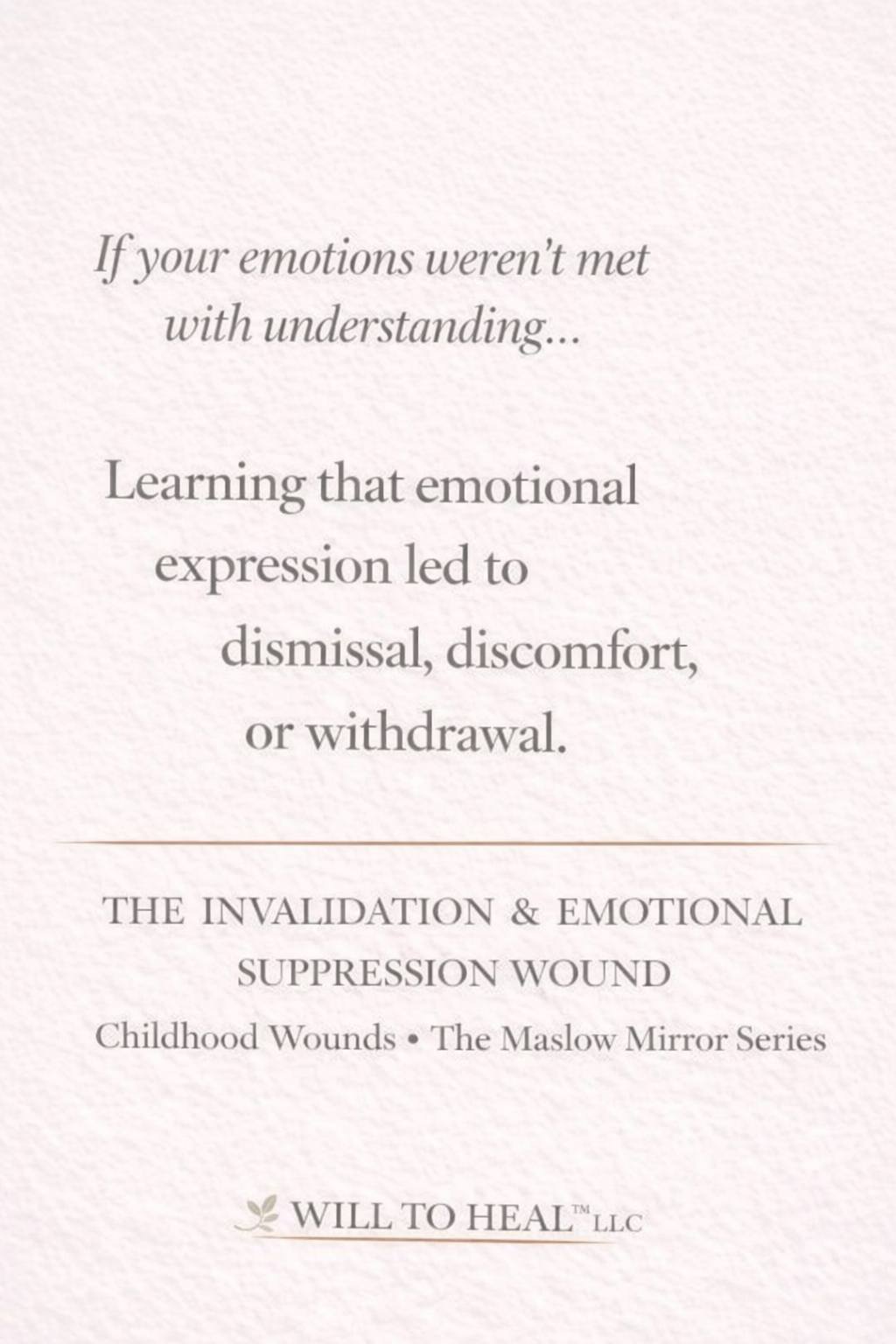
Ran for 5 days, from February 2 to February 7, 2026, the last day Crush saw it.
Run by Will to Heal LLC on Facebook. Crush is not the advertiser and does not verify its claims. See this ad in Meta's Ad Library(opens in a new tab)
Want an ad like this for your product?
Crush makes new ad images for your product from this ad: your logo, your product photo, your offer.
Trials from $19.95 USD, then $79.95 USD a month. Cancel anytime.
About this ad
- Meta Ad Library ID
- 874698318523038
- Platforms
- Relaunches
- 0
- EU reach
- 120
Ad text
🌱 THE INVALIDATION & EMOTIONAL SUPPRESSION WOUND — PART 1 (Childhood Wounds • The Maslow Mirror Series) (Spanish translation following English) Before we talk about how invalidation and emotional suppression show up in adulthood, it helps to understand how this wound forms — and how the nervous system adapts to survive it. The invalidation and emotional suppression wound develops when a child’s internal experience — their emotions, perceptions, needs, or reactions — is consistently dismissed, minimized, ignored, or corrected instead of understood. This wound does not require overt cruelty. It often forms in environments that appear “normal,” “well-intentioned,” or even loving — where a child is told they are safe, but their emotional reality is not allowed. Invalidation occurs when a child’s feelings are met with responses such as: • “You’re overreacting.” • “That’s not a big deal.” • “You’re too sensitive.” • “Stop crying.” • “There’s no reason to feel that way.” • “Other people have it worse.” Emotional suppression develops when the child learns — explicitly or implicitly — that expressing emotion leads to discomfort, rejection, withdrawal, or disapproval from caregivers. Over time, the child adapts. Not by expressing less need — but by disconnecting from it. When a child’s emotions are repeatedly dismissed instead of attuned to, the nervous system learns that emotional expression is unsafe. Beliefs form not because they are true, but because they help the child survive. Survival becomes the priority — not authenticity, emotional awareness, or connection. 🌱 Where the Invalidation & Emotional Suppression Wound Begins This wound often forms in environments where: • emotions are seen as inconvenient, dramatic, or disruptive • emotional expression is punished, mocked, ignored, or shut down • logic is valued over feelings • children are expected to self-regulate before they are developmentally able • caregivers are emotionally unavailable, overwhelmed, or uncomfortable with feelings Common experiences include: • being told to “calm down” instead of being soothed • being corrected rather than comforted • being praised for being “easy,” “low-maintenance,” or “not emotional” • having feelings explained away instead of explored • being taught that emotions must be controlled to be acceptable In these moments, the child does not learn emotional regulation. They learn emotional suppression. 🌱 What the Child Learns A child experiencing chronic invalidation may internalize beliefs such as: • “My feelings don’t matter.” • “I can’t trust my emotional experience.” • “I shouldn’t need comfort.” • “If I express emotion, I’m a burden.” • “I need to handle everything on my own.” These beliefs are not flaws. They are adaptive responses to an environment where emotional attunement was missing. 🌱 What the Child Learns About the World When invalidation becomes a pattern, the child may internalize: • “Emotions cause problems.” • “Connection requires emotional restraint.” • “Being vulnerable leads to dismissal.” • “Support is unreliable.” • “I must minimize myself to belong.” The nervous system adapts through: • emotional numbing or disconnection • intellectualization instead of feeling • hyper-independence • difficulty identifying or naming emotions • discomfort receiving care or reassurance To the nervous system, emotional expression feels like risk — not relief. 🌱 How the Invalidation & Emotional Suppression Wound Shows Up Later As the child grows, these adaptations don’t disappear — they evolve. Adults may experience: • difficulty accessing or expressing emotions • chronic self-reliance paired with exhaustion • discomfort needing others • emotional shutdown during stress • feeling disconnected from their inner world • confusion about their own needs • delayed emotional reactions These patterns often feel necessary — even when they create isolation, burnout, or emotional distance. 🌱 Why These Patterns Make Sense (Maslow + Attachment) From a Maslow perspective, invalidation disrupts core needs for: • Safety • Emotional attunement • Belonging • Acceptance When emotional needs are unmet, the nervous system prioritizes self-protection over emotional expression. From an attachment lens, this wound often aligns with: • avoidant attachment (suppressing needs to stay connected) • anxious or fearful-avoidant attachment (longing for support while fearing dismissal) These patterns are not personality traits. They are survival strategies shaped by experience. 🌱 How Healing Begins Healing the invalidation and emotional suppression wound begins with restoring internal attunement — not forcing emotional expression or vulnerability. This includes: • recognizing emotions without judgment • validating internal experiences before seeking external validation • separating past dismissal from present-day safety • allowing emotions to exist without justification • relearning that emotional needs do not make you weak Healing does not require becoming “more emotional.” It requires learning that your emotions were always valid. 🌱 Explore Related Educational Series If you’d like to explore these themes more deeply, related content is available — and upcoming — on our page: • Generational Trauma — how invalidation and emotional suppression patterns are passed down and interrupted • Maslow’s Hierarchy of Needs — how unmet emotional and relational needs shape identity and behavior • The Fire Within Series — inspired by Carl Jung’s work on the Self, shadow, and integration • Faith & CBT — integrating belief renewal, nervous system regulation, and thought reframing 🌱 Coming Next: Conscious Parenting We will soon begin transitioning into Conscious Parenting — not as a judgment or a reset, but as a continuation of this work. This series will focus on: • recognizing inherited patterns in real time • understanding age-appropriate developmental needs • identifying moments of rupture and repair • applying nervous-system-informed insight to everyday parenting situations Examples will be practical, grounded, and developmentally appropriate, and will include: • dual-parent homes • single-parent homes • low-conflict and high-conflict family systems This phase is about application — not perfection — and about creating safety, clarity, and repair in the present. 🌱 Guided Reflection Support Guided email reflection sessions will be opening soon for those who want a gentle, private way to explore invalidation-based beliefs, emotional suppression patterns, and nervous system responses at their own pace. These sessions are educational and reflective — not therapy — and are designed to support insight, regulation, and self-understanding. — Will to Heal™ LLC ESPAÑOL 🌱 LA HERIDA DE INVALIDACIÓN Y SUPRESIÓN EMOCIONAL — PARTE 1 (Heridas de la Infancia • La Serie del Espejo de Maslow) Antes de hablar sobre cómo la invalidación y la supresión emocional aparecen en la adultez, es importante comprender cómo se forma esta herida y cómo el sistema nervioso se adapta para sobrevivir. La herida de invalidación y supresión emocional se desarrolla cuando la experiencia interna de un niño — sus emociones, percepciones, necesidades o reacciones — es constantemente minimizada, ignorada, corregida o descartada en lugar de ser comprendida. Esta herida no requiere crueldad abierta. Con frecuencia se forma en entornos que parecen “normales”, “bien intencionados” o incluso amorosos — donde se le dice al niño que está a salvo, pero su realidad emocional no es permitida. La invalidación ocurre cuando las emociones del niño reciben respuestas como: • “Estás exagerando.” • “No es para tanto.” • “Eres demasiado sensible.” • “Deja de llorar.” • “No hay razón para sentirte así.” • “Otros la pasan peor.” La supresión emocional se desarrolla cuando el niño aprende — explícita o implícitamente — que expresar emociones genera incomodidad, rechazo, distancia o desaprobación por parte de los cuidadores. Con el tiempo, el niño se adapta. No expresando menos necesidad — sino desconectándose de ella. Cuando las emociones del niño son invalidadas repetidamente en lugar de ser acompañadas, el sistema nervioso aprende que la expresión emocional no es segura. Las creencias no se forman porque sean verdaderas, sino porque ayudan al niño a sobrevivir. La supervivencia se vuelve la prioridad — no la autenticidad, la conciencia emocional o la conexión. 🌱 Dónde Comienza la Herida de Invalidez y Supresión Emocional Esta herida suele formarse en entornos donde: • las emociones se consideran inconvenientes, exageradas o problemáticas • la expresión emocional es castigada, ridiculizada, ignorada o reprimida • la lógica se valora más que los sentimientos • se espera que los niños se autorregulen antes de estar preparados • los cuidadores están emocionalmente indisponibles, abrumados o incómodos con las emociones Experiencias comunes incluyen: • decirle al niño que “se calme” en lugar de consolarlo • corregir en lugar de acompañar • elogiar al niño por ser “fácil”, “no demandante” o “poco emocional” • explicar las emociones en lugar de explorarlas • enseñar que las emociones deben controlarse para ser aceptado En estos momentos, el niño no aprende regulación emocional. Aprende supresión emocional. 🌱 Lo Que Aprende el Niño Un niño que experimenta invalidación crónica puede internalizar creencias como: • “Mis emociones no importan.” • “No puedo confiar en lo que siento.” • “No debería necesitar consuelo.” • “Si expreso emociones, soy una carga.” • “Tengo que manejar todo solo.” Estas creencias no son defectos. Son respuestas adaptativas a un entorno sin sintonía emocional. 🌱 Lo Que el Niño Aprende Sobre el Mundo Cuando la invalidación se convierte en un patrón, el niño puede internalizar: • “Las emociones causan problemas.” • “La conexión requiere contención emocional.” • “Ser vulnerable lleva al rechazo.” • “El apoyo no es confiable.” • “Debo minimizarme para pertenecer.” El sistema nervioso se adapta mediante: • entumecimiento o desconexión emocional • intelectualización en lugar de sentir • hiperindependencia • dificultad para identificar o nombrar emociones • incomodidad al recibir cuidado o apoyo Para el sistema nervioso, la expresión emocional se siente como riesgo — no como alivio. 🌱 Cómo Aparece Esta Herida Más Adelante A medida que el niño crece, estas adaptaciones no desaparecen — evolucionan. Los adultos pueden experimentar: • dificultad para acceder o expresar emociones • autosuficiencia crónica acompañada de agotamiento • incomodidad al necesitar a otros • desconexión emocional bajo estrés • confusión sobre sus propias necesidades • respuestas emocionales retrasadas Estos patrones suelen sentirse necesarios — incluso cuando generan aislamiento o desgaste. 🌱 Por Qué Estos Patrones Tienen Sentido (Maslow + Apego) Desde la perspectiva de Maslow, la invalidación interfiere con necesidades básicas de: • seguridad • sintonía emocional • pertenencia • aceptación Cuando estas necesidades no se satisfacen, el sistema nervioso prioriza la autoprotección sobre la expresión emocional. Desde el apego, esta herida suele relacionarse con: • apego evitativo • apego ansioso o temeroso-evitativo Estos patrones no son rasgos de personalidad. Son estrategias de supervivencia moldeadas por la experiencia. 🌱 Cómo Comienza la Sanación La sanación comienza restaurando la sintonía interna — no forzando la vulnerabilidad ni la expresión emocional. Esto incluye: • reconocer emociones sin juicio • validar la experiencia interna antes de buscar validación externa • separar la invalidación pasada de la seguridad presente • permitir que las emociones existan sin justificación • aprender que necesitar no es debilidad Sanar no requiere ser “más emocional”. Requiere aprender que tus emociones siempre fueron válidas. 🌱 Series Educativas Relacionadas Si deseas profundizar más, en nuestra página encontrarás contenido relacionado y próximo: • Trauma Generacional — cómo los patrones de invalidación se transmiten y se interrumpen • La Jerarquía de Necesidades de Maslow — cómo las necesidades emocionales no satisfechas moldean la identidad • La Serie El Fuego Interior — inspirada en Carl Jung, el Self y la sombra • Fe y TCC — integrando regulación del sistema nervioso y renovación de creencias 🌱 Próximamente: Crianza Consciente Próximamente comenzaremos la transición hacia la Crianza Consciente — no como juicio ni reinicio, sino como continuidad de este trabajo. Esta serie se centrará en: • reconocer patrones heredados en tiempo real • comprender las necesidades del desarrollo según la edad • identificar momentos de ruptura y reparación • aplicar enfoques informados por el sistema nervioso a situaciones cotidianas de crianza Los ejemplos serán prácticos, realistas y apropiados para el desarrollo, e incluirán: • hogares con dos padres • hogares monoparentales • sistemas familiares de bajo y alto conflicto Esta fase trata sobre aplicación — no perfección — y sobre crear seguridad, claridad y reparación en el presente. 🌱 Apoyo de Reflexión Guiada Las sesiones de reflexión guiada por correo electrónico estarán disponibles próximamente para quienes deseen explorar creencias basadas en la invalidación, patrones de supresión emocional y respuestas del sistema nervioso a su propio ritmo. Estas sesiones son educativas y reflexivas — no terapia — y están diseñadas para apoyar la comprensión, regulación y autoconocimiento. — Will to Heal™ LLC