Will to Heal LLC
Will to Heal LLC Facebook ad: “CONSCIOUS PARENTING SERIES”
Ran for 5 days, from March 25 to March 30, 2026, the last day Crush saw it.
Run by Will to Heal LLC on Facebook. Crush is not the advertiser and does not verify its claims. See this ad in Meta's Ad Library(opens in a new tab)
Want an ad like this for your product?
Crush makes new ad images for your product from this ad: your logo, your product photo, your offer.
Trials from $19.95 USD, then $79.95 USD a month. Cancel anytime.
About this ad
- Meta Ad Library ID
- 903422045844039
- Platforms
- Relaunches
- 0
- EU reach
- 176
Ad text
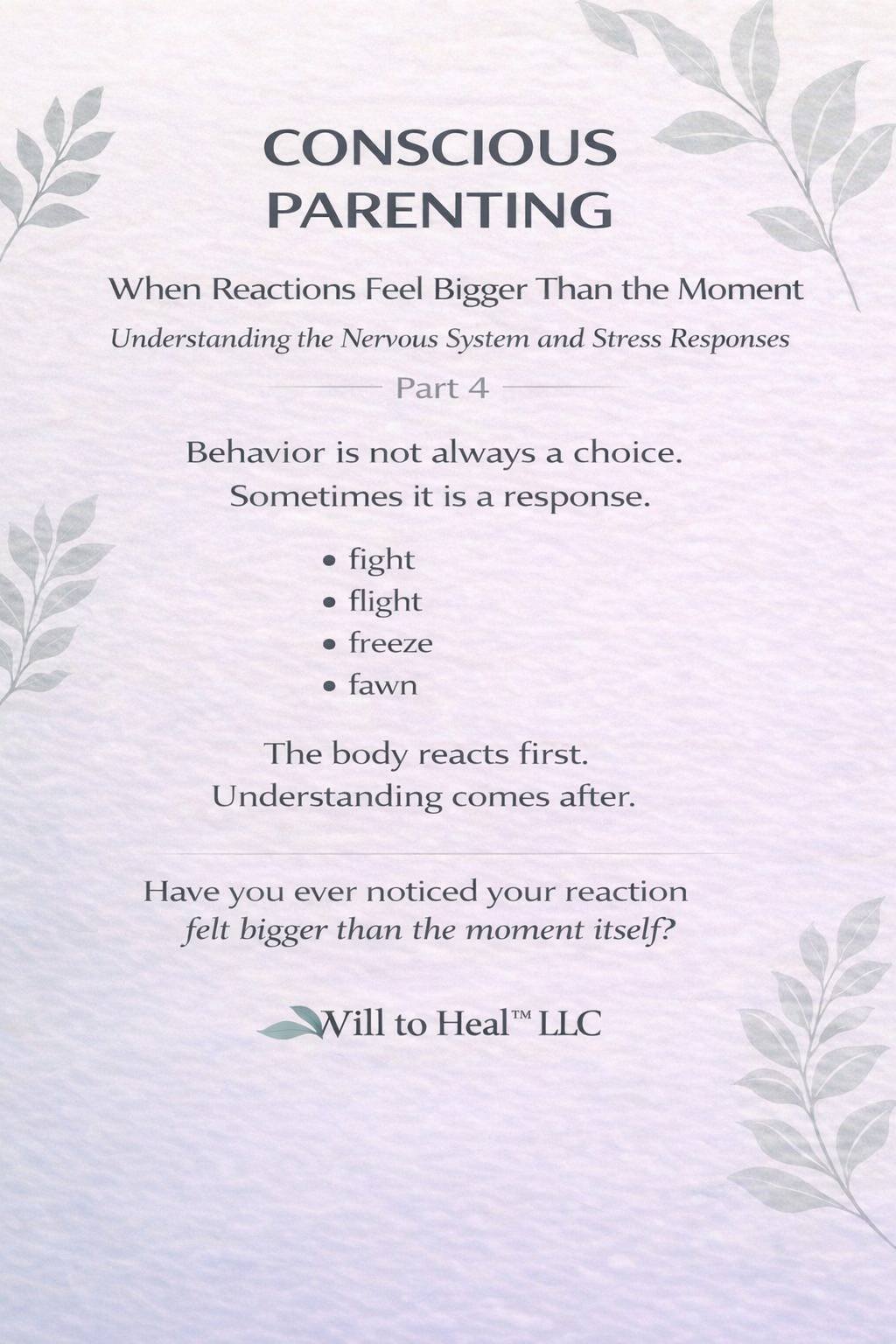
CONSCIOUS PARENTING SERIES Part 4: The Nervous System Understanding Why Reactions Feel So Intense (Traducción en español a continuación) In the last post, we talked about how behavior is often not the real issue. It is connected to deeper needs, stress responses, and developmental stages. Now we go one layer deeper. Because many parenting conflicts are not just emotional. They are physiological. And they are often shaped by early experiences, developmental stages, and unmet needs. This means: In the moment, your child is not always choosing how they respond. Their nervous system is. The same is true for us as parents. So what is the nervous system doing? It is constantly asking one question: “Am I safe?” Based on that answer, the body shifts into different states: • Regulated: calm, connected, able to listen and respond • Fight: anger, arguing, pushing back • Flight: avoidance, distraction, shutting down • Freeze: withdrawal, silence, “I don’t know,” no response • Fawn: people pleasing, over-agreeing, trying to avoid conflict When your child seems: • Disrespectful • Disengaged • Overwhelmed • Reactive • Or even overly compliant It may not be defiance. It may be a nervous system response. And here is the deeper layer: These responses are not random. They are learned patterns shaped over time. This connects directly to concepts we have already explored: • Maslow’s Hierarchy of Needs • Childhood wounds and unmet needs • Generational patterns and trauma • Developmental stages (Erik Erikson) • The inner world and “The Fire Within” (Carl Jung) • Faith and cognitive patterns (Faith and CBT) All of these influence how the nervous system learns to respond. And those patterns can carry into adulthood. Which means: Sometimes we are not just reacting to our child. We are reacting from our own history. And here is the key: When the nervous system is activated, logic decreases. Connection must come before correction. But this applies to parents too. If we are already carrying: • Stress • Pressure • Emotional exhaustion • Unresolved patterns Our nervous system becomes more reactive. That is when moments escalate. Not because anyone is the problem. But because two nervous systems are dysregulated at the same time. So what helps? Instead of immediately correcting behavior, we focus on regulation first. This can look like: • Slowing down your tone • Lowering your voice • Giving space instead of pushing • Offering simple, structured choices • Pausing before reacting Then, once calm returns: That is when teaching, problem solving, and boundaries are most effective. This is not about avoiding discipline. It is about timing it correctly. When we understand the nervous system, we stop asking: “How do I control this behavior?” And start asking: “What does my child need to feel safe and regulated right now?” Because safety creates connection. And connection creates cooperation. REFLECTION Have you ever noticed a moment where your reaction was stronger than the situation itself? What do you think your nervous system was responding to in that moment? CALL TO ACTION • Follow the page to continue this series • Save this for your next stressful moment • Go back and explore the earlier posts mentioned above to deepen your understanding • Share this with someone who may need this perspective Will to Heal ™ LLC SERIE DE CRIANZA CONSCIENTE Parte 4: El sistema nervioso Comprendiendo por qué las reacciones se sienten tan intensas En la publicación anterior, hablamos de cómo el comportamiento muchas veces no es el verdadero problema. Está conectado a necesidades más profundas, respuestas al estrés y etapas del desarrollo. Ahora vamos un nivel más profundo. Porque muchos conflictos en la crianza no son solo emocionales. Son fisiológicos. Y muchas veces están formados por experiencias tempranas, etapas del desarrollo y necesidades no cubiertas. Esto significa que, en el momento, tu hijo no siempre está eligiendo cómo responder. Su sistema nervioso lo está haciendo. Y lo mismo ocurre con nosotros como padres. Entonces, ¿qué hace el sistema nervioso? Constantemente hace una pregunta: “¿Estoy a salvo?” Basado en esa respuesta, el cuerpo entra en diferentes estados: • Regulado: calma, conexión, capacidad de escuchar y responder • Lucha: enojo, discusiones, resistencia • Huida: evasión, distracción • Congelamiento: aislamiento, silencio, “no sé” • Complacer: buscar agradar, evitar conflicto Cuando tu hijo parece: • Irrespetuoso • Desconectado • Abrumado • Reactivo • O incluso demasiado obediente Puede que no sea desafío. Puede ser una respuesta del sistema nervioso. Y aquí está la capa más profunda: Estas respuestas no son aleatorias. Son patrones aprendidos con el tiempo. Esto conecta directamente con conceptos que ya hemos explorado: • La jerarquía de necesidades de Maslow • Las heridas de la infancia • Los patrones generacionales y el trauma • Las etapas del desarrollo (Erik Erikson) • El mundo interno y “El fuego interior” (Carl Jung) • La fe y los patrones de pensamiento (Fe y CBT) Todo esto influye en cómo el sistema nervioso aprende a responder. Y estos patrones pueden continuar en la adultez. Lo que significa que a veces no solo reaccionamos a nuestros hijos. Reaccionamos desde nuestra propia historia. Y aquí está la clave: Cuando el sistema nervioso está activado, la lógica disminuye. La conexión debe venir antes que la corrección. Pero esto también aplica a los padres. Si ya estamos cargando: • Estrés • Presión • Agotamiento emocional • Patrones no resueltos Nuestro sistema nervioso se vuelve más reactivo. Ahí es cuando los momentos escalan. No porque alguien sea el problema. Sino porque dos sistemas nerviosos están desregulados al mismo tiempo. Entonces, ¿qué ayuda? En lugar de corregir inmediatamente el comportamiento, primero nos enfocamos en regular. Esto puede verse como: • Bajar el ritmo de la voz • Hablar con un tono más calmado • Dar espacio en lugar de presionar • Ofrecer opciones simples y estructuradas • Hacer una pausa antes de reaccionar Y luego, cuando regresa la calma: Ahí es cuando enseñar, resolver problemas y establecer límites es más efectivo. REFLEXIÓN ¿Has notado un momento en el que tu reacción fue más intensa que la situación? ¿Qué crees que estaba respondiendo en tu sistema nervioso en ese momento? LLAMADO A LA ACCIÓN • Sigue la página para continuar esta serie • Guarda esta publicación para momentos difíciles • Regresa a las publicaciones anteriores mencionadas para profundizar • Comparte esto con alguien que lo necesite Will to Heal ™️ LLC