
Inactive· since Jun 21, 2026
- 27
- days it ran
- 0
- relaunches
Ad copy
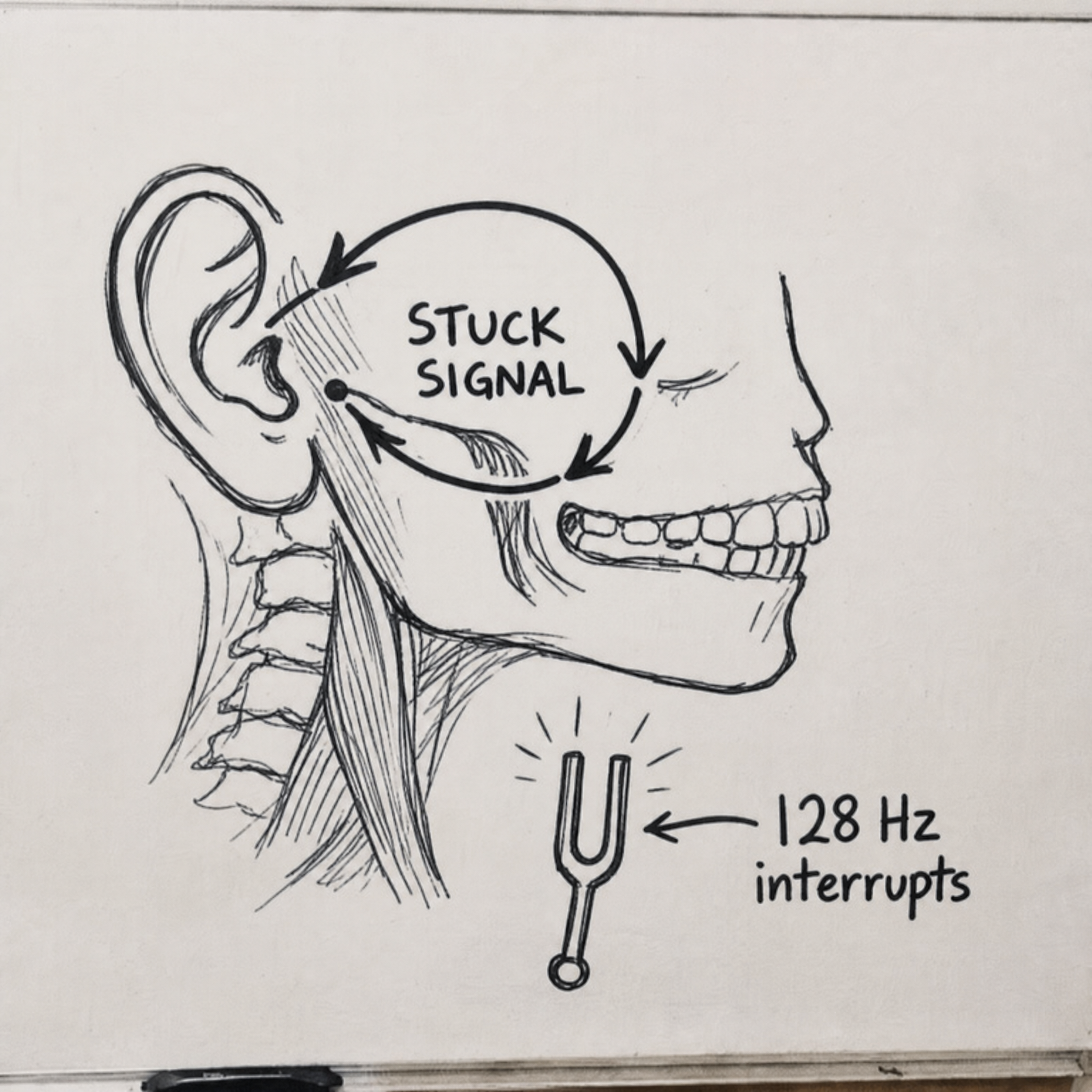
The number one fix for tinnitus isn't a hearing aid. It's not a white-noise machine. And it's not "learning to live with it." And I'm not going to tell you to mask it. If you're reading this, you've probably got the masking trick memorized. The fan you can't fall asleep without. The rain app running at 2 AM. The TV left on all night so the silence never gets the chance to scream at you. You know the exact moment a room goes quiet and the hiss rushes in to fill it. You know the shame of snapping at someone you love because they chewed too loud, or asked you to repeat one sentence, and the sound landed like sandpaper dragged across a raw nerve. You've stopped reading the books you used to disappear into, because you can't hold a single sentence in your head over the static. And somewhere along the way, a doctor leaned back, glanced at the clock, and said the words that hollowed you out: "There's no cure for this. You'll just have to learn to live with it." I lived with it for ten years. Ten years of falling asleep to a fan and waking up to a scream only I could hear. So let me tell you what not one of those doctors ever told me. I did everything an honest, desperate person does. I saw three different ENTs over four years. I spent north of two thousand dollars on "tinnitus support" supplements. Ginkgo. Zinc. A $79 bottle that promised to "quiet the ringing in 30 days" and quieted nothing but my bank account. None of it touched the sound. Because every single thing I tried was aimed at my ears. Here's what I found at 3 AM, the night I finally stopped typing "tinnitus cures" into Google and started typing "how does the ear actually make that sound." For most people, tinnitus was never an ear problem at all. Researchers who study somatic tinnitus have pulled this apart. In most cases, the ringing is somatic. It comes from tension in the neck and the jaw, not from anything broken inside the ear. In one clinical group, 61.7% of patients could change the volume or the pitch of their tinnitus just by moving their neck or clenching their jaw. Most of them were treating the wrong organ the whole time. I wasn't crazy. I wasn't broken. I'd spent a decade and thousands of dollars aiming at my ear, while the real source sat quietly in my jaw and the base of my skull. Here's why that one fact changes everything. Sound travels through air. That's exactly how a white-noise machine works, and exactly why it never reached my problem. But bone carries what air can't. It's the same reason you can hear your own voice from the inside when you hum with your ears plugged. Vibration travels through bone, into places sound through the air can never follow. That's why a white-noise machine never had a chance. Air can't reach tension locked into your jawbone and skull. Bone can. But it wasn't just any vibration that worked. The deeper I dug, the more one number kept coming up in the stories of people who'd finally turned the volume down. 128 Hz. A low, specific, steady frequency. Hold onto that number. It comes back at the end of this story in a way that made me angry. When a low, steady 128 Hz vibration is pressed against the jawbone and behind the ear, two things happen at the same time. It physically loosens the clamped muscles and the constricted nerves feeding that phantom noise. And it nudges your nervous system out of the fight-or-flight loop that keeps the volume pinned at the top. The intruder in your ear was never really in your ear. It's a stuck signal. And a stuck signal can be interrupted. So why didn't a single one of my three ENTs just hand me one of these forks? Because they already hold one. They press a 128 Hz tuning fork to the bone behind your ear during a standard hearing test. It's called the Rinne test. They use that exact fork to test your nerves. They were just never taught to use it to calm them. And a one-time piece of metal doesn't refill every month the way a prescription does. The relief was sitting on the desk at every appointment I ever had. Nobody once thought to turn it around and point it at me. So I'll do what they wouldn't. I'm going to be honest with you, because we've been lied to more than enough. This is not a cure. I won't insult you with that word, and if anyone else uses it on you, walk away. To be honest, I almost didn't buy it. A forty-dollar piece of metal, after ten years and thousands of dollars down the drain? It seemed too good, or too dumb, to work. But the guarantee gave me the nerve, and I ordered one. When it showed up, I stood there holding it, feeling kind of stupid. The first time I struck the fork, pressed the base to my jaw, and held it there, the hiss didn't vanish forever. But the volume dropped. From a screaming 10 down to a low 2. For the first time in a decade, the room was quiet enough for me to hear something other than the inside of my own head. There are people right now paying four thousand dollars for an FDA-cleared prescription device that combines sound and physical input to retrain these exact nerve pathways. I'm not knocking it. I'm telling you the two inputs it uses come out of a 128 Hz fork you press to your own jaw at home. I made it a ritual. Morning and night. Strike, place, breathe, three minutes a side. The first week, I slept. Actually slept, because for once the volume was low enough to let me drift off instead of bracing against it. By the second week, the fog that had sat behind my eyes for years started to lift, because my body had finally stopped fighting a 24-hour emergency. My wife noticed before I said a single word about it. "You haven't asked me to repeat myself in three days," she said one morning, and she looked at me like she'd gotten a piece of me back. And then one evening, I sat on the porch after my three minutes, and I heard the wind move through the maple in the yard. I heard a car pass two streets over. I heard the small, ordinary quiet that lives between the sounds. I sat there in the dark and cried. Not from pain, for once. From relief. If you want to try this, here's the one thing that actually matters: the frequency has to be exact. The cheap forks online are molded aluminum. They drift off 128 Hz over time, and the hum dies in about six seconds, before you can even get it to your jaw. If the pitch is off by a few hertz, you don't get the effect. You get a paperweight. I use the Nourial 128 Hz Healing Instrument. It's the only one I found calibrated to exactly 128 Hz, weighted at the base so the vibration runs deep and holds for almost a full minute, with a guide that shows you exactly where to place it along the jaw and behind the ear. They back it with a 60-day money-back guarantee. So if it does nothing for your kind of ringing, you send it back and you're out nothing but a little time. That guarantee was the only reason I was brave enough to try one more thing, after ten years of being let down by everything else. I left the link below. Right now it's 50% off for new customers. Worth a look while it lasts. You don't have to learn to live with it. You just have to stop aiming at the wrong place.
If the ringing never stops, you may be treating the wrong thing ☝️
If you wake up to a constant ringing or hissing in your ears, or if the noise has started stealing your sleep and your peace of mind, read this short article right now before you try anything else.
SEE DETAILSLike this ad? Make it yours.
Crush rebuilds this exact creative around your product — your brand, your colors, your offer — in about a minute.