
Active· since Jul 6, 2026
- 73
- days running
- 0
- relaunches
Ad copy
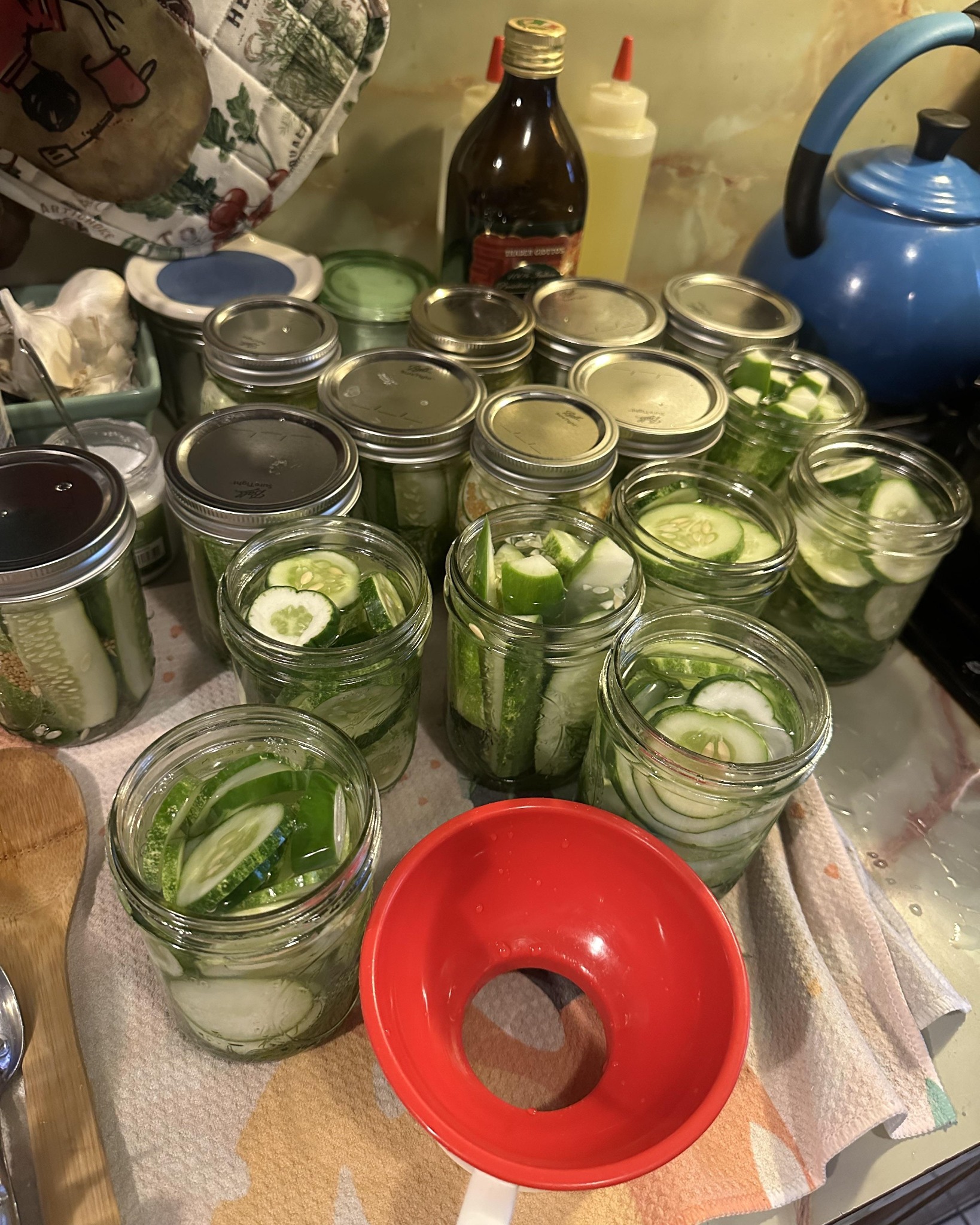
I found a jar of my mother's bread and butter pickles in the back of my pantry last Tuesday. She made them the summer before she died. 2021. The lid still had her handwriting on it in black Sharpie, "JUNE, sweet" in that loopy way she wrote everything, like she was always halfway through a thought. I'd been saving them. Not for any reason really. Just because they were the last thing her hands ever made for me. And my grandson Cole asked for a pickle on his peanut butter sandwich. He's 8. He does that. Peanut butter and pickles and a glass of chocolate milk and he calls it lunch. His mama says it's gross and I say it's genius and we go back and forth about it every Tuesday when he comes over after school. So I pulled the jar down. And I couldn't open it. I want you to understand what I mean when I say I couldn't open it. I don't mean it was tight. I don't mean I struggled. I mean I sat at my kitchen table in Tupelo, Mississippi, 62 years old, with my mother's last jar of pickles in my hands, and I could not make my fingers close around that lid hard enough to turn it a quarter inch. I tried a dish towel. I tried running it under hot water. I tried tapping the rim against the counter the way my daddy used to. Nothing. And Cole was sitting at the table swinging his little legs and saying, "Nana, is it stuck?" And I said, "Yeah baby, it's stuck." And he said, "Maybe we should just have grape jelly." And I said okay. And I put the jar back on the shelf. And I went to the bathroom and I cried for 20 minutes with the water running so he wouldn't hear me. Let me back up. My name is Loretta. I've lived in the same little brick house off Gloster Street for 31 years. My husband Wendell passed in 2018 from a heart thing nobody saw coming. I have two kids, Sherry and Marcus, and three grandbabies, and a beagle named Biscuit who is allegedly mine but actually belongs to whoever is feeding her at any given moment. I worked at the elementary school cafeteria for 22 years. I retired in 2019 and I thought I'd finally have time to do all the things I'd been putting off. Garden in the spring. Quilting. Maybe a part time job at the church. What I did instead was watch my hands stop working. It happened slow. That's the part nobody warns you about. It doesn't happen all at once where you can point to a Tuesday and say "that's when it started." It just sort of creeps. First it was twisting off water bottles. I started buying the kind with the pull tabs. Then it was opening the mail. I bought a little letter opener shaped like a sword from a yard sale. Then it was buttoning the back of my church dresses. I started wearing the ones that zip. Each time, I just adjusted. I told myself it was fine. I told myself everybody slows down. I went to my doctor about it. Dr. Patel. Nice woman, very smart, never makes you feel stupid for asking dumb questions. She looked at my hands. She moved my fingers around. She said, "Loretta, this is just wear and tear. You're 62. You worked in a cafeteria for over two decades. Your hands are tired." She prescribed me an anti inflammatory and told me to try warm compresses. I took the pills. I did the compresses. I bought one of those little squishy balls you're supposed to squeeze. And nothing got better. Nothing got worse either, to be fair. It just sort of stayed. The same dull ache in the morning. The same stiffness when I tried to make a fist. The same little surrender every time I needed to open something. I just got better at hiding it. The thing about getting older is everybody around you starts treating you like a fragile thing before you've decided you are one. Sherry started coming over on Sundays to help me carry groceries in from the car. Marcus installed one of those grabber sticks in my kitchen, the kind for getting things off high shelves, like I was already in some assisted living catalog. The kid who does my lawn started rolling my trash can up to the house on collection day without me asking. I appreciated all of it. And I hated all of it. Both things at once. Because the truth is I didn't feel old. I felt the same as I did at 45. I still wanted to do the things. Plant the tomatoes. Hang the laundry. Pick up Cole and spin him around even though he's getting too big for that now. But my hands kept telling a different story than my heart. And then came the pickle jar. I sat in that bathroom for a long time after Cole left that afternoon. His mama came and got him at 5:30. He kissed my cheek and said, "Bye Nana, love you," and skipped out to the car like nothing had happened. Because to him nothing had happened. We had grape jelly. That was it. But I sat in there and I looked at my hands in the mirror over the sink, and I thought about my mother. She was 71 when she made those pickles. 71. And she canned a whole batch by herself. Sliced the cucumbers, sterilized the jars, boiled the brine. Her hands moved like they were 30 the whole time. And I lied to my grandson because mine couldn't twist a lid. I sat down at my kitchen table that night and I wrote down on a piece of yellow legal pad paper the things I couldn't do anymore. Open jars. Wring out a dishrag. Use the can opener without resting my hand halfway through. Button the small buttons on Wendell's old denim shirt that I still sleep in sometimes. Pick up a coffee mug with one hand if it was full. Use the pinking shears my mother left me. Put my hair up in a clip without it slipping out three times. It was a long list. Longer than I thought it would be when I started. And the worst part wasn't any one thing on the list. It was the pattern. It was the realization that I had been quietly, slowly, politely accepting a smaller and smaller version of myself for years. And nobody had stopped me. Because everybody around me had decided it was just what happens. I went to bed that night and I couldn't sleep. The next morning, my friend Earlene called. Earlene is 64 and she has been my friend since we were both 19 working the deli counter at a Piggly Wiggly that doesn't exist anymore. She's the kind of friend who calls you at 7:15 in the morning and immediately starts in the middle of a sentence like you've been on the phone the whole time. "You busy?" "No." "Come over. I need to show you something." I drove over. Earlene lives 12 minutes from me in a little ranch with a bird feeder that the squirrels won. She made coffee and we sat at her kitchen table and she slid a phone across to me. She had been reading something. Now Earlene is not a "supplement" person. Earlene is suspicious of vitamins. She thinks Vitamin C is a fad. She drinks black coffee and she eats greens and she has a deep distrust of anything that comes in a brown bottle with a label. But she was reading something about a berry. A small green berry from a tree in India. Something her sister in law had been taking for about 4 months. Her sister in law, who used to complain about her knees every time she got up from a chair, had stopped complaining. Just like that. Stopped. Earlene noticed it at Easter dinner and asked her about it. The berry is called Amla. I'd never heard of it. I don't think most people in Tupelo have. It's been used in this thing called Ayurveda for something like 3,000 years, which Earlene pronounced "Ah-yer-vee-da" and looked very proud of herself for saying. She told me what she'd learned. And I want to try to tell you what she told me, because this is the part where my whole understanding of what was happening in my hands started to change. Here's the thing nobody told me about joint discomfort. I always thought it was a wear problem. Like a tire. Like I'd used my hands too much for too many years and the tread had run out and that was just that. Sand them down. Slow down. Accept it. But what Earlene was reading, and what I started reading after I went home that afternoon, told a different story. The discomfort isn't just wear. It's also what your body is doing in response to the wear. When tissues get stressed over years, your body starts producing what scientists call inflammatory signals. Little chemical messengers that tell the area "something is wrong here, send help." That help comes in the form of swelling, stiffness, that deep ache. The problem is the messengers don't always know when to stop. They keep firing. The signal keeps going out. And your joints keep responding to a problem that isn't really there anymore, or isn't as big as your body thinks it is. That's why warm compresses help for an hour and then it comes back. They're soothing the symptom. They're not quieting the signal. Amla, from what I read, has been studied for what it does to those signals. It's been shown to support the body's natural inflammatory response. Not block it. Not shut it down. Just bring it back into balance. Help your body stop overreacting to a problem it's been overreacting to for years. And it does this through compounds called polyphenols. Specifically a few that the berry happens to have in unusually high concentrations. Things like emblicanin and gallic acid, which my husband would have called "smarty pants chemistry words" if he were still here. These compounds are associated with supporting healthy joint function and helping maintain the kind of cellular balance that, when it's working right, just means your hands feel like your hands again. I read about this for 3 days. I read studies. I read forums. I read a long blog post by a woman in Oregon who said she could garden again at 67 after taking it for 5 months. And the more I read, the more one thing kept hitting me. I had been treating the symptom my whole adult life. The compresses. The squishy ball. The anti inflammatory pills that gave me heartburn and didn't really do much. The grabber stick. The pull tab water bottles. None of those things had ever asked the question, "What if your body just needs help calming down?" They just helped me work around the problem. Amla, from everything I read, seemed to actually be talking to the underlying signal. I'm going to be honest with you. I was skeptical. I am a 62 year old Black woman from north Mississippi and we are not, as a people, easily sold on miracle berries from India. I asked Sherry about it. She googled it on her phone right there at my kitchen table and she said, "Mama, this actually has a lot of research behind it. Like, real research. Not just blogs." I asked Dr. Patel about it at my next visit. She didn't pooh pooh it. She said, "I've read some interesting things about Amla. There's some real science there. It's been studied for joint comfort and for cardiovascular markers. I wouldn't tell you not to try it." That was as close to a green light as Dr. Patel gives anybody. So I went looking for a good one. This is where I have to tell you something, because I almost gave up at this part. There are a lot of Amla products out there. Most of them are junk. Cheap powders in plastic tubs that don't tell you how much of the actual active compounds are in there. Pills that have been sitting in a warehouse so long the polyphenols have probably given up. I went down a rabbit hole comparing them and I almost just gave up and ordered the cheapest one on Amazon. But Earlene called me again and said her sister in law had been taking one specifically. A company called Alevia. They make a version of Amla that's standardized, which is a word I had to look up, but it basically means you actually get the same amount of the good stuff in every capsule. Not "trust us, it's in there somewhere." Standardized. Their version is also concentrated. Not just dried berry powder packed into a capsule, but the actual active extract. And they had a 90 day money back guarantee. Which I appreciated. Because at 62 I am not in the business of throwing money down a hole for things that don't work. I ordered a bottle. It came in the mail 4 days later in a brown box with my name on it. I sat at my kitchen table and I opened it and I took the first one with my morning coffee on a Wednesday. I want to tell you it worked the first week. It did not work the first week. The first week I felt the same. I took the capsule, I went about my business, I forgot I was taking it half the time. Week two, same story. I almost gave up. I almost called Sherry and said "your mama got swindled." Week three, something funny happened. I was making my bed on a Sunday morning. And I realized I had tucked the fitted sheet around all four corners without having to stop and shake my hands out between corners. I didn't think anything of it in the moment. I just kept making the bed. It was only that night, lying in the bed I'd just made, that it hit me. I had tucked all four corners. Without stopping. The next morning I went to the bathroom and I tried to button the buttons on Wendell's old denim shirt. The little brass ones near the cuffs that I'd given up on in 2022. I got both of them. It took me a minute. It wasn't smooth. But I got them. I sat on the edge of my bed and I just stared at my cuff for a while. Week 5 was when Earlene came over for coffee and I opened the half and half carton for her without thinking about it. She watched me do it and she just smiled and didn't say anything. She knew. I knew. We didn't have to say it. Week 7 was when I started leaving the grabber stick in the closet. I just stopped reaching for it. I didn't decide to. I just stopped needing it. Week 9 was when Cole came over for his Tuesday afternoon and he asked for a pickle on his peanut butter sandwich. I want you to picture this. Me, in my kitchen, with the same yellow walls and the same humming refrigerator and the same little 8 year old swinging his legs under the table. I went to the pantry. I pulled down my mother's last jar. I held it in my left hand. I twisted with my right. And it opened. Not easy. Not like it was nothing. But it opened. With a soft pop and the smell of sweet brine and dill that hit me like a memory I hadn't visited in 4 years. I put a pickle on Cole's peanut butter sandwich and I stood at the counter and I cried while he ate it. He looked up halfway through and said, "Nana, are you okay?" And I said, "Yeah baby. I'm good. I'm real good." I'm going to tell you something honest now. I don't know what Amla does for everybody. I'm not a doctor and I'm not going to sit here and tell you it's going to do for you what it did for me. What I can tell you is that I had spent years quietly accepting a smaller version of my own life. I had let my body teach me what I couldn't do anymore instead of asking my body why it was telling me that. And when I found something that worked with what my body needed instead of just covering up what it was complaining about, things started to change. Not overnight. Not in a way you'd put on a billboard. But in a way that mattered. I planted tomatoes this spring. 4 plants. Heirloom Cherokee Purple, my favorite. I dug the holes myself. I have been wringing out my own dishrags for 4 months. Last weekend, Sherry came over to help me carry groceries in and I had already brought them all in myself. She stood in my driveway with her hands on her hips and said, "Mama, you cut me out of my job." I said, "Baby, you can have your job back when I'm actually old." She laughed. I laughed. Biscuit barked at a leaf. It was a good morning. If you're sitting where I was sitting a year ago, with a list on a yellow legal pad of all the small things you've quietly given up on, I want to tell you something. It might not be just aging. I'm not saying it isn't. I'm saying it might not be only that. There may be a signal in your body that's been firing for years that you can help quiet down. There may be a reason your hands or your knees or your hips or your back have been speaking up that has more to do with how your body is responding than how much you've used them. It's worth looking into. Alevia Amla is what worked for me. The bottles come in the mail in a little brown box. You take one a day. It doesn't taste like anything. You won't notice anything for a few weeks. And then one day you'll notice something small, like a fitted sheet or a button cuff or a jar that opened, and you'll know. They have a 90 day money back guarantee, which is what got me to try it in the first place. If 90 days goes by and you haven't noticed anything, you send the bottle back and they refund you. No fight, no questions, no hassle. I read the policy myself before I ordered. I'm not sponsored by them. Nobody asked me to write this. I'm just a grandma in Mississippi who couldn't open her mother's pickle jar a year ago and who opened it last month for her grandson. If that story sounds anything like yours, you can find out more here. P.S. My mother used to say that the small things are the whole thing. That a life is built out of jar lids and button cuffs and tucked corners on a fitted sheet. I didn't really understand what she meant until I lost those things and got them back. If you've been losing them too, the 90 day guarantee means you risk nothing to find out what your body has been trying to tell you. P.P.S. Cole asked me last Tuesday if we could make our own pickles this summer. I said yes. We're starting in June. My mother would have loved that. 👉 alevia.com/amla/33
Like this ad? Make it yours.
Crush rebuilds this exact creative around your product — your brand, your colors, your offer — in about a minute.