
Inactive· since Apr 30, 2026
- 138
- days it ran
- 3
- relaunches
Ad copy
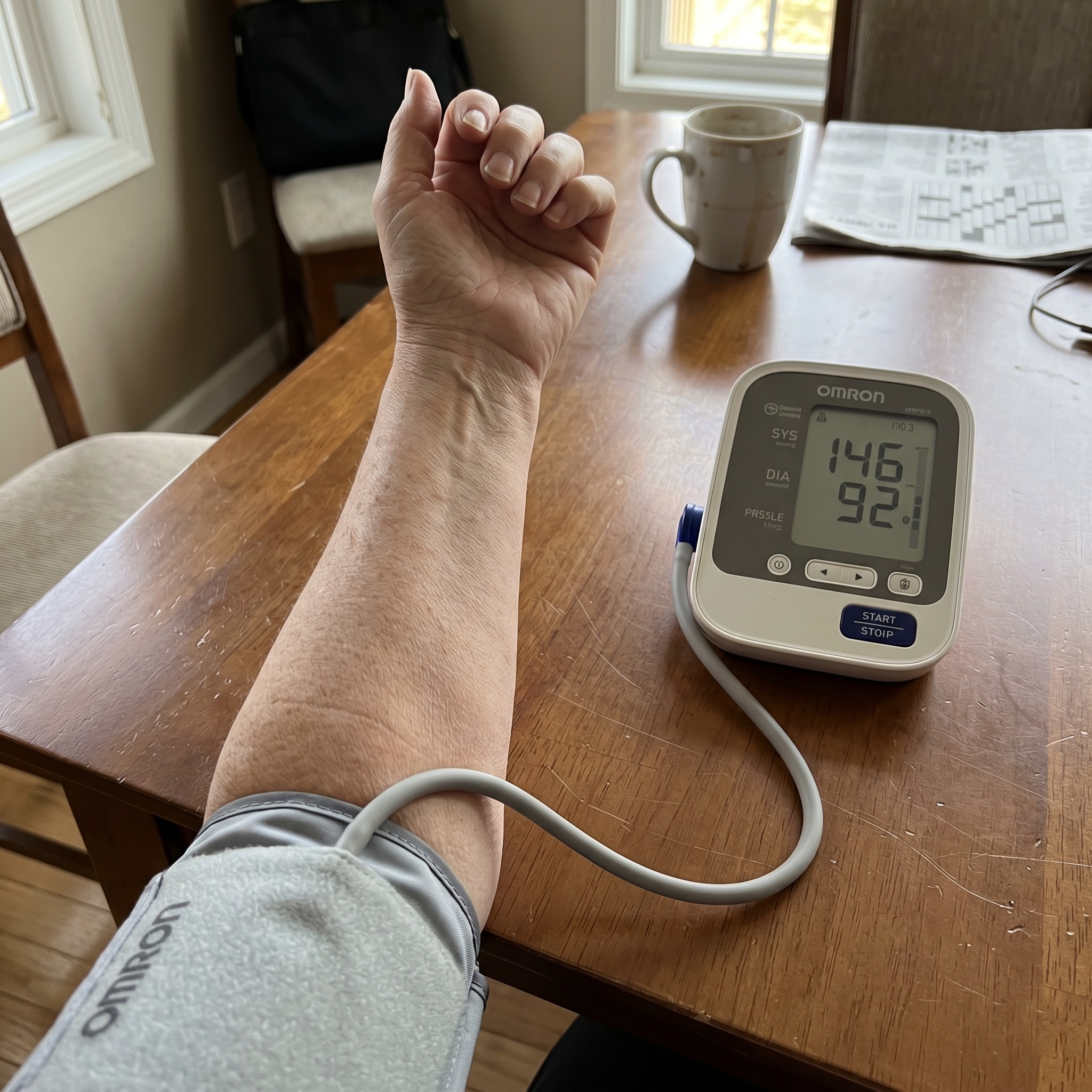
I'm so f****ing sick of people posting here saying garlic, beetroot, and fish oil lower blood pressure. They don't. Not really. I've tried all of them. So has everyone in my Facebook group. So has my sister. So has the guy at the supplement store who, by the way, is still on Lisinopril. Let me tell you what two years of "natural blood pressure protocols" actually got me. Garlic capsules every morning. $24 a bottle. Six bottles. Six months. My systolic dropped four points. Then crept right back up. Beetroot powder mixed into my coffee. $39 a tub. Tasted like dirt. Stained everything pink. Numbers barely moved. The fitness guys swore by it. Maybe it works if you're 32 and run marathons. I'm 57 and my numbers were 148 over 92 when I started and 144 over 90 when I stopped. Fish oil. $32 a bottle. Three bottles. Nothing for blood pressure. Just fish burps for half a year and a fridge that smelled like a pier. Magnesium glycinate at $28 a bottle. Then magnesium citrate when the glycinate didn't do anything. Then the expensive German one a guy on Reddit recommended for $46. Same result. My doctor said "well it's good for sleep" like that was supposed to be a consolation. CoQ10 at $35. Hibiscus tea at $22 a tin. Potassium. Berberine when someone told me it worked for "everything metabolic," another $40. Add it all up. I sat down one night and actually did the math. Two years of natural protocols. Over $1,400 in supplements. And I was four points lower than where I started, on a good day. You know what they all have in common. They all kind of work. A little. For a few weeks. And then your body settles right back where it was, and you're sitting at the kitchen table at 6am with the cuff on your arm watching the same numbers come up again, and you're wondering if you're going to spend the rest of your life on this hamster wheel before you finally give in and take the pill your doctor has been waving in your face for three years. That was me in February. I'd lost 22 pounds. I was walking 40 minutes a day. I'd cut salt to the point that my wife stopped eating dinner with me because she said the chicken tasted like a hospital tray. 145 over 88. That was my number that morning. After everything. I sat at the table and I almost cried. Not from sadness. From rage. The kind of rage where you start to wonder if the whole "natural supplement" world is just a slightly cleaner version of the pharmaceutical world. Different bottles. Same scam. I'm writing this from the other side of that morning. My pressure was 124 over 76 when I checked it before I sat down to type this. It's been in that range for eleven weeks. No medication. No prescription pad. No daily dread when I see the cuff on the counter. What changed wasn't another supplement off the shelf. It wasn't a different brand of beetroot or a stronger garlic or a fancier magnesium. It was an entirely different theory of what was actually wrong with me. Something none of those bottles had ever touched. Something my regular doctor had never mentioned in three years of appointments. I'm going to tell you exactly how I found it. Because if you're somewhere on the same wheel I was on, you need to hear this before you spend another six months and another four hundred dollars on the next supplement that promises to be the one. Back to that morning at the kitchen table. That night I couldn't sleep. I was scrolling our local community page on my phone in the dark. The one where neighbors post about lost dogs and which plumbers not to call. A woman a few streets over had posted a long question. She'd been on three blood pressure medications. The last one gave her a cough so bad she couldn't sleep through the night. She was asking if anyone in the area knew a doctor who would actually listen instead of writing another prescription. Forty-two comments. Most of them useless. But one comment near the top had thirty-eight replies under it. A guy I didn't know recommended a holistic doctor on the other side of the city. Said he'd gone in there at 158 over 96, on two medications, frustrated and out of options. Said the doctor had spent ninety minutes with him on the first visit and walked him out with a different understanding of what was actually wrong. Reply after reply under that comment. People I didn't know, but people from my own zip code, saying the same thing. He took his time. He explained things nobody else had explained. He didn't rush. I screenshotted the doctor's name and put my phone down. Forty five minutes across the city in traffic. Out of network. Three hundred dollars for the first visit, no insurance. I almost didn't go. Three hundred dollars on top of the $1,400 I'd already burned felt like another donation to the natural health industrial complex. But I kept thinking about that comment thread. Thirty eight replies. From my own town. People who weren't trying to sell me anything. So two weeks later I drove across the city on a Tuesday morning and sat in a quiet office with bookshelves and no fluorescent lights, and a doctor with grey hair and reading glasses pulled my chart up on his laptop while I listed every supplement I'd tried. He let me finish. Then he closed the laptop. "You're treating the wrong thing," he said. I waited. "Your blood vessels aren't just tubes. They're living tissue. The inside is lined with a thin inner wall. A layer of living cells that controls everything about how your blood flows. Garlic, beetroot, fish oil, magnesium, none of them are doing anything to that wall. And until you fix the wall, your pressure is going to keep doing exactly what it's doing." He pulled out a notepad and drew a cross section of an artery. The outer muscle. The blood flowing through. And a thin inner lining he tapped with the end of his pen. "This. It's called the endothelium. One cell thick. This is where blood pressure actually gets decided." He kept going. "When that wall is healthy, it produces a molecule called nitric oxide. That's your body's natural signal telling your blood vessels to relax. The wall makes it. The vessels respond to it. Your pressure stays balanced without you ever thinking about it. The way you don't think about breathing." "But that wall is exposed to everything in your blood. Every processed meal. Every sugar spike. Every stress hormone. Every year of inflammation. It scrapes across the wall, day after day, year after year. The surface that was once smooth gets pitted and raw. Like the inside of an old pipe that's been corroding for decades." "Once the wall is damaged, it stops producing nitric oxide. Your vessels can't relax. They stay tight. Your heart pushes harder against them. And here's the part that matters. The harder your blood pushes through, the more it damages the wall. Less nitric oxide. Tighter vessels. More pressure. More damage. The cycle feeds itself." "That's high blood pressure. Not a mystery. Not bad genes. A damaged inner wall stuck in a cycle that gets worse every year." I sat there for a long second. He let me sit with it. Then he counted on his fingers. "Now look at what you've been taking. Beetroot adds nitric oxide from the outside. It works for a few hours. By the next morning it's back where it was, because the wall that's supposed to make nitric oxide on its own is still damaged. You're topping off a tank with a hole in the bottom." "Garlic thins your blood. Doesn't touch the wall." "Magnesium relaxes the muscle around the vessel. Doesn't reach the wall." "Fish oil reduces inflammation in the bloodstream. Can't repair the damage already done. It's cleaning the water while the pipe keeps corroding from the inside." He set the pen down. "Every supplement you've tried has either added nitric oxide from outside or worked on the blood flowing through. Nothing has repaired the wall itself. That's why nothing has worked. You've been treating everything around the wall. Nobody fixed the wall." $1,400 over two years. Treating everything around the wall. I asked him what does fix the wall. He nodded like he'd been waiting for the question. He told me about a fruit that grows in the foothills of the Himalayas called amla. Gooseberry. Healers in the Himalayas have used it for over five thousand years. They called it "the nurse." It was the thing they reached for when somebody's body was breaking down from the inside. I had never heard of it. Not once. Not on any supplement comparison list. Not in any of the "best blood pressure supplements" articles I'd read for two years. Not from my regular doctor, who has a cardiology fellowship and a wall of diplomas, and not from anyone in my Facebook group. Five thousand years of use and it had never made it across my radar. "Amla contains compounds called emblicanins," he said. "Antioxidants found only in this fruit. When researchers tested the antioxidant strength of over thousands of foods, amla ranked at the top. Above blueberries. Above turmeric. Above green tea. And it isn't close." "Here's what emblicanins do. They go to work on the damaged inner wall." "The free radicals corroding your wall, the ones from stress and processed food and sugar and just getting older, emblicanins find them and neutralize them. Not in your gut like garlic. Not in the muscles around the vessel like magnesium. Not floating loosely in your blood like fish oil. Directly on the wall itself. Where the actual damage is happening." "When the assault stops, the wall gets a chance to recover. The same way your skin recovers once you stop picking at a cut. And once it's working properly again, it starts producing nitric oxide on its own. On its own. The way it did when you were younger." He looked at me over his glasses. "You didn't need more nitric oxide from a bottle. You needed to support the wall that produces it." That was the moment two years of frustration finally made sense. "When the wall starts working again, your vessels relax on their own. Blood flows without forcing. The pressure drops. And when the pressure drops, the wall stops getting shredded. The cycle that's been running for years finally breaks. Your pressure comes down because your body is doing what it already knows how to do. You just had to fix the wall first." He pulled up a clinical study on his laptop and turned the screen toward me. Researchers had tested standardized amla extract head to head against atorvastatin, one of the most prescribed cardiovascular drugs in the world. The amla performed in the same range as the drug. Blood pressure dropped. LDL cholesterol came down. Inflammation markers dropped. No dry cough. No brain fog. No swollen ankles. A fruit extract going head to head with a pharmaceutical and matching it. Other studies he showed me had standardized amla extract producing meaningful drops in systolic pressure. The kind of range a lot of prescription medications produce. And it was working on the same pathway that drugs like Lisinopril target. Without the side effects those drugs come with. Multi-pathway. From one whole food. "Why didn't my regular doctor know this," I asked him. He shrugged. "Most of this research is in cardiology and nutrition journals she isn't going to read. Amla isn't part of the standard hypertension protocol yet. It probably will be in ten years. For now, you just have to know about it." Then he leaned back and said the part I want you to read twice. "Before you go on Amazon and buy the first amla you see, you need to hear this. Not all amla supplements are the same. Most of what you'll find online is low quality powder with degraded nutrient content and no third party testing. Some are contaminated with heavy metals. Some use fillers to cut costs. Some deliver a dose so low it won't move the needle on anything. And most use heat during processing, which destroys the very emblicanins that make amla work in the first place." He paused. "The difference between raw amla powder and a properly standardized extract is like the difference between chewing on willow bark and taking an aspirin. One is the plant. The other is the precise, concentrated compound that actually produces results. If you buy the wrong one, you'll think amla doesn't work, and you'll be right back on the carousel." He told me what to look for. Organic. Third party tested for purity and potency. Made in the USA. Small batch production to preserve potency. A standardized extract, not raw powder. No fillers, no heat processing. He told me he takes amla himself every morning. Said he doesn't recommend a specific brand to patients because he's not in the supplement business. But if I matched everything he just listed, I'd find one. He also told me what to expect from the timeline, because most people quit too early. He said the first two weeks the emblicanins start neutralizing the free radicals corroding the wall. You won't see your numbers move yet, but the assault is slowing. Some people notice their energy clearing or their head feeling less foggy. That's the antioxidant protection building. Weeks three and four, the wall starts working well enough to produce nitric oxide on its own again. That's when the numbers start to respond. The vessels begin relaxing without anything forcing them open. The heaviness lifts. Weeks five through eight, the cycle that's been grinding on for years can finally start to ease up. The vessels relax, blood flows more freely, the pressure on the wall eases, and the wall gets a break from getting shredded. That's the window where most people start to see their numbers move on the cuff. Weeks nine through twelve and beyond, the wall stays protected. The emblicanins keep neutralizing the oxidative stress that damaged it in the first place. Your body holds healthy pressure the way it was designed to. The way it did when you were younger. He said the people who fail with amla are the ones who quit at week two because nothing showed up on the cuff yet. The biology takes time. Twelve weeks minimum to see what it can really do. I drove home with two pages of his handwritten notes in my jacket pocket. That night I sat at my kitchen table with my laptop and started looking. Most of what came up on Amazon failed the criteria immediately. Raw powder, not extract. No third party testing. No mention of how it was processed. Long fillers list. Made in places I couldn't pronounce. I looked at probably forty brands over two nights. The one that hit every single thing on his list was a small company called Alevia. Organic. Third party tested for purity and potency. Made in the USA. Small batches to preserve potency. A standardized extract, not raw powder. No fillers. No heat processing. Every box checked. I ordered a bottle that night. Two capsules every morning with water. Week one and two, exactly like he said. Nothing on the cuff. But by day ten my afternoon energy was different. The brain fog I'd been pushing through after lunch lifted. I didn't think much of it. Week three I checked one morning and got 138 over 84. Week four I was averaging 132 over 80 across morning readings. Just like he said. The wall was healing enough to make its own nitric oxide. Weeks five through eight my numbers kept moving. By the end of week eight I was at 126 over 78. Three readings in a row. The cycle he described, the one that had been grinding on me for years, had finally broken. I went back to my regular doctor at the three month mark. The one with the cardiology fellowship. She took my pressure twice. Looked at the cuff. Looked at me. Asked what I was doing differently. I told her. She wrote it down. No prescription that visit. None. That was eleven weeks ago. I'm at 124 over 76 this morning. My wife and I had pasta last night. Real pasta. With salt. Here's what I want to say to you, because I'm guessing you're somewhere on the same wheel I was on. Maybe you've also added up what you've spent on supplements that didn't move your numbers. Maybe you're afraid to do that math. If you've been cycling through garlic, fish oil, beetroot, magnesium, hibiscus, CoQ10, you are not crazy and you are not failing at this. You were given the wrong tools. Every one of those supplements works on something downstream of the actual problem. They were designed by people who didn't know about the endothelium, or who knew and didn't have a single ingredient that addressed it. Amla addresses it. Directly. That's the difference. But only the right amla. Organic. Third party tested. Standardized extract, not raw powder. No fillers. No heat processing. If a brand fails any one of those, you'll think amla doesn't work and you'll be right back where you started. Alevia is the brand I found that hit every one. Two capsules with water every morning. I've been taking it ever since. You don't need to scroll a community page at midnight or drive across the city and pay three hundred dollars and spend two nights comparing forty brands to find this out. I already did all of that for you. Alevia has a 90 day money back guarantee. Take it for three months. That's the timeline. The first two weeks the wall starts protecting itself. Weeks three and four it starts producing nitric oxide again. Weeks five through eight the cycle breaks and the numbers move. Weeks nine through twelve your body holds the new pressure on its own. If your numbers don't improve in that window, full refund. No questions. The fact that a small supplement company will offer that and the pharmaceutical industry won't tells you something. I hope this helps someone. I really do. Because nobody should spend two years and $1,400 feeling proud of a solution that was never designed to work where the problem actually starts. 👉 https://alevia.com/amla/8 P.S. The endothelium is the thing every blood pressure supplement on Amazon is bypassing. Garlic, beetroot, fish oil, magnesium, none of them touch it. Amla is the only single-ingredient extract I've found that works on it directly. But it has to hit every requirement, or you're just buying expensive powder. P.P.S. The 90 day money back guarantee covers the full timeline. Two weeks for the antioxidant protection to build. Four weeks for nitric oxide to start coming back. Around eight weeks for the cycle to start easing. Twelve weeks to see what your body can do when it's actually supported the right way. After spending $1,400 on supplements that didn't fix the wall, that guarantee is the first time the math has worked in my favor. P.P.P.S. Small batches sell out. If they're in stock when you click, grab a bottle. The next batch usually takes a few weeks. Every week your inner wall stays damaged is another week your pressure keeps doing what it's doing. 👉 https://alevia.com/amla/8
Like this ad? Make it yours.
Crush rebuilds this exact creative around your product — your brand, your colors, your offer — in about a minute.