
Key Takeaways
- 1Stop using blended ROAS; it hides true performance across ad campaigns.
- 2Segment ad spend into TOFU, MOFU, and BOFU stages for predictable scaling.
- 3Accept lower TOFU ROAS to feed high-converting BOFU retargeting pools.
- 4Use AI tools to automate budget balancing across your ROAS funnels.
Looking at account-wide ROAS is a quick way to kill your ad performance. Discover why building dedicated ROAS funnels for TOFU, MOFU, and BOFU stages, powered by AI, is the true secret to scaling predictable, profitable revenue.
In the world of performance marketing, "Return on Ad Spend" (ROAS) is the metric that dictates whether you are building a legitimate business or just funding a very expensive hobby. However, a common mistake media buyers make is looking at ROAS as a single, holistic number across an entire ad account.
If your account ROAS is 2.5, you might think you are doing well. But that number is a blended average. It hides the fact that you might be losing money on cold traffic and making it all back (and then some) on retargeting.
To truly scale a business predictably, you need to transition from looking at account-level metrics to structuring your Facebook ad account around dedicated ROAS funnels.
In this article, we will break down what ROAS funnels are, why they are essential for profitable scaling, and how artificial intelligence is changing the way we construct them.
What is a ROAS Funnel?
A ROAS funnel is a strategic architecture of advertising campaigns designed to move a user from complete ignorance to a repeat purchaser, while meticulously tracking and optimizing the Return on Ad Spend at every single stage.
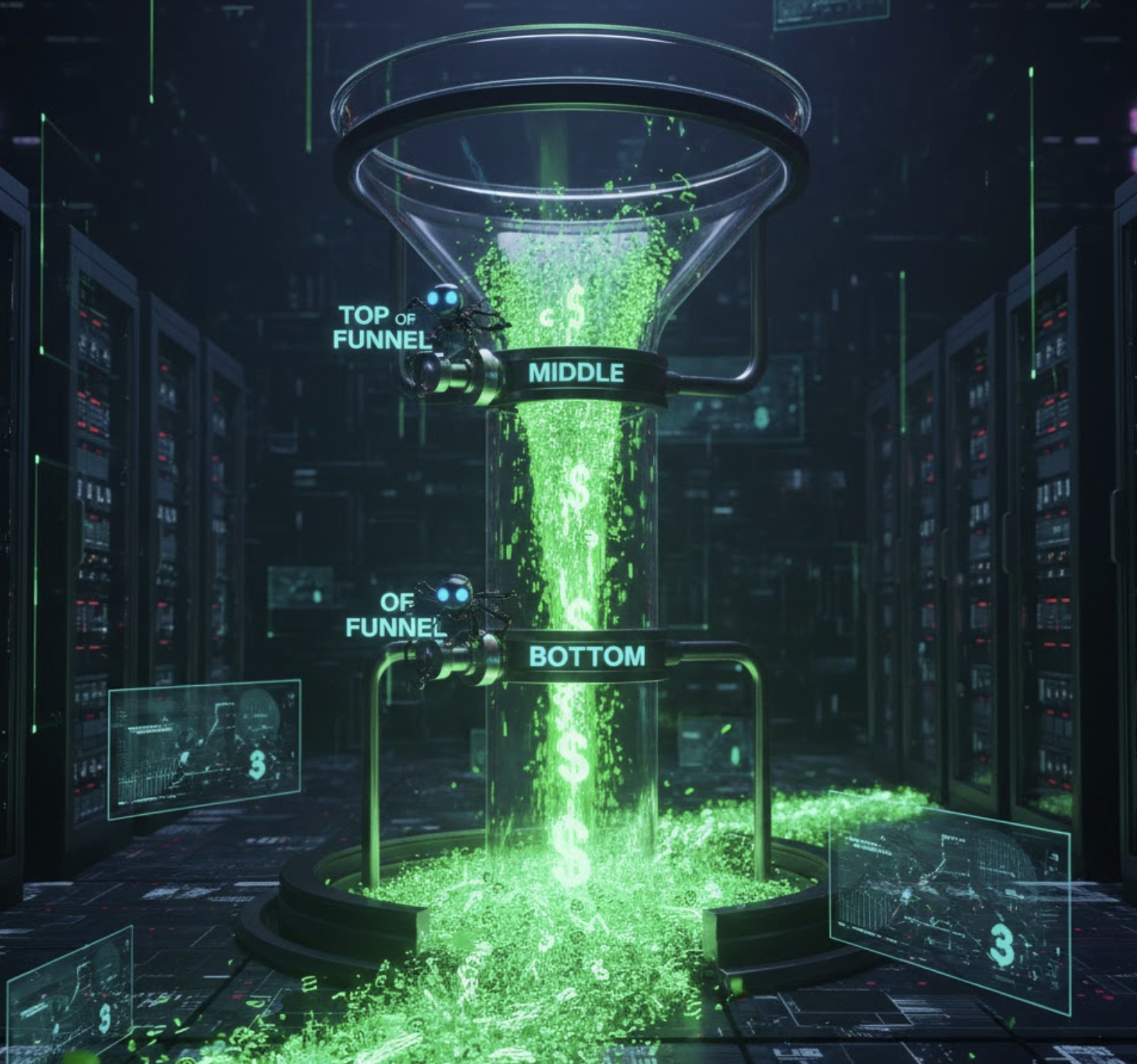
Instead of having one massive campaign optimizing for purchases, a true ROAS funnel is segmented into three distinct psychological stages:
1. Top of Funnel (TOFU): The Awareness Stage
This is where you target cold traffic, people who have never heard of your brand. The goal here is not necessarily immediate profitability (though that is nice). The primary objective is to acquire high-quality traffic at a low cost.
The ROAS Expectation: Your TOFU ROAS might only be 0.8 or 1.2. In a vacuum, this looks bad. But within a ROAS funnel, this is acceptable because you are buying data and building a robust retargeting pool.
2. Middle of Funnel (MOFU): The Consideration Stage
These are users who have watched your TOFU videos, clicked on your website, or engaged with your social pages, but haven't purchased. They know you, but they don't trust you yet.
The ROAS Expectation: Here, you deploy educational content, social proof, and unboxing videos. Your expected ROAS should jump to 2.0 or 3.0.
3. Bottom of Funnel (BOFU): The Conversion Stage
These are the cart abandoners. They added the product to the cart but got distracted. They have incredibly high intent.
The ROAS Expectation: This is where you deploy aggressive offers, scarcity tactics, and direct calls to action. Your BOFU ROAS should be the highest in your funnel, often hitting 5.0, 10.0, or even 20.0.
The Blended ROAS Fallacy
The magic of ROAS funnels is that they allow you to understand your Blended ROAS accurately. If you spend $1,000 at TOFU and make $800, and you spend $200 at BOFU and make $2,000, your total spend is $1,200 and your total revenue is $2,800.
Your blended ROAS is 2.33. You are highly profitable.
If you didn't have a funnel structure, and you just looked at the TOFU campaign, you might panic, turn off the cold traffic ads, and destroy your entire business ecosystem. This data blindness around Facebook's ROAS is exactly why advertisers fail. ROAS funnels provide the context necessary to make intelligent scaling decisions.
Building ROAS Funnels with AI
Historically, building and maintaining complex ROAS funnels was a nightmare. It required setting up intricate custom audiences, managing overlapping exclusions, and constantly adjusting budgets manually to ensure the funnel didn't get "clogged" (e.g., spending too much on retargeting when there wasn't enough cold traffic entering the top).
In 2026, AI has completely revolutionized this process. If you want to build bulletproof ROAS funnels, you need an autonomous system. This is precisely how TryCrush is engineered.
How TryCrush Automates the Funnel
TryCrush does not just generate single ads; it builds ecosystems. Here is how the AI automates the heavy lifting:
Stage-Specific Creative Generation: TryCrush understands that a TOFU ad needs a different psychological hook than a BOFU ad. It automatically generates broad, attention-grabbing creatives for the top of the funnel, and high-urgency, offer-driven creatives for the bottom.
Autonomous Budget Balancing: The hardest part of managing ROAS funnels is budget allocation. TryCrush monitors the size of your retargeting pools in real-time. If your BOFU audience gets too small, it automatically shifts budget to TOFU campaigns to acquire more traffic, ensuring a steady flow of conversions.
Granular Kill Switches: TryCrush applies different success metrics to different stages of the funnel. It won't kill a TOFU ad just because its ROAS is 1.0, as long as its Cost Per Outbound Click (CPC) is low enough to feed the profitable BOFU campaigns. However, if a BOFU ad drops below a 3.0 ROAS, the system will trigger a kill switch protocol to stop wasting budget instantly and generate a new variation.
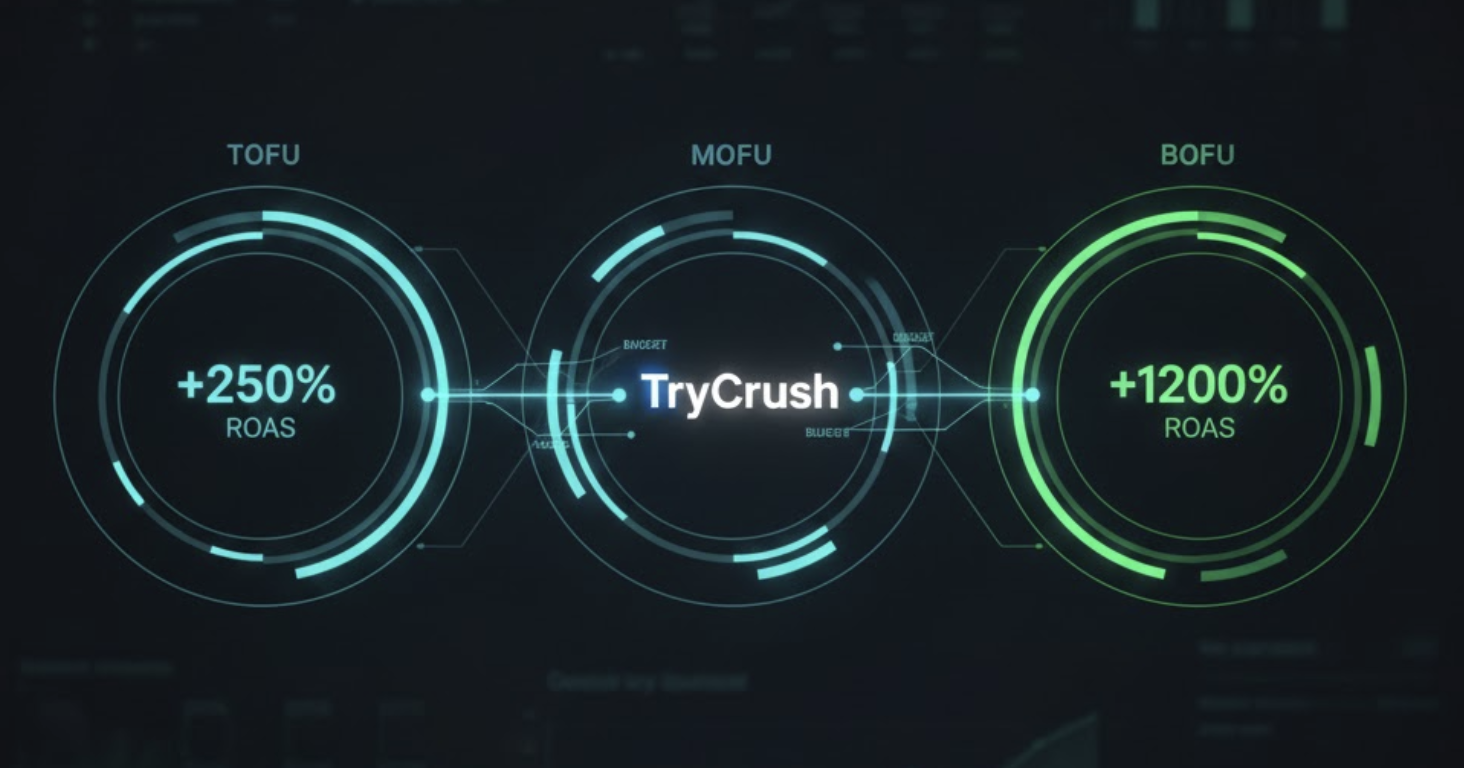
The Profitability Matrix: Predictable Ad Scaling
When you implement an AI-driven ROAS funnel, your advertising ceases to be a gamble. It becomes a mathematical matrix.
You no longer wake up hoping your ads perform well. You know that for every $1 you put into the top of the funnel, the system will automatically route it, retarget it, and optimize it until it yields $3 at the bottom.
This level of predictability is what allows eight-figure brands to scale aggressively. They aren't smarter than you; they just have a scientific framework for predictable scaling and a better funnel infrastructure.
Conclusion
If you are still dumping all of your ad budget into single, broad campaigns and hoping the platform sorts it out, you are leaving massive amounts of profit on the table.
The secret to predictable, scalable revenue is segmenting your customer journey and optimizing the math at every stage. By leveraging an AI growth engine like TryCrush to build and manage your ROAS funnels, you remove human error, automate the tedious budget balancing, and ensure that every dollar spent is working efficiently to acquire and convert your ideal customer.
Frequently Asked Questions
Common questions about this topic
1What is a ROAS funnel?
2Why is blended ROAS misleading?
3How does AI improve ROAS funnels?
Written by

Ignas Obulaitis
Head of ITIgnas Obulaitis is the head of IT for TryCrush.ai, leading the platform’s engineering and AI innovation. With a strong background in product-driven development, Ignas has built and scaled complex systems across fintech, SaaS, and AI-focused companies. An ex-IBM engineer and former Head of Development at Fluensure, Ignas combines deep technical expertise with a sharp product mindset to turn ambitious ideas into scalable, production-ready technology.
Stop Guessing.
Start Crushing.
AI Ad Manager trained by world-class media buyers to generate your creatives and optimize your ads 24/7.
Learn more
Related articles

Ecom Benchmarks 2026: Why "Average" Means You're Losing Money
In 2026, aiming for average e-commerce metrics means aiming for bankruptcy. Discover the new CTR, AOV, and conversion benchmarks you need to survive, plus actionable AI and CRO strategies to push your brand into the profitable top 1%.

Higgsfield AI vs TryCrush: Which Platform Delivers Better ROAS?
The arms race in generative AI is accelerating. Discover the core differences between Higgsfield AI and TryCrush, and learn why transitioning from organic content creation to profitable paid ad conversion requires a specialized performance engine.
ROI vs ROAS: Metric Differences and Top Software in 2026
ROAS measures gross ad revenue, while ROI measures total net business profit. Discover the key differences and compare the top tools for tracking true margins.

The Art of the Algorithm: Mastering AI Creative Advertising
The era of the subjective Creative Director is over. Discover how AI creative advertising replaces human opinion with objective data to generate high-converting ads. Learn the H.E.R.O framework and modern testing methodologies to scale your campaigns efficiently.