

Key Takeaways
- 1Agencies charging % of spend are incentivized to increase budgets, not your profit
- 2Automation can replace manual media buying tasks for a fraction of agency costs
- 3Bring ads in-house to retain institutional knowledge and data history forever
- 4Reallocate saved agency fees into high-quality creative and copywriting
- 5Modern ad automation tools offer 24/7 optimization unlike 9-5 manual management
Are you paying your ad agency $5,000 a month just to "press refresh"? The media buying landscape has changed. Learn why manual bidding is dead and how to replace expensive retainers with efficient, in-house automation tools that keep the knowledge within your company.
It’s the first of the month.
You get an email from your ad agency. Subject line: "Monthly Performance Report - [Your Brand]".
You open the PDF. It’s beautifully designed. It has your logo on it. It has colorful pie charts.
It says things like:
"Optimized campaign structure."
"Refreshed creative assets."
"Monitored audience overlap."
And then, at the bottom, is the invoice: $5,000 (or 15% of spend).
You pay it. You always pay it. Because you believe that without them, your sales would stop.
But deep down, you have a nagging suspicion.
"What did they actually DO this month?"
Did they really spend 40 hours "optimizing" your account? Or did they spend 1 hour tweaking a budget and 39 hours ignoring you?
I’m going to tell you a secret that agencies don’t want you to know.
They are pressing "Refresh."
The Agency Model is Broken
I am not attacking all agencies. There are some incredible creative agencies out there. There are strategic partners who truly understand growth.
But the "Media Buying Agency", the firm that charges you a retainer just to manage your Facebook Ads account, is a dinosaur.
Why?
Because the work they used to do (manual bidding, audience hacking, technical setup) has been automated by Meta.
Ten years ago, you paid an agency for their Access and their Technical Skill. You needed them to navigate the complex cockpit of Ads Manager.
Today, you are paying them for... what? Reassurance?
Most agencies assign a junior media buyer to your account. This person manages 10, 20, maybe 30 other accounts. Do the math.
If they work 40 hours a week and have 20 clients, that means they spend 2 hours a week on your business.
You are paying $5,000 a month for 8 hours of work. That’s $625 per hour.
And what are they doing in those 2 hours? They are doing manual tasks that software can do better, faster, and cheaper.
The Misaligned Incentive Structure
There is a deeper problem than just time. It’s about Incentives.
Most agencies charge a "Percentage of Ad Spend" (usually 10-20%). Think about what this means. They make more money when you spend more money.
They do not necessarily make more money when you make more profit.
If they convince you to increase your budget from $10k to $20k, their fee doubles. But if your ROAS drops from 4.0 to 1.5, you lose money. They still get paid.
This creates a conflict of interest. They are incentivized to push for scale, even when the efficiency isn't there. They are incentivized to "spend the budget" at the end of the month, even if the traffic is bad.
Crush has no such conflict. Crush is a flat monthly fee. It doesn't care if you spend $100 or $1,000,000.
Its only goal is to hit the targets you set. If you tell Crush "Do not spend a penny unless ROAS is above 3.0," it will obey you. It won't try to talk you into spending more just to pad its invoice.
The Knowledge Transfer Problem
Here is another nightmare scenario.
You work with an agency for two years. They manage everything. They build the campaigns, they name the ad sets, they hold the keys.
One day, you decide to leave. You fire them.
What happens? They hand over the ad account, but they take the institutional knowledge with them.
You look at the account and it’s a mess of codes and naming conventions that only they understood. You don't know why they paused Ad A and scaled Ad B. You don't know the history.
You are starting from zero.
When you use Crush, the knowledge stays in-house. The logic is transparent. The history is recorded in your dashboard.
If your marketing manager leaves, you don't lose the "brain" of your operation. The brain is the software. You just plug a new person in, and they can see exactly what the strategy is.
You are building an asset, not renting a service.
The "Agency in a Box"
The solution isn’t to fire your agency and try to do it all yourself manually. You don’t have time for that.
The solution is to replace the manual labor of the agency with automation, and keep the strategy in-house.
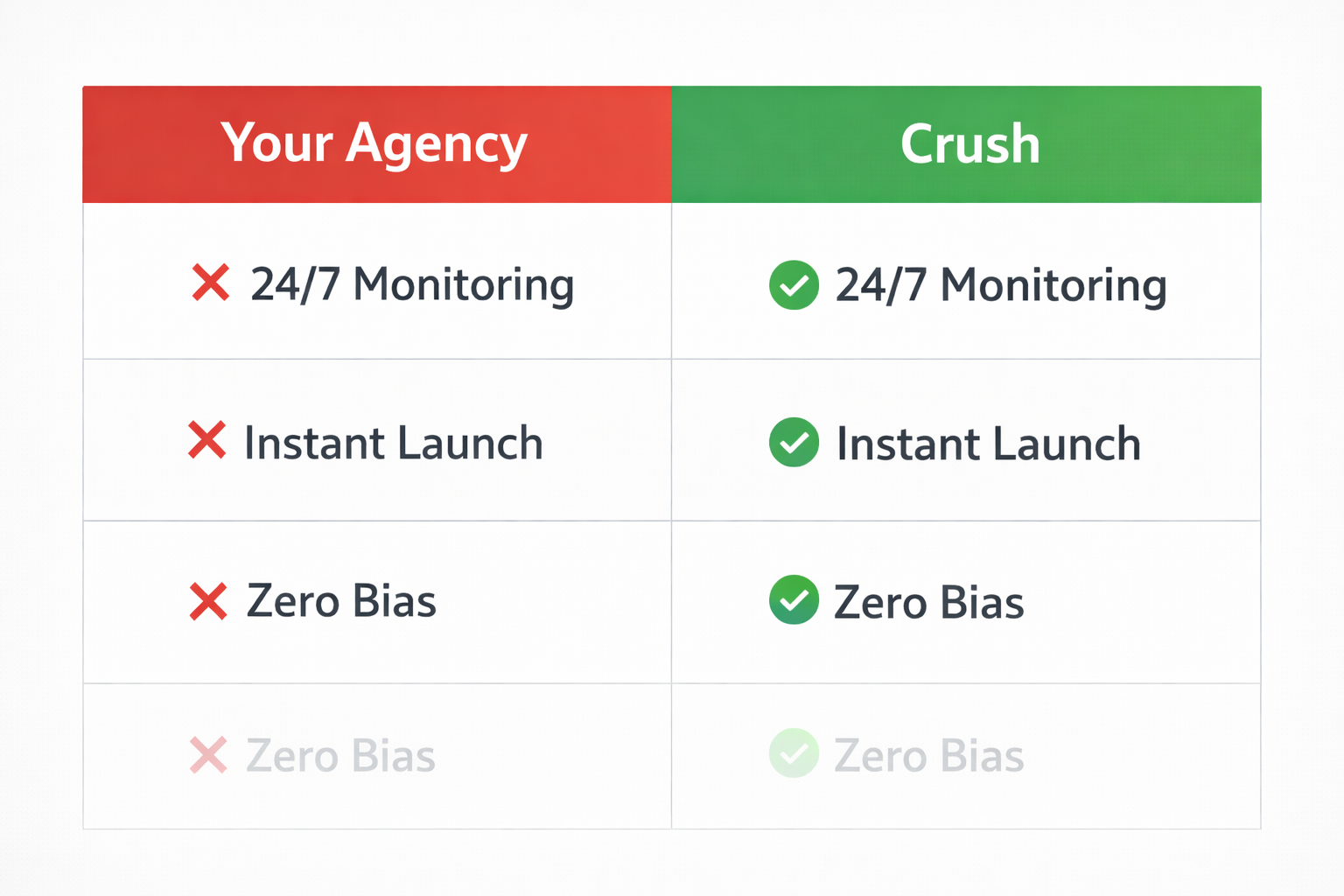
This is what Crush is. It is an "Agency in a Box." Let’s compare the two:
The Agency
Cost: $3k - $10k/month + % of spend.
Availability: 9-5, Mon-Fri (maybe).
Speed: Takes 3 days to launch a new ad.
Transparency: Hides behind monthly reports.
Incentive: Wants you to spend more (so their % goes up), even if performance drops.
Knowledge: Leaves with them when they quit.
Crush
Cost: A tiny fraction of an agency fee.
Availability: 24/7/365.
Speed: Launches ads in minutes.
Transparency: Real-time dashboard with clear metrics.
Incentive: Pure performance. No bias.
Knowledge: Stays with you forever.
Bringing it In-House (Without the Headache)
Many founders are scared to bring ads in-house because they think it’s too complicated. They think they need to hire a "Head of Growth" for $150k/year.
You don’t.
With Crush, a junior marketing manager, or even a smart intern, can run your ad account like a pro.
Because Crush handles the execution (the testing, the scaling, the pausing), your team member only needs to focus on the creative.
Imagine if you took that $5,000 agency retainer and spent it on:
A freelance video editor to make better ads.
A copywriter to write better angles.
More ad spend to test more ideas.
That is how you grow. You don't grow by paying someone to "monitor" your account. You grow by feeding the machine better creative.
The Communication Gap
Finally, let's talk about speed.
When you have an idea for a sale, say, a flash sale for the weekend, you have to email your agency.
"Hey guys, let's run a 20% off promo this weekend."
You send this on Wednesday. They reply on Thursday: "Sure, send us the assets."
You send the assets on Thursday afternoon. They reply on Friday morning: "Received. We will set it up."
By the time the ads go live, it's Friday afternoon. You missed the morning rush. And if there is a mistake? Good luck getting hold of them on Saturday.
With Crush, the communication gap is zero.
You have the idea. You open Crush. You upload the creative. You click launch.
Total time: 10 minutes.
The market moves fast. If your execution is slow, you lose.
The Great Unbundling
We are witnessing the "Great Unbundling" of the agency model.
Strategy and Creative are still high-value human skills. You should pay for those. Hire a consultant for strategy. Hire a studio for creative.
But Media Buying, the act of pushing buttons in Ads Manager, is a commodity.
Don't pay a premium for a commodity.
Fire the button-pushers. Hire the robots.
Stop paying for "Refresh." Start paying for Results.
Frequently Asked Questions
Common questions about this topic
1Why is the traditional media buying agency model considered broken?
2What is the conflict of interest with agencies charging a percentage of spend?
3Is it difficult to bring ad management in-house without a large team?
4What happens to my campaign data if I fire my ad agency?
Written by

Rokas Steponavičius
Founder, CEORokas is the Founder and CEO of TryCrush.ai, an ex-IBM professional turned entrepreneur focused on building AI-driven growth platforms. With a strong background in ecommerce, performance marketing, media buying, and artificial intelligence, Rokas specializes in creating scalable, data-led systems that drive measurable revenue. His mission is to help modern businesses leverage AI to optimize acquisition, conversions, and long-term profitability.
Stop Guessing.
Start Crushing.
AI Ad Manager trained by world-class media buyers to generate your creatives and optimize your ads 24/7.
Learn more
Related articles
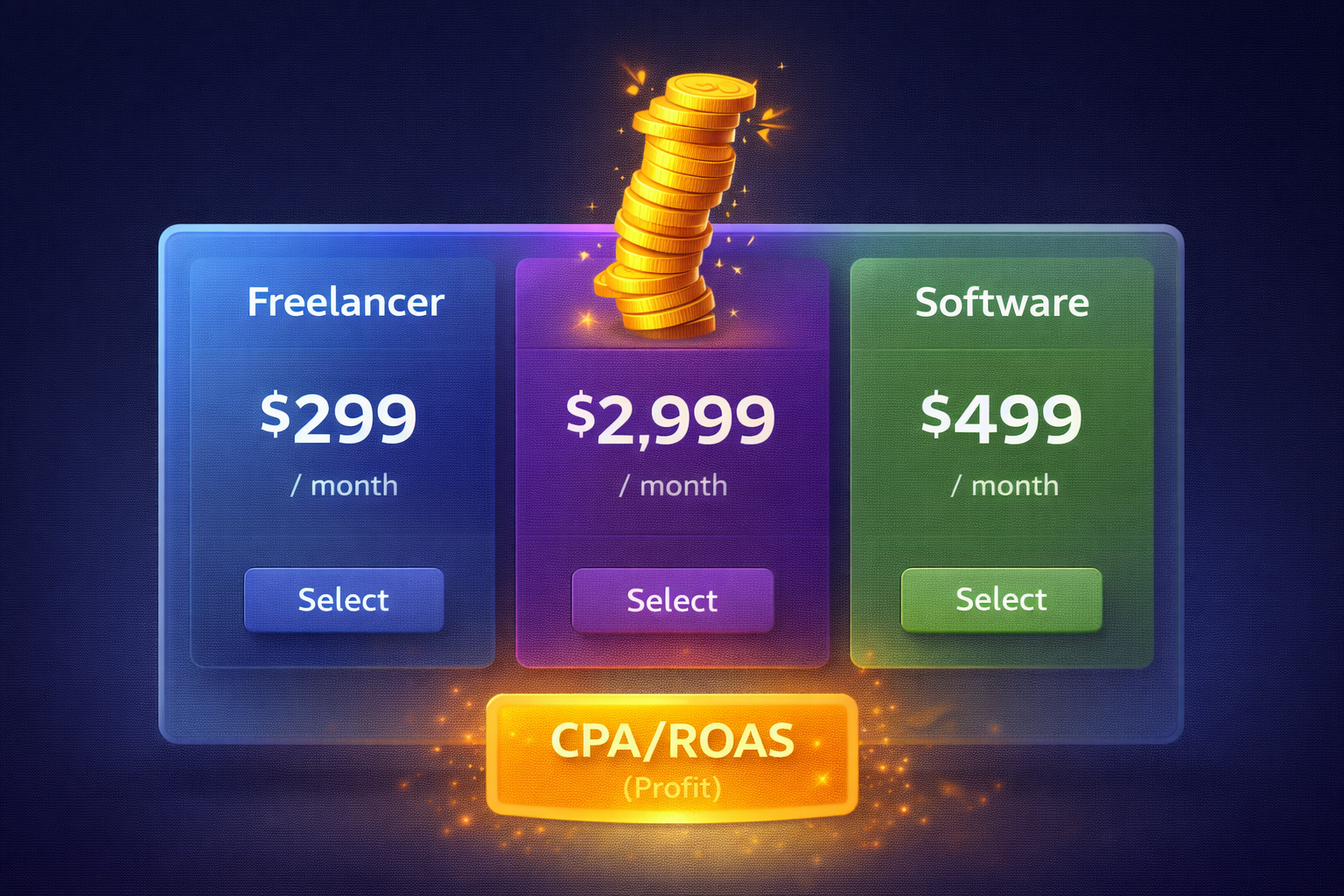
Facebook Ad Agency Pricing Guide: What Should You Pay?
Hiring an ad agency is confusing. We break down standard pricing models, from percentage of spend to performance kickers, and expose hidden fees. Find out exactly what you should pay based on your budget in this comprehensive guide.
Facebook Ads Management Services: The 2026 Buyer's Guide
Overwhelmed by agency options? We pull back the curtain on the ads management industry, exposing pricing traps and why "local" agencies might be a liability. Discover the hybrid automation model taking over in 2026.

What is a Burn Rate and How to Prevent It From Destroying Your Ad Budget
Are losing ad tests destroying your profit margins? Learn the true definition of advertising burn rate and discover how AI-driven micro-testing can act as a financial bodyguard for your ad spend.

The 24/7 Employee: Why Algorithms Beat Humans at Media Buying Every Time
Humans need sleep; algorithms don't. Discover how reliance on manual ad management causes profit leaks through latency and decision fatigue. Learn how the "24/7 Employee" optimizes spend globally, seizing opportunities human buyers miss.