Key Takeaways
- 1A successful targeted ad matches a high-converting offer with a precise hook that qualifies the audience immediately.
- 2Among top ecommerce ads, the average run time is 149 days, proving that winning campaigns run long-term.
- 3The most frequent calls to action for ecommerce ads are learn more, whatsapp message, and sign up.
- 4You can reverse engineer competitor success by checking an ad's active days and its duplicate count.
- 5Automated ad platforms can generate creative iterations from reference ads and scale winners without manual adjustments.
Discover exactly how top advertisers match creatives and hooks to specific audiences by analyzing real, long-running Facebook campaigns.
Targeted ads examples reveal exactly how top advertisers match specific creatives, hooks, and offers to hyper-specific audiences. Analyzing proven winners shows you which angles actually convert. Instead of guessing, you can study real, proven direct response ad examples with long run times to see what delivers consistent results.
What makes a targeted ad successful in 2026?
A successful targeted ad in 2026 matches a high-converting offer with a precise hook that speaks directly to a distinct audience segment. At Crush, our platform tracks exactly what works in the market by measuring how long an ad stays live. Advertisers do not spend money on losing campaigns for years.
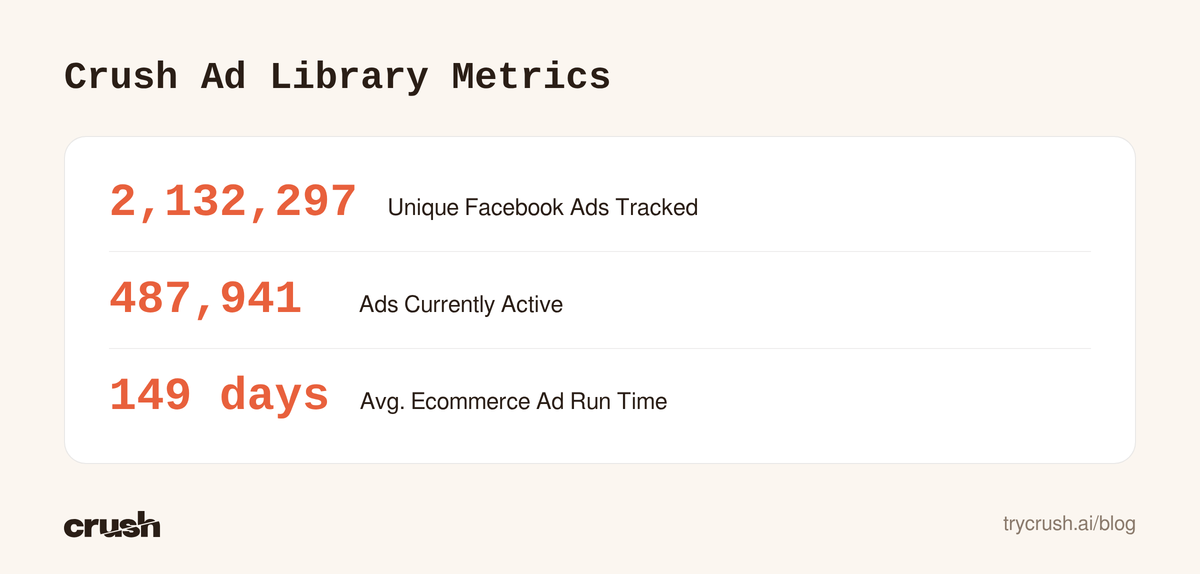
Our ad library tracks 2,132,297 unique Facebook ads (487,941 currently active). This massive scale allows us to see patterns that individual media buyers miss. Our system tracks competitors' Facebook ads via the Meta Ad Library and keeps history, including ads that were taken down. When you look at this data, you stop caring about opinions and only care about market feedback.
How does ad targeting actually work today?
Ad targeting today relies heavily on the creative itself rather than manual audience settings. The copy and the visual do the heavy lifting to find the right buyer. When you write highly specific copy, the algorithm learns who stops to read it and finds more people with similar behaviors.
This means your hook is your primary targeting tool. If your hook is broad, your audience is broad. If your hook is specific, your audience is specific.
The role of the algorithm
Facebook uses machine learning to match your ad with the people most likely to take your desired action. The algorithm needs data to make these matches, which it gets directly from user engagement. If you use a "shop now" button, the algorithm looks for users with a history of clicking that specific button and completing purchases.
Why broad targeting requires specific copy
Many media buyers now use broad targeting settings and rely entirely on the ad text to filter the audience. If you sell fishing gear, you do not need to manually target fishing interests. You just need to write copy that only a fisherman would care about. The words you choose dictate who pays attention and who ignores your message entirely.
What do the top ecommerce ads look like?
The top ecommerce ads rely heavily on direct calls to action and long lifespans to maximize return on ad spend. We pulled the specific numbers for this sector. Exactly 1,258 tracked ads match "ecommerce" (479 active right now). The most important metric to look at is the lifespan of these campaigns.
Among top "ecommerce" ads, average run time is 149 days.
That number is critical. Furthermore, 150 of the top 400 ran 90+ days, crossing the threshold of a proven winner.
The most effective calls to action
The data also reveals exactly how these brands are asking for the sale, relying on proven call to action examples. The button you choose dictates the friction the user experiences. Here is the breakdown of the most common CTA buttons on "ecommerce" ads:
| Call to Action Button | Frequency | Primary Function |
|---|---|---|
| Learn more | 25% | Drives traffic for consideration |
| Whatsapp message | 19% | Initiates direct conversation |
| Sign up | 9% | Captures leads and emails |
These buttons indicate a preference for starting conversations or providing more context before asking for a direct purchase.
Targeted Ads Examples: 5 Proven Campaigns Analyzed
We identified five specific targeted ads examples from our database that ran for over a thousand days. These are not hypothetical ideas. These are market-tested assets.
1. Justine's Jewels Mtl (Active in 2026)
This campaign is currently running right now in 2026. It has been active for an incredible 1702 days. The advertiser relaunched it 0 times, simply letting the original winner scale.
- The CTA: "shop now"
- The opening line: "Beautiful pink stone earrings in rose sterling Italian silver"
- Why it works: This is hyper-descriptive targeting. The ad does not try to be clever. It tells the buyer exactly what the product is immediately. If a user is looking for pink stone earrings, they stop scrolling. If they are not, they keep scrolling, which prevents wasted clicks.
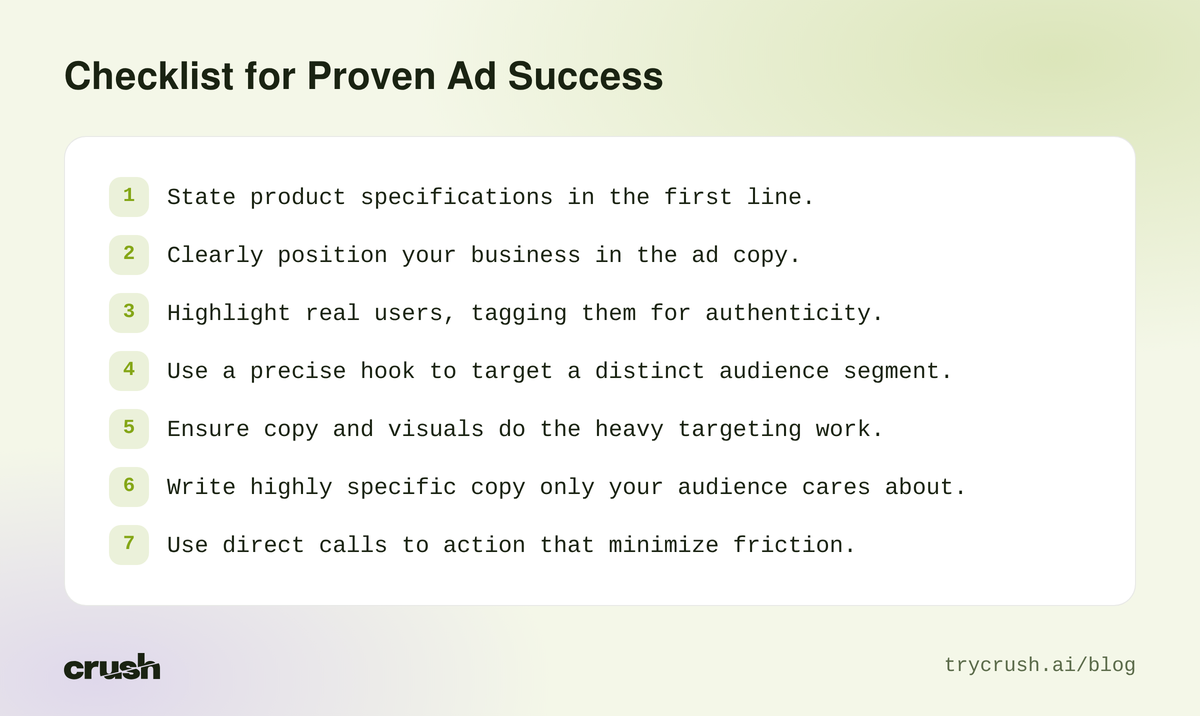
- What you should copy: State your product specifications in the first line. Do not hide the actual item behind a vague lifestyle hook.
2. Apex Wilderness Tackle (Active in 2026)
Another campaign currently running right now is from Apex Wilderness Tackle. It has been running for 1222 days with 0 relaunches.
- The CTA: "shop now"
- The opening line: "Apex Wilderness Tackle is an E-Commerce store that supplies outdoor recreation Goods & Equipment."
- Why it works: This acts as a clear positioning statement. It qualifies the audience immediately by stating exactly who they serve. Outdoor recreation enthusiasts know instantly that this ad is for them, and the straightforward approach builds trust.
- What you should copy: Treat your ad copy like a digital storefront sign. Tell them exactly what your business does before asking them to buy anything.
3. Chikigo (Historical Winner)
This ad ran for 1506 days with 0 relaunches.
- The CTA: "book travel"
- The opening line: "Spotted @__auliafitri__ in our polo knit - earthy blue 💙🤍 Grab yours now at our ecommerce store! 😃"
- Why it works: This ad leverages social proof by calling out a specific user. It targets people who value community validation. The language is highly conversational and blends right into the organic social media feed.
- What you should copy: Highlight real users wearing or using your product. Tagging a user adds immediate authenticity to the claim.
4. It Expert Service's (Historical Winner)
Running for a total of 1292 days with 0 relaunches, this ad utilized a direct messaging approach.
- The CTA: "message page"
- The opening line: "𝘼𝙙𝙫𝙚𝙧𝙩𝙞𝙨𝙚 𝙮𝙤𝙪𝙧 𝘽𝙪𝙨𝙞𝙣𝙚𝙨𝙨 𝙖𝙣𝙙 𝙞𝙣𝙘𝙧𝙚𝙖𝙨𝙚 𝙩𝙝𝙚 𝙨𝙖𝙡𝙚𝙨 👉DO YOU KNOW THE SECRET TO SUCCESSFUL ONLINE BUSINESSES? ✔️YES, Facebook"
- Why it works: It targets business owners directly. It asks a specific question and answers it immediately, positioning the service as the solution. The text formatting stands out in the feed and forces the reader to pause.
- What you should copy: Call out your target audience's primary goal in the first five words. If your audience wants to increase sales, state that goal clearly.
5. Crystal Brown (Historical Winner)
This ad ran for 1217 days with 0 relaunches.
- The CTA: "learn more"
- The opening line: "♂️La imp🔞tencia ya no es un problema!♂️"
- Why it works: It addresses a specific, highly sensitive pain point head-on. The highly targeted copy speaks strictly to the demographic experiencing that exact issue. It uses a "learn more" CTA because the topic requires education and trust-building before a sale can happen.
- What you should copy: Do not shy away from the core problem your product solves. State the problem clearly to capture the exact people who need your solution.
How to analyze competitor ads for your own campaigns?
You analyze competitor ads by tracking their active days in market and noting how often the advertiser re-launches the same creative. A high duplicate count is a strong signal of a winning ad. When an advertiser launches the exact same creative multiple times, it means that creative is profitable.
You can automate this research using our comprehensive ad library guide and free tool. The free public ad library lives at trycrush.ai/ad-library. Our ads library contains millions of Facebook ads across niches. It provides the exact longevity data you need to make informed decisions.
The competitor analysis checklist
Before you write a single line of copy, you should evaluate what is already working. Use this checklist:
- Check the total days running. Ignore anything under 30 days. Prioritize ads running over 90 days.
- Look at the exact CTA button being used. Match your CTA to the intent level of their proven ad.
- Identify the hook in the first sentence. Determine if they are targeting by product specification, pain point, or social proof.
- Check the duplicate counts. Determine how many times an advertiser re-launched the same creative.
How can you deploy successful ads automatically?
You can deploy successful ads automatically by using software that handles the entire lifecycle for you. Building the creative is only the first step. Media buying requires constant monitoring. You must launch, test, scale, and pause based on real-time data.
Our product Crush fully automatically runs Facebook ads. It creates campaigns, scales winners, and kills losers without manual intervention. You do not need to manually adjust budgets at midnight. The platform handles the operational heavy lifting.
Steps to automate your ad buying
To remove the manual work from your advertising, follow these steps:
- Connect your ad account to the platform.
- Select a proven reference ad from the library.
- Let the system generate ad-creative iterations automatically.
- Allow the AI to scale the winners and kill the losers.
Scaling what works
When you find a winning angle, you must create variations to prevent ad fatigue. Our platform can generate ad-creative iterations from a winning reference ad. This allows you to scale what works based on actual data, rather than starting from scratch every time.
If you are ready to stop guessing and start running proven campaigns, you can check out our trial options. Paid plans start with a trial. See our current tiers at trycrush.ai/pricing.
How we got this data
The numbers in this article come from Crush’s ad library: 2,132,297 unique Facebook ads tracked via the Meta Ad Library, 487,941 of them active at the time of writing. Ad examples reference real advertisers and their public ads. Data queried on 2026-09-23. Third-party product facts are attributed inline to their sources.
Frequently Asked Questions
Common questions about this topic
1What is an example of a highly targeted ad?
2How do you find competitor ad examples?
3Why does ad longevity matter?
4What is the best call to action for ecommerce ads?
5Can I automate my Facebook ad campaigns?
Written by

Ignas Obulaitis
Head of ITIgnas Obulaitis is the head of IT for TryCrush.ai, leading the platform’s engineering and AI innovation. With a strong background in product-driven development, Ignas has built and scaled complex systems across fintech, SaaS, and AI-focused companies. An ex-IBM engineer and former Head of Development at Fluensure, Ignas combines deep technical expertise with a sharp product mindset to turn ambitious ideas into scalable, production-ready technology.
Stop Guessing.
Start Crushing.
AI Ad Manager trained by world-class media buyers to generate your creatives and optimize your ads 24/7.
Learn more
Continue Reading
Proven Facebook Group Description Examples for 2026
A high-converting Facebook group description treats its text like proven ad copy. Learn what works by analyzing active campaigns running for hundreds of days.
Ads Photography Data For 2026: Proven Metrics And Examples
Stop guessing with your Facebook campaigns. We analyzed millions of ads to uncover the exact metrics, copy, and structural strategies driving photography bookings in 2026.
Reminder Advertising Examples: 5 Ads That Ran Over 500 Days
Explore real reminder advertising examples backed by proprietary 2026 data. Learn how top brands keep winning ads running for hundreds of days to maximize return on ad spend.