Key Takeaways
- 1An ad lib in media buying is a modular copy template where specific variables are swapped to test new angles.
- 2Our data shows that 165 of the top 400 ecommerce ads ran for over 90 days, setting the benchmark for a proven winner.
- 3The learn more button is the highest converting call to action for ecommerce at 23%, beating shop now.
- 4Testing only one copy variable at a time ensures you gather accurate data on what drives conversions.
- 5Using automated platforms allows you to generate variations from winning reference ads instantly.
An ad lib in media buying is a modular copy framework. Learn how to swap variables to test new angles and find winning campaigns without writing from scratch.
What exactly are ad libs?
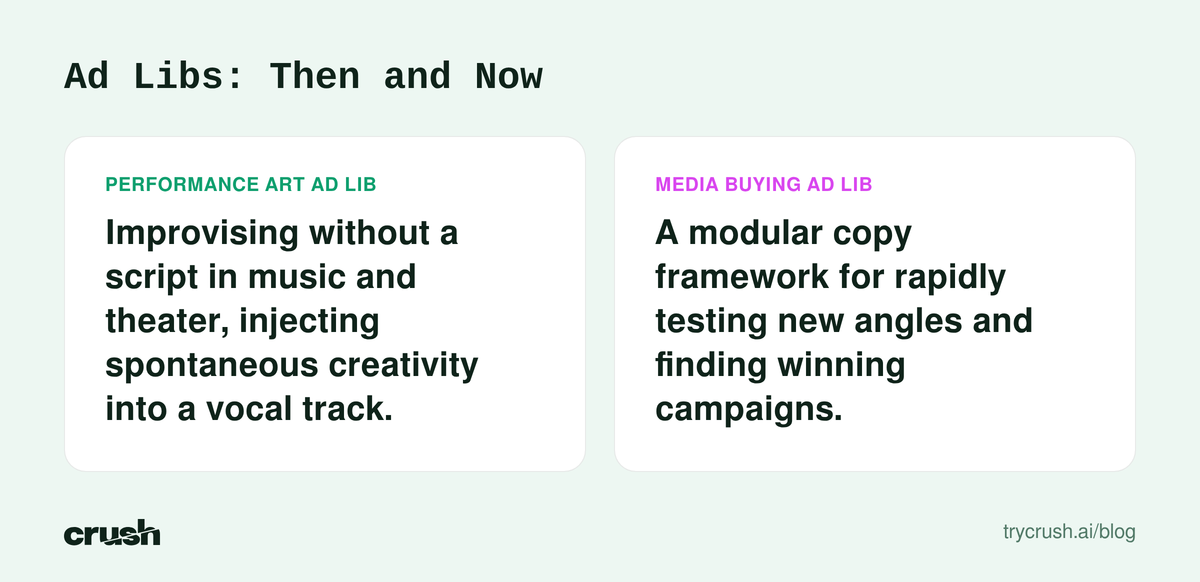
An ad lib comes from the Latin phrase ad libitum, meaning at one's pleasure. In music and theater, it means improvising without a script. In Facebook media buying, an ad lib is a modular copy framework where you swap out specific variables to rapidly test new angles and find winning campaigns.
If you search online for what are ad libs, you will mostly find definitions related to performance art. Musicians use them to inject spontaneous creativity into a vocal track. Actors use them to handle forgotten lines. However, media buyers in 2026 use the concept very differently.
We do not improvise randomly when spending budget. Instead, we use structured fill-in-the-blank frameworks. This approach allows advertisers to test multiple variations of an ad while keeping the core psychological structure intact. You maintain control over the variables while giving the ad platform enough options to optimize delivery.
How do ad libs work in Facebook advertising?
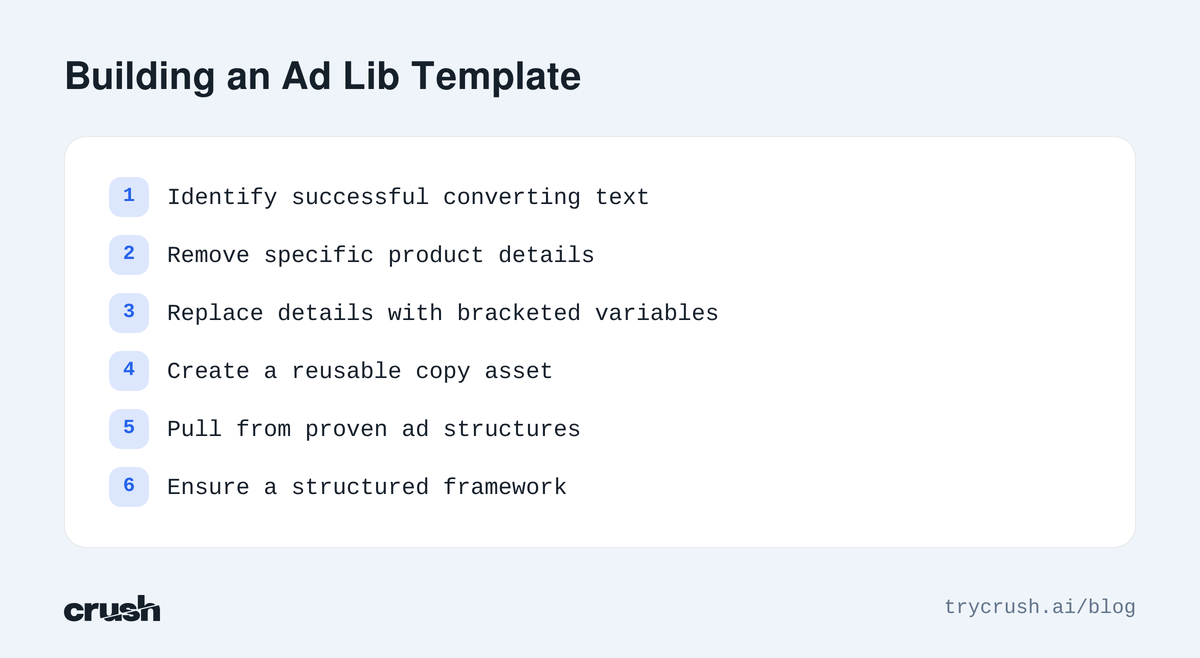
In the context of Facebook media buying, an ad lib is a foundational copy template. You identify a piece of text that successfully converts users, strip out the specific product details, and replace them with bracketed variables.
This creates a reusable asset. Instead of staring at a blank screen and guessing what to write, you pull from a library of proven structures. Say your target CPA is $50. You do not want to risk that budget on unproven creative text. You want a formula that has already demonstrated an ability to hold attention.
A classic example looks like this: Attention [Audience], are you struggling with [Pain Point]? Discover how our [Product] delivers [Benefit] in under [Timeframe].
The shift from rigid scripts to dynamic variables
Media buying has evolved past writing a single perfect ad. The current Meta algorithm requires volume and variation. Facebook's dynamic creative features expect you to provide multiple headlines, primary texts, and descriptions.
When you feed the algorithm ad lib variations, you are essentially letting machine learning match the right variable to the right user. One user might click when the pain point is emphasized. Another might convert when the timeframe is the focal point. Structured variations make this matchmaking process highly efficient.
Why modular copy beats random testing
Randomly writing completely different ads makes it impossible to isolate variables. If ad A beats ad B, you need to know why. If ad A and ad B share the exact same ad lib structure but feature a different hook, you learn exactly which hook resonates.
This structured testing prevents wasted spend and gives you clear directives for future campaigns. You learn if your audience cares more about speed, price, or quality, and you apply that knowledge across your entire account.
What does our data show about winning ecommerce formulas?
To understand what makes a successful copy framework, we rely on hard data rather than intuition. Currently, our product Crush maintains an ad library that tracks competitor campaigns across the ecosystem.
Crush's ad library tracks 1,860,083 unique Facebook ads (445,242 currently active). This massive dataset allows us to see exactly which ad lib structures survive the initial learning phase and scale profitably. When we narrow our focus, 918 tracked ads match "ecommerce" (363 active right now).
Among top "ecommerce" ads, average run time is 145 days; 165 of the top 400 ran 90+ days (the "proven winner" threshold).
Ads do not run for 145 days unless they are highly profitable. Advertisers kill losers quickly. Therefore, any ad crossing that 90-day threshold contains a copy structure worth analyzing and turning into a modular template.
Call to action preferences in successful ads
Your call to action is the final variable in any copy framework. By analyzing proven call to action examples, our data reveals a clear hierarchy in what actions users are willing to take. The most common CTA buttons on "ecommerce" ads: learn more (23%), whatsapp message (16%), shop now (12%).
It is notable that "learn more" outperforms "shop now" significantly. Hard sells often create friction. A softer call to action fits perfectly into an educational ad lib structure, guiding the user to a landing page where the actual conversion happens.
How long do winning ad formulas actually last?
To see these frameworks in action, we isolated some of the longest-running ecommerce ads in our system. These campaigns showcase specific opening lines that hook the reader immediately.
| Advertiser | Days Active | CTA Button | Opening Line (The Hook) |
|---|---|---|---|
| Justine's Jewels Mtl | 1675 | shop now | Beautiful pink stone earrings in rose sterling Italian silver |
| Chikigo | 1506 | book travel | Spotted @__auliafitri__ in our polo knit - earthy blue 🤍 Grab yours now at our ecommerce store! 😃 |
| It Expert Service's | 1292 | message page | 𝘼𝙙𝙫𝙚𝙧𝙩𝙞𝙨𝙚 𝙮𝙤𝙪𝙧 𝘽𝙪𝙨𝙞𝙣𝙚𝙨𝙨 𝙖𝙣𝙙 𝙞𝙣𝙘𝙧𝙚𝙖𝙨𝙚 𝙩𝙝𝙚 𝙨𝙖𝙡𝙚𝙨 👉DO YOU KNOW THE SECRET TO SUCCESSFUL ONLINE BUSINESSES? ✔️YES, Facebook |
| Crystal Brown | 1217 | learn more | ♂️La imp🔞tencia ya no es un problema!♂️ |
| Apex Wilderness Tackle | 1195 | shop now | Apex Wilderness Tackle is an E-Commerce store that supplies outdoor recreation Goods & Equipment. |
These Facebook advertising examples prove that you do not need overly complex copy. Apex Wilderness Tackle is running 1195 days, relaunched 0x, CTA "shop now", opening line: "Apex Wilderness Tackle is an E-Commerce store that supplies outdoor recreation Goods & Equipment." It is a direct, factual statement.
Similarly, Chikigo ran 1506 days, relaunched 0x, CTA "book travel", opening line: "Spotted @__auliafitri__ in our polo knit - earthy blue 🤍 Grab yours now at our ecommerce store! 😃" This is a classic social proof ad lib: Spotted [influencer] in our [product]. You can steal this exact structure for any apparel brand.
How do you build an ad lib template for your campaigns?
Creating your own modular copy system requires a disciplined creative strategy. You cannot just guess what variables matter. You must build your templates based on historical performance.
- Audit your historical winners: Pull the top five ads from your account over the last year. Look for the common threads in how you introduced the product.
- Extract the core framework: Strip away the specific product names, prices, and features. Leave only the psychological triggers and transitional phrases.
- Define your variables: Decide what you are testing. Are you testing the audience callout, the primary benefit, or the urgency mechanism? Pick one variable per test.
- Draft multiple iterations: Write five different versions of the chosen variable. Keep the rest of the template exactly the same.
- Launch using dynamic placement: Feed these variations into Facebook as primary text options on a single ad creative. Let the algorithm find the best combination.
Extracting frameworks from competitors
If you have a new ad account with no historical data, you must look outward. Knowing how to search the Facebook ad library allows you to view active ads, but the native platform lacks historical longevity data. You need to know how many days an ad has been running to verify if the formula actually works.
This is where our free public ad library comes into play. It tracks competitors' Facebook ads and keeps history, including ads that were taken down. It provides duplicate counts, showing how many times an advertiser re-launched the same creative, which is a massive signal of a winning ad.
What are the biggest mistakes when writing ad libs?
While modular copy is powerful, poor execution ruins the data. Media buyers often break the testing methodology by rushing the process or combining too many elements.
- Testing multiple variables simultaneously: If you change the hook, the pain point, and the offer in the same test, you learn nothing. Stick to one moving part at a time.
- Ignoring the visual pairing: Your copy framework must align with the video or image. If your text promises a fast solution but the video is a slow unboxing, the disconnect will hurt conversion rates.
- Cutting the test too early: The algorithm needs time to match your text variations with the right users. Killing an ad before it exits the learning phase prevents you from finding a true winner.
- Forcing unnatural grammar: When you swap variables, read the sentence out loud. If plugging a new product feature into the template sounds robotic, rewrite the transitional phrase.
Overcomplicating the offer
A common error is trying to cram too many value propositions into a single fill-in-the-blank space. An ad lib should be punchy. Look at the Justine's Jewels Mtl example: running 1675 days, relaunched 0x, CTA "shop now", opening line: "Beautiful pink stone earrings in rose sterling Italian silver".
It works because it is highly specific and visually descriptive. It expert service's ran 1292 days, relaunched 0x, CTA "message page", opening line: "𝘼𝙙𝙫𝙚𝙧𝙩𝙞𝙨𝙚 𝙮𝙤𝙪𝙧 𝘽𝙪𝙨𝙞𝙣𝙚𝙨𝙨 𝙖𝙣𝙙 𝙞𝙣𝙘𝙧𝙚𝙖𝙨𝙚 𝙩𝙝𝙚 𝙨𝙖𝙡𝙚𝙨 👉DO YOU KNOW THE SECRET TO SUCCESSFUL ONLINE BUSINESSES? ✔️YES, Facebook". This uses a direct question framework. Keep your variables focused on a single, clear idea.
How can AI automate your ad variations?
Managing hundreds of copy variations manually in spreadsheets is tedious. It leads to upload errors and messy naming conventions in Ads Manager. Modern media buying requires automation to scale effectively.
Crush is an AI creative studio and Facebook-ads platform built specifically for this workflow. It fully automatically runs Facebook ads, meaning it creates campaigns, scales winners, and kills losers without manual intervention. When you find a framework that hits your CPA target, the platform takes over.
Crucially, Crush can generate ad-creative iterations from a winning reference ad. It identifies the structure of your best performer and automatically builds the next round of ad libs for you to test. If you are ready to stop guessing and start scaling based on hard data, review our pricing plans to see how automated creative testing fits your budget.
How we got this data
The numbers in this article come from Crush’s ad library: 1,860,083 unique Facebook ads tracked via the Meta Ad Library, 445,242 of them active at the time of writing. Ad examples reference real advertisers and their public ads. Data queried on 2026-08-27. Third-party product facts are attributed inline to their sources.
Frequently Asked Questions
Common questions about this topic
1What does ad lib mean in advertising?
2How do I write ad lib copy?
3Why do Facebook ads need text variations?
4What is a good run time for an ecommerce ad?
5What call to action button converts best?
Written by

Ignas Obulaitis
Head of ITIgnas Obulaitis is the head of IT for TryCrush.ai, leading the platform’s engineering and AI innovation. With a strong background in product-driven development, Ignas has built and scaled complex systems across fintech, SaaS, and AI-focused companies. An ex-IBM engineer and former Head of Development at Fluensure, Ignas combines deep technical expertise with a sharp product mindset to turn ambitious ideas into scalable, production-ready technology.
Stop Guessing.
Start Crushing.
AI Ad Manager trained by world-class media buyers to generate your creatives and optimize your ads 24/7.
Learn more
Continue Reading
Fragrance Advertising Data: Ad Metrics and 2026 Benchmarks
Forget high-budget aesthetic commercials. Success in fragrance advertising requires direct-response mechanics, rigorous testing, and data-backed media buying strategies.
AdSpy 2026 Review: Features, Pricing & Adspyder Alternatives
A detailed 2026 review of AdSpy features, pricing, and limitations. We explore how it compares to other adspyder alternatives and our execution platform, Crush.
US Dropshippers Data: Ad Insights & Supplier Guide 2026
Discover how to leverage US based dropshipping suppliers to reduce ad costs, speed up fulfillment, and build high-converting Facebook ad creatives.