Michael Anderson, PhD.
Michael Anderson, PhD. Facebook ad: “I prescribed gabapentin for 14 years until a patient asked…”

Ran for 8 days, from August 11 to August 19, 2026, the last day Crush saw it.
Run by Michael Anderson, PhD. on Facebook. Crush is not the advertiser and does not verify its claims. See this ad in Meta's Ad Library(opens in a new tab)
Want an ad like this for your product?
Crush makes new ad images for your product from this ad: your logo, your product photo, your offer.
Trials from $19.95 USD, then $79.95 USD a month. Cancel anytime.
About this ad
- Meta Ad Library ID
- 1716805919435324
- Platforms
- Facebook, Instagram, Audience Network, Messenger and Threads
- Relaunches
- 1
- EU reach
- 19
Ad text
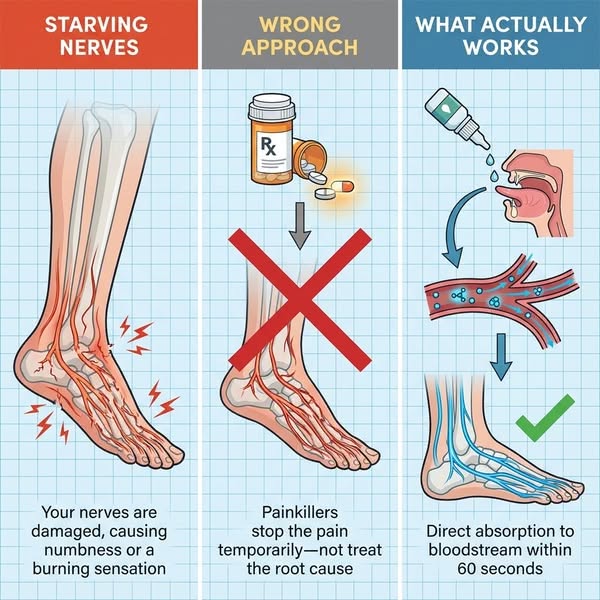
I was a conventional neurologist for 14 years. In that time I prescribed gabapentin to hundreds of patients with peripheral neuropathy. I believed in it. I was trained on it. It was the standard of care and I delivered the standard of care without much question. Then one of my patients asked me something I couldn't answer. He said: "Dr. Anderson, I've been on gabapentin for three years. The burning is quieter but it's still there. My hands are getting worse. Am I actually getting better, or are you just making it easier for me to ignore that I'm getting worse?" I told him we were managing the condition effectively. He looked at me for a moment and then he said: "That's not what I asked." I drove home that night and I couldn't get it out of my head. Because he was right. I hadn't answered his question. I'd given him the answer the protocol gave me, which wasn't the same thing. I went back to my office that weekend and I started reading. Not the current literature — I knew that. I went back further. Much further. And what I found changed everything I thought I knew about nerve disease. My name is Dr. Michael Anderson. I practiced conventional neurology for 14 years before transitioning to functional medicine. I've now spent another nine years studying what the body actually needs to maintain and repair nerve tissue — not how to manage the symptoms when it can't. Here's what I found in those old papers. In the late 1800s — before pharmaceutical companies existed, before gabapentin, before any of the drugs we now call standard of care — physicians documented something they called subacute combined degeneration of the spinal cord. Patients with progressive nerve damage. Burning in the feet. Numbness spreading upward. Weakness. Coordination problems. They didn't have an MRI. They didn't have nerve conduction studies. But they understood the pattern, and they found the cause. B vitamin deficiency. Specifically the compound we now call B12. They documented this meticulously. They showed that patients with these nerve symptoms had depleted B12. They showed that replacing it — through injection, because the oral route was already understood to be unreliable — reversed the nerve damage in patients who were caught early enough. They published these findings. They established the mechanism. This was over 130 years ago. Then pharmaceutical companies developed gabapentin. Pregabalin. Duloxetine. Drugs that quieted the nerve pain signal without addressing what was causing the nerve to misfire in the first place. These drugs could be patented. They could be manufactured at scale. They generated revenue. They became the standard of care. And the B vitamin research — still valid, still documented, still sitting in the same libraries — got buried under the weight of everything that came after it. I'm not telling you this to make you angry at your doctor. Your doctor was trained the same way I was trained. The curriculum moved on. The old papers stayed in the archive. But I spent a weekend reading those papers, and I understood something I should have understood 14 years earlier. Here is what the old physicians understood that the modern standard of care has forgotten. Your nerves are not static structures. They're living tissue under constant stress, constantly repairing themselves. The myelin sheath — the protective coating around every nerve fiber — breaks down continuously and gets rebuilt continuously. Every day. The repair process is always running. But it can only run with specific fuel. Think of it this way. Your nerve is like an electrical wire. The rubber coating around the wire is the myelin. Electricity flows through the wire cleanly when the coating is intact. When the coating cracks or thins, the electricity leaks. It goes to the wrong places. It fires when there's nothing to carry. That's the burning, the tingling, the numbness — the wire misfiring because the insulation broke down. Your body repairs that coating constantly. But only with two specific compounds. Methylcobalamin and methylfolate. The active forms of B12 and B9. Not the versions at the pharmacy. Those are synthetic forms that have to be converted before any nerve cell can use them — a conversion that becomes increasingly unreliable after the age of 50. The active forms go directly to work. No conversion. Straight to the nerve cell. Straight into the energy cycle that powers myelin repair. When both are present, the repair process runs. The myelin gets rebuilt. The wire stays intact. When they're depleted — and in most adults over 55, eating a modern processed diet, they are functionally depleted in ways the standard blood panel doesn't detect — the repair process stalls. The myelin thins. The nerve misfires. And no amount of gabapentin addresses that. Not one milligram. The old physicians knew this. They documented it. They treated it. We forgot. Now here's why taking B12 supplements didn't help — because I know that's what you tried. And I know it didn't work. And I know that's part of why you've stopped believing B vitamins have anything to do with this. B12 in pill form requires a protein called intrinsic factor to be absorbed. Your stomach produces it. Its only job is to grab B12 the moment it arrives and escort it through the gut wall into the bloodstream. Without intrinsic factor, B12 passes through. It never gets absorbed. Intrinsic factor production declines significantly with age. By the time most people are in their late 50s or 60s, they're producing a fraction of what they need. The pill goes in. The bloodwork shows a number in range. The nerve cells get almost nothing. The old physicians understood this too. It's why they used injections — not because they preferred needles, but because they had already established that the oral route was unreliable. They bypassed the gut entirely and delivered B12 directly to the bloodstream. The results were documented. The nerve damage reversed in patients who received early treatment. Today the practical equivalent of injection — without the needle — is sublingual delivery. The tissue under your tongue sits directly over a dense network of blood vessels, separated from the surface by a membrane barely thicker than a piece of paper. When methylcobalamin and methylfolate dissolve there, they cross that membrane and enter the bloodstream in minutes. No stomach. No intrinsic factor. No gut required. That's not a new discovery. That's a delivery method established because the oral route was already known to fail. When I started applying this in my functional medicine practice — recommending sublingual methylcobalamin and methylfolate to patients who'd been through the conventional neuropathy protocol and were still losing ground — the pattern I observed was consistent. Patients who'd been on gabapentin for years, whose symptoms had been described as managed, started reporting changes within the first few weeks. Not elimination — a shift. The burning changed character before it reduced. The tingling became less sharp. Sensation began returning in patches. This is what the old physicians documented as the early signs of myelin repair. The nerve isn't suddenly fixed — it's beginning to rebuild, at approximately one millimeter per day, which is the measured biological rate of peripheral nerve regeneration. Damage that built over years takes months to fully address. But the direction changes. Several patients reduced their gabapentin dose with their prescribing doctor's agreement — not because I told them to, but because the pain the medication was suppressing started reducing on its own. The nerve was misfiring less because it was getting what it needed to repair the source of the misfiring. None of them were cured overnight. Nerve repair doesn't work that way and never has. But the trajectory changed. For patients who'd been told their condition was being managed — who understood by now that managed meant slowly worsening with the alarm quieted — the trajectory changing was not a small thing. If you've been told your neuropathy is idiopathic — that there's no identified cause and the goal is symptom management — I want you to understand what idiopathic actually means. It means we didn't find the cause. It doesn't mean there is no cause. It means the standard workup, which does not include checking whether your nerve cells have the specific compounds they need to run the repair process, didn't find it. The cause the old physicians documented 130 years ago — B vitamin deficiency at the cellular level, a depleted repair process, myelin thinning because the fuel to maintain it isn't arriving — is not part of the standard idiopathic neuropathy workup. It's not checked. It's not addressed. It wasn't part of what I was trained to look for when I was writing gabapentin prescriptions. I was asking the wrong questions for 14 years. I'm asking the right ones now. The product I recommend is Nuvel. Sublingual methylcobalamin and methylfolate — both active forms, dissolved under the tongue, bypassing the absorption problem the old physicians identified over a century ago. Edit: I've had many people ask for the specific product — https://trynuvel.com/products/b-essence-complex Morning. Empty stomach. Thirty seconds under the tongue before swallowing. No coffee for an hour. Give it twelve weeks. Nerve repair happens at one millimeter per day — patience is not optional, it's biology. The first signal is a change in the character of your symptoms, not an elimination of them. That change is the repair beginning. The old physicians found this answer before any of us were born. We just stopped looking for it.
Where the ad sends people
trynuvel.com
I prescribed gabapentin for 14 years until a patient asked me a question I couldn't honestly answer.
Doctors documented the real cause of nerve pain 130 years ago. Then pharmaceutical companies arrived. We forgot.
Learn more: trynuvel.com(opens in a new tab)