
Inactive· since May 12, 2026
- 51
- days it ran
- 2
- relaunches
Ad copy
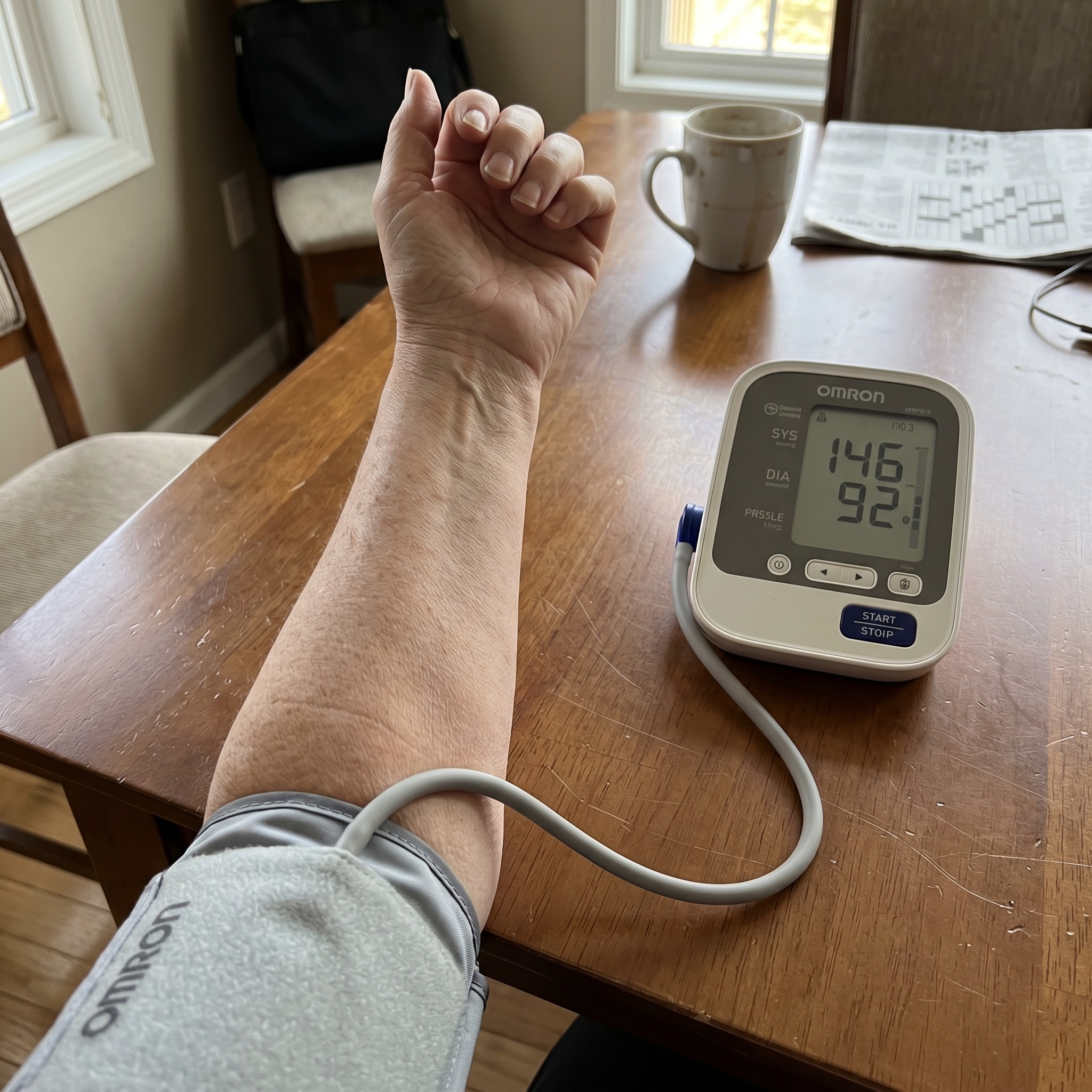
My dad's blood pressure cuff broke on a Tuesday morning at 7:15 AM and I was the one who heard it happen. I was in the kitchen making coffee. He was in the den, in the same spot he'd been sitting in every morning since my mom died 4 years ago, the same brown leather recliner with the same plaid blanket folded over the arm and the same little side table with the lamp my mom had bought at a yard sale in 1994. He was doing what he did every morning. Rolling the cuff onto his arm. Pressing the start button on the little machine that sat next to the lamp. Waiting for it to inflate. Except this time it didn't. I heard a small wheezing sound, the kind of sound a balloon makes when it has a slow leak. Then I heard him say, in a voice that was quieter than I think he meant it to be, "Karleen. It's not working." I want to tell you what happened over the next 4 hours. Because what happened in the parking lot of a CVS on Tunnel Road in Asheville, North Carolina at 11:42 AM that Tuesday morning, and what happened in my own kitchen at 4:30 that same afternoon when my father said something to me he had not said in 40 years, is the reason I'm sitting here at my own kitchen table writing this for any other daughter who is watching her father get smaller. My name is Karleen. I'm 57 years old. I live with my dad in the house I grew up in, on a curving street in west Asheville with a sycamore tree in the front yard that drops its leaves in big yellow handfuls every November. I moved back in with him in February of 2021, 8 months after my mom died, after he called me on a Sunday afternoon and asked me, in the gentlest voice you've ever heard a 79 year old man use, if I could come stay for a couple weeks because the house felt too big. I was supposed to stay 2 weeks. I have stayed 4 years and 3 months. I'm divorced. No kids. I work remotely doing medical billing for a clinic in Hendersonville, which is the kind of job nobody dreams about as a child but the kind that lets you take care of an aging father without quitting your career. My ex husband and I sold our house in 2019 in a way that gave me enough cash to be okay for a long time if I was careful. I have been careful. My father is named Wendell. Everybody calls him Wendy, which he hates and tolerates the way men of his generation tolerate everything. He's 83 now. He was an English teacher at Asheville High for 36 years. He coached the chess club. He directed the spring play 17 years in a row. He has a library in our house that takes up an entire wall of the den, three bookshelves deep in some places, and he can still tell you which shelf any book is on if you give him 10 seconds to think about it. He has high blood pressure. He has had high blood pressure since 1987. He was 45 years old. His doctor put him on a medication called atenolol and he took it every single morning for 35 years. In 2022, after my mom passed, his numbers started climbing in a way they never had before. His doctor added a second pill. Then a third. By the time I'm telling you about, the Tuesday morning the cuff broke, he was on three medications and his pressure was still running higher than anyone wanted it to. He took his readings every morning. Religiously. He wrote them down on a yellow legal pad next to the recliner. He brought the pad to every doctor appointment. The doctor would look at the numbers and adjust the medication and send him home and the next month it would be the same conversation. I had watched my dad for 4 years be a man who measured his health by a number on a screen and who never moved that number no matter what he did. So when the cuff stopped working that Tuesday morning, what I heard in his voice wasn't frustration about a broken machine. It was something deeper. It was the voice of a man who had been clinging to a routine that wasn't working and had just lost the routine. I came into the den. He was sitting in the chair holding the cuff in his hand. The little Velcro strap was open. The tube that connected the cuff to the machine had a small split in it, right where it joined. I could see daylight through the rubber. He looked up at me. "Honey, this thing has been with me for 11 years." I sat down on the ottoman across from him. I held my coffee cup with both hands. "Dad. We can get a new one today. We'll just go to CVS." He nodded. He didn't say anything for a long time. He turned the cuff over in his hands. Then he said, "Karleen. I don't want to go to CVS." I waited. "I'm tired." That was all he said. Three words. He didn't elaborate. He didn't need to. I had been living with this man for 4 years and I knew, the way you know the weather is about to change, that those three words were a door opening to a much bigger conversation. I drank my coffee. I waited. He went on. "I have been measuring this thing every single morning for 11 years. I have been on three pills for 18 months. The number on the screen is still too high. The doctor still tells me, with a kind face, that we will keep adjusting. I am 83 years old. I have been doing what I am told to do for 35 years and the number is still wrong." He looked down at the cuff in his hands. "I am tired of measuring. I am tired of writing it down. I am tired of being a number." I want you to understand. My dad doesn't talk like this. My dad is the kind of man who, when his wife of 51 years died, told me he was "doing fine" for 8 weeks before he called me at 2 PM on a Sunday and admitted that the house was too big. He doesn't say what he's feeling. He almost never has. Hearing him say "I am tired" out loud, in his own voice, in the chair my mother used to read in next to him, was like watching a wall come down. I put my coffee cup on the side table. I got up. I sat down on the floor in front of his chair the way I used to sit when I was 8 years old and he read to me out of his big leather Robert Frost. I said, "Dad. We are going to CVS. We are going to get you a new cuff. And then we are going to figure out what is actually going on. Together." He nodded. He reached out. He put his hand on the top of my head the way he used to when I was little. We sat like that for a minute and a half. Then we got in my car and we drove to CVS. The CVS on Tunnel Road in Asheville is in a strip mall next to a Publix and a Cook Out. I parked in a spot by the front door because my dad's hip has been bothering him for the last 18 months and the walk from the back of the lot is too much for him on bad days. We went in. We walked past the seasonal aisle, which still had Easter candy out in mid May, and we found the home health section. There were three full shelves of blood pressure monitors. I want to tell you what those three shelves looked like to me. There was an Omron at $79.99. A different Omron at $59.99. A Withings that connected to your phone for $99.99. There was a Walgreens brand for $39.99. There was an arm cuff and a wrist cuff and a thing that looked like a smart watch. There were 22 different products. I counted. My dad stood there. He looked at the shelves. He didn't reach for any of them. A woman came down the aisle behind us. She was probably my age. Maybe a little older. Mid to late 50s. She was pushing a small cart with a few items in it. She had grey hair pulled back in a low ponytail and she was wearing a denim jacket over a dark green dress. She stopped at the same shelves. She picked up an Omron. Looked at the box. Put it back. Picked up the Withings. Looked at the box. Put it back. I caught her eye. The way you catch the eye of another mother in a grocery store when both of your kids are having meltdowns at the same time. A small flicker of recognition. She gave me a small smile. She said, quietly, "These shelves are awful, aren't they." I laughed, a small laugh, just enough. She looked at my dad. He was still staring at the shelves and not picking anything up. She looked back at me. She said, "Is it for him, or for somebody back home?" I said, "It's for him. His old one broke this morning." She nodded slowly. Then she said something I have repeated to myself probably 100 times since. She said, "I bought my mom one of these cuffs every 11 months for 6 years. I have had this exact conversation with myself in this exact aisle. The cuffs aren't the problem. The numbers aren't the problem. The problem is what you do after you read the number. Can I tell you what changed for us?" My dad turned and looked at her. She introduced herself. Her name was Renata. She was a librarian at the Pack Memorial public library in downtown Asheville. Her mother was 81 and lived with her and her husband. Her mother had been on three blood pressure medications for years and her numbers had still been a problem. Renata told us about her cousin in Charlotte who had married a man whose family was originally from Kerala in southern India. Renata had gone to Charlotte for Easter dinner two years before. Her cousin's mother in law, an 84 year old woman who walked everywhere and did her own grocery shopping and gardened in the backyard, had been the most alive 84 year old Renata had ever met. Renata had asked, the way you ask, what her secret was. The mother in law had told her about a fruit they grew back home. A small green fruit called amla. Indian gooseberry. They had been eating it for thousands of years. It was, the mother in law said, "the fruit you give your husband when he won't take care of himself." Renata had laughed. Then she had asked more questions. Then she had spent the next three months reading about it. She had started giving her mother a standardized extract from a brand she had eventually settled on. She told us, standing right there in the home health aisle of a CVS, that 11 months in, her mother's numbers had come down enough that her mother's doctor had reduced one of her medications. She said, "I am not telling you this fruit is a miracle. I am telling you that for the first time in 6 years, the conversation in our house was not about the number. It was about how my mother felt. And how she felt was different. Better. More like herself." My dad was looking at her with the same focused attention he used to give a student who was about to crack open a poem in class. He said, "What's it called?" She wrote it down for us. She had a pen in her purse. She wrote "Alevia Amla" on the back of an old grocery receipt and handed it to my dad. My dad folded the receipt. Put it in the breast pocket of his shirt. Tapped it twice. Renata smiled at me. She said, "I hope it helps. Even if it doesn't, I hope something else does." She picked up an Omron from the shelf, the $59.99 one, and handed it to my dad. "This is the one we use. It's reliable. The cuff lasts longer than the more expensive ones, in our experience." We bought it. We drove home. My dad put the new cuff on the side table next to his chair and he laid down on the couch and he slept for an hour and a half, which my dad does not do. I sat at my own kitchen table that afternoon and I did what Renata had done. I read. I read for 4 hours. Here is what I came to understand about amla and about high blood pressure and about why my father, after 35 years of doing exactly what he was told to do, was still a man whose numbers were too high. When you have high blood pressure, what's actually happening inside you is more complicated than the numbers suggest. The number on the screen is the result. The cause is a much longer story. It's a story about the inside of your blood vessels, the layer called the endothelium, which is supposed to be smooth and flexible and responsive. Over decades, that layer can become stiff, inflamed, less able to dilate the way it should. It's a story about oxidative stress, the cellular wear and tear that builds up year after year. It's a story about chronic low grade inflammation that doesn't show up on standard bloodwork but quietly damages the tissues that regulate pressure. Most blood pressure medications are aimed at the outcome. They lower the number. They don't necessarily address the underlying biology of why the number was high in the first place. That's why people end up on two medications, then three, then four. The number is a signal, not the source. Amla is interesting because the research on it suggests it works on the source. It's been associated with support for healthy endothelial function, which is the responsiveness of those vessel walls. It's a powerful antioxidant, partly because of its naturally high vitamin C content but also because of compounds called polyphenols and tannins that show up in good standardized extracts. It's been linked to reductions in inflammatory markers like hs-CRP. It's been studied for its effects on healthy lipid profiles, which matters because cholesterol and blood pressure are part of the same vascular story. In plain English: it doesn't push the number down by force. It works on the cellular environment that determines what the number wants to be. That made sense to me in a way 35 years of pharmacology had not made sense. I want to be careful here. I am not telling you my father stopped taking his medications. He did not stop taking his medications. He did not stop taking them at week 4, or week 8, or week 12. He took them every single morning the way he had taken them for 35 years. What I am telling you is what happened after he started taking 2 capsules of Alevia Amla every morning with his coffee, in addition to the medications he was already on. He started on a Friday in late May. I had ordered the bottle the night Renata talked to us. It came on Thursday. He took his first 2 capsules on Friday morning. Week 1, nothing changed. The numbers on the new cuff were the same as the numbers on the old cuff. Week 3, he slept through the night. I want to be precise about that. My father had been waking up at 2:30 AM almost every night for the last 4 years to use the bathroom and then would lie awake until 5 or 6. The night between Thursday May 30 and Friday May 31, he slept from 10:15 PM until 6:45 AM. He came down to the kitchen the next morning and he said, "Karleen. Something is different. I don't know what it is." Week 5, his hands. I had not realized, until they stopped, how often my father had been rubbing his hands together while he was reading. It was a small movement. Almost a tic. He had done it for years. I think it was a circulation thing. His hands were always cold, even in summer. One Saturday in mid June I was sitting across from him in the den and he was reading and I noticed his hands were just resting on the book. Not moving. Not rubbing. Warm. Week 8, the morning routine. He still measured his blood pressure every morning. He still wrote it down on the yellow legal pad. The number had come down. Not dramatically. Not in a way that would make a doctor pick up a phone. But consistently. The 7 day rolling average he had been tracking for years had dropped by a meaningful amount. Enough that I noticed it on the page when I glanced at it one morning while making coffee. Week 12, the doctor's appointment. I drove him to it. We had a 2:00 PM appointment with Dr. Halliday, who has been my father's primary care doctor for 22 years. She is a careful, warm, smart woman who takes her time. She measured his pressure in the office. She looked at the legal pad. She looked at my dad over her reading glasses. She said, "Wendy. Your numbers are the best they've been since 2021. What have you been doing?" My father told her. The whole thing. The cuff. The CVS. Renata. The amla. The 12 weeks. Dr. Halliday listened carefully. She took notes. She said, "I want you to keep taking everything you're taking. Don't change anything. Let's see where you are in 3 months." 3 months later, in October, she reduced one of his medications. I want to tell you the conversation I had with my dad that afternoon, the day the cuff broke, that I haven't told you about yet. The one I started telling you about at the beginning of this story. We came home from CVS at around 12:30. He took his nap. I sat at my kitchen table and I read until about 4:00. At 4:30, he came into the kitchen. He had the receipt with Renata's handwriting in his hand. He sat down across from me. He said, "Karleen. I want to say something I should have said a long time ago." I waited. He said, "Thank you for staying with me. I know you came here to be with your mother in the last weeks. I know you stayed because of me. I know I've never said it. I want you to know I know." I started crying. I couldn't help it. He reached across the table. Took my hand. He said, "I don't want to be a number anymore. I want to be your father again. The man who reads to you. I want to figure out how to do that. I'm 83 years old and I'd like to stop disappearing." I got up. I went around the table. I hugged him. That was 14 months ago. We are still here. We are still in this house. He still measures his pressure every morning. The number is still better than it was. But the most important thing that has changed in the last 14 months isn't the number. It's the man. He started reading out loud again, the way he used to in the spring play. He drove himself to the library two weeks ago, which he had not done since 2022. He has color in his face I had not seen in 4 years. He laughed at a joke at dinner last Sunday so hard that his eyes watered. If you've been watching your father become a number, I see you. If you've been buying blood pressure cuffs every 11 months, I see you. If your dad has said "I am tired" to you in a way that meant something deeper than sleep, I see you. If you have stayed in a house that was too big, with a parent who needed you, longer than you thought you would, I see you. There is a fruit on the other side of the world. It's called amla. The brand my father takes, that we settled on after 4 hours of reading at this kitchen table, is called Alevia. The product is Alevia Amla. It's made in the United States. It's 2 capsules a day with breakfast. They have a 90 day money back guarantee, which means if your father takes it for 3 months and nothing changes, you mail the bottle back and they refund you the money. There's no paperwork. There's no fight. I want to be clear about something. I am not telling you to take your father off his medications. I am not telling you anything about anyone's medications. I am telling you that there is a quiet, well researched fruit that has been used in India for 3,000 years that has a way of supporting the body's own systems in a way that medication does not, and that, alongside what your father is already doing, it might be the thing that changes the conversation in your house from being about the number to being about the man. P.S. Renata and I are friends now. I emailed her in July through the library's contact form. I told her my dad's numbers had come down and I told her about the conversation we had at the kitchen table that afternoon. She wrote back the next day. She told me her own mother was now on a single blood pressure medication, down from three. We have had coffee at the Battery Park Book Exchange three times since then. She is a wonderful person. Some encounters at a CVS turn into something that matters. P.P.S. The 90 day guarantee is the only reason my father agreed to try it at all. He is the kind of man who will read a journal article before he takes an aspirin. The fact that there was a real, no questions asked refund policy is what got him over the threshold. If you're talking to a parent who is stubborn the way my father is stubborn, the guarantee is the part to lead with. It costs them nothing to try. P.P.P.S. The new blood pressure cuff is still working. 14 months later. Renata was right about that too. P.P.P.P.S. My dad read the manuscript of this post before I finished writing it. He read it sitting in his recliner with the same lamp my mother bought at the yard sale in 1994 turned on next to him. He took off his reading glasses when he was done. He said, "Karleen. Send it. There's some other 57 year old daughter out there in a CVS aisle right now. Tell her about Renata." So I'm telling you. 👉 https://alevia.com/amla/33
Like this ad? Make it yours.
Crush rebuilds this exact creative around your product — your brand, your colors, your offer — in about a minute.