 rizvimdpsychoeducation
rizvimdpsychoeducation Facebook ad: “Did you know?”
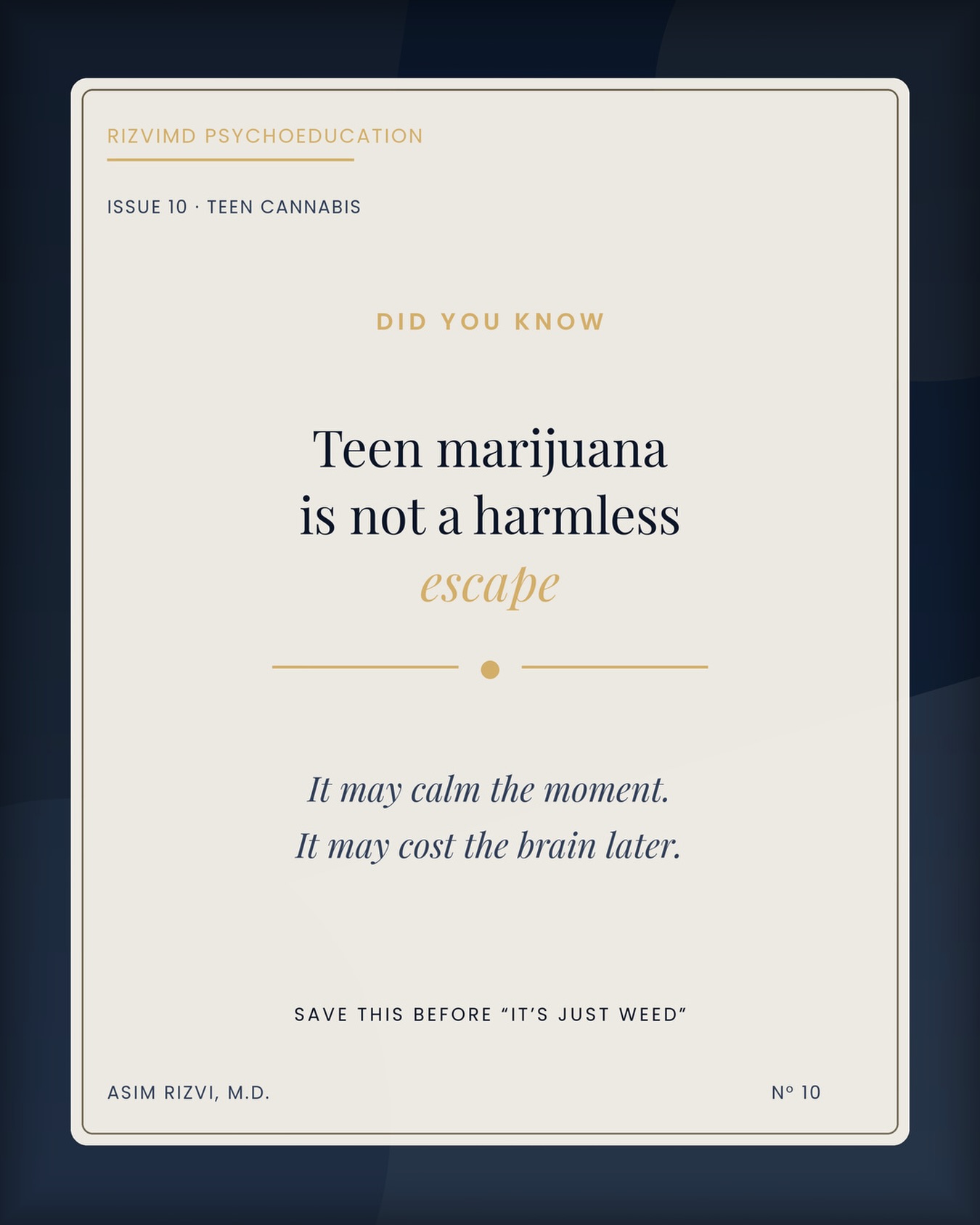
Ran for 6 days, from May 23 to May 28, 2026, the last day Crush saw it.
Run by rizvimdpsychoeducation on Instagram. Crush is not the advertiser and does not verify its claims. See this ad in Meta's Ad Library(opens in a new tab)
Want an ad like this for your product?
Crush makes new ad images for your product from this ad: your logo, your product photo, your offer.
Trials from $19.95 USD, then $79.95 USD a month. Cancel anytime.
About this ad
- Meta Ad Library ID
- 969006009381943
- Platforms
- Relaunches
- 0
- Niche
- Parenting & Kids
Ad text
Did you know? Teen marijuana is rarely just about marijuana. Sometimes it is a shortcut to sleep. Sometimes it is social armor. Sometimes it is untreated anxiety. Sometimes it is loneliness with a vape pen. That does not make it harmless. It makes it clinically important. For some teens, cannabis is not a phase. It is an accelerant. It can worsen motivation, attention, anxiety, panic, paranoia, school decline, and in vulnerable teens, psychosis risk. If marijuana were truly “the answer,” you probably would not be sitting in my clinic. That is not judgment. That is the clinical clue. By the time a teen is using cannabis to sleep, calm down, focus, escape, socialize, or stop feeling, marijuana is no longer just “recreation.” It has become a treatment plan. Just not a very good one. And if you are coming in for ADHD treatment while regularly using cannabis, we have to be honest: We are not starting with stimulants. We are starting with the question underneath the symptom: Is this ADHD? Is this anxiety? Is this depression? Is this trauma? Is this insomnia? Is cannabis impairing attention, motivation, memory, and executive function? Because stimulants do not clarify a brain that is being fogged, numbed, or destabilized by high-potency THC. First we treat the function of the cannabis. Then we treat the diagnosis with clarity. Marijuana may be the symptom they chose. The real diagnosis may be what they were trying not to feel. Sources: Arseneault et al., BMJ 2002; Andréasson et al., Lancet 1987; Marconi et al., Schizophrenia Bulletin 2016; Di Forti et al., Lancet Psychiatry 2019; Morin et al., American Journal of Psychiatry 2019. Follow @rizvimdpsychoeducation for one evidence-based psychiatric insight every day. #teencannabis #childpsychiatry #psychosisawareness #teenmentalhealth #parentingtips