James Whitaker
James Whitaker Facebook ad: “The Bible's Most Mysterious Figure”
Ran for 27 days, from June 6 to July 3, 2026, the last day Crush saw it.
Run by James Whitaker on Facebook. Crush is not the advertiser and does not verify its claims. See this ad in Meta's Ad Library(opens in a new tab)
Want an ad like this for your product?
Crush makes new ad images for your product from this ad: your logo, your product photo, your offer.
Trials from $19.95 USD, then $79.95 USD a month. Cancel anytime.
About this ad
- Meta Ad Library ID
- 992965713487979
- Platforms
- Facebook, Instagram, Audience Network, Messenger and Threads
- Relaunches
- 0
Ad text
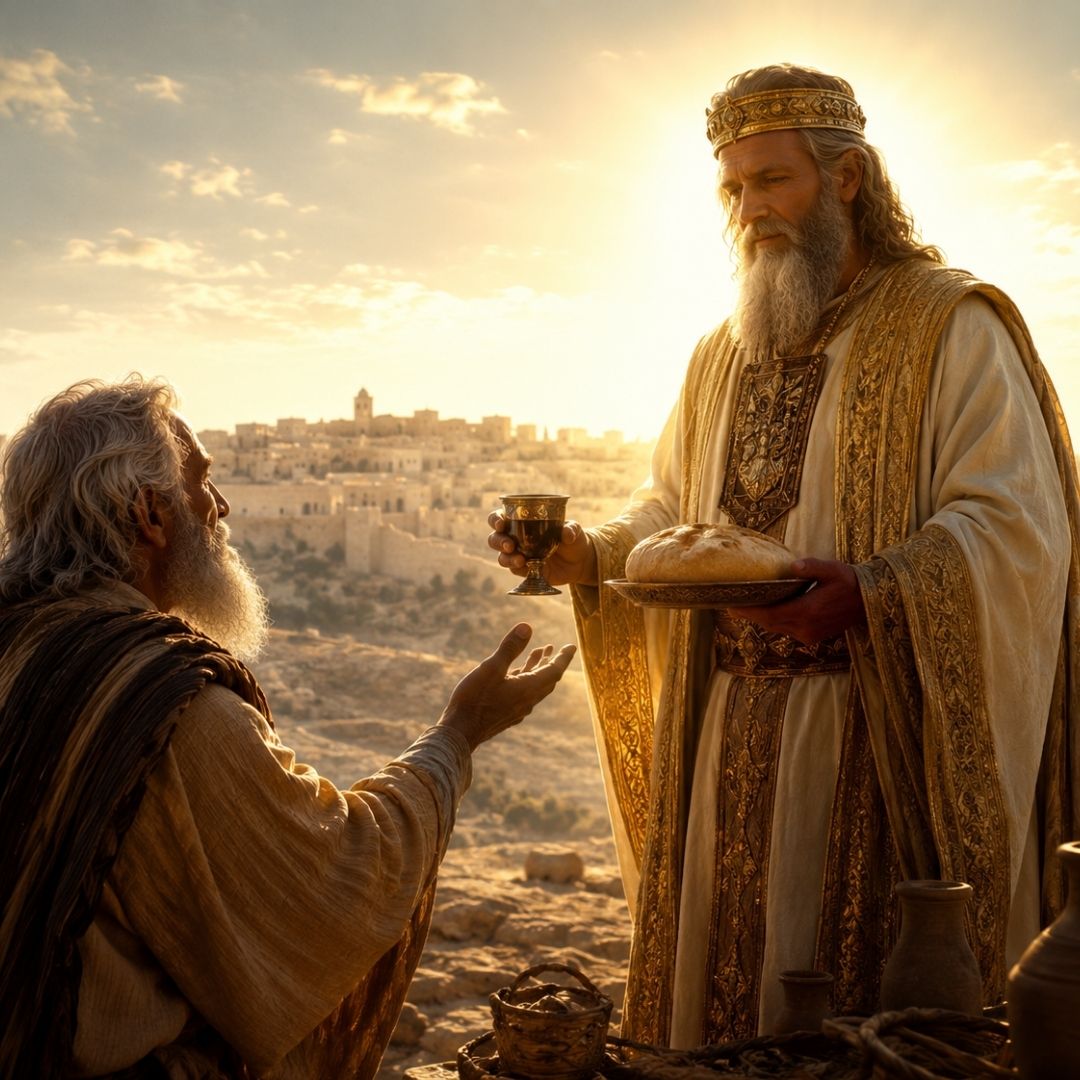
The bread and wine of the Last Supper do not appear for the first time in the New Testament. They appear two thousand years earlier, in the hands of a priest over whom death had no power, in a city called Salem — in the region that would become Jerusalem. Most Christians who have taken communion hundreds of times have never heard this. And when they do, something changes. Because bread and wine in the hands of an eternal priest, two thousand years before Christ, in the region that would become the center of it all — that is not coincidence. That is a pattern. And when you learn to see that pattern, the Bible you thought you knew becomes something you have never actually encountered before. The name of that priest is Melchizedek. And what the Bible conceals about him in three verses — and reveals across five chapters — will change the way you read every page of the New Testament. --- Genesis 14. Abraham has just won a battle. He rescued his nephew Lot, defeated four kings, and is on his way home. And then, out of nowhere, a man appears. No genealogy. No father mentioned. No mother. No birth date. No death date. He simply appears in the text as if he had always existed. His name is Melchizedek. King of Salem. Priest of God Most High. He brings bread and wine. He blesses Abraham. And Abraham — the father of all promises, the man with whom God made covenant, the patriarch of the entire faith — gives Melchizedek a tithe of everything. Everything. The greatest man of faith in the Old Testament bows before a priest who has no recorded origin and no recorded end. And then Melchizedek disappears from the text. No explanation. No farewell. No further mention for nearly a thousand years. --- A thousand years later, David writes Psalm 110. And in the middle of a prophecy about the Messiah, a line appears that nobody could quite explain: *"You are a priest forever, in the order of Melchizedek."* Priest forever. Not in the order of Aaron. Not in the order of Levi. In the order of Melchizedek. The rabbis read this and went silent. Because that line created an enormous problem. The priesthood belonged to Levi. The law was clear. Only the tribe of Levi could serve as priests. Only the family of Aaron could approach the altar. It was the law. It was non-negotiable. It was the foundation of Israel's entire religious system. And then David prophesies that the Messiah would be a priest according to a completely different order. An older order. An order that predated the law. An order that existed before Levi was born, before Aaron was born, before Moses received any instruction at Sinai. Priest forever, in the order of Melchizedek. The rabbis read it. And went silent. --- Now here is the part most Christians have never been told. When Jesus appears in the New Testament, the religious leaders had a specific problem with Him that went beyond theology. Jesus was from the tribe of Judah. Not Levi. Not Aaron. Judah. That meant that under Mosaic law, Jesus had absolutely no right to be a priest. None. The law was explicit. The tribe of Judah produced kings. The tribe of Levi produced priests. The roles were separated by divine law and could never be mixed. A man from Judah presenting himself as a priest was not just being bold. He was breaking the law. And the Pharisees knew it. And they used it. But the author of Hebrews knew something they deliberately ignored. That there was a priestly order older than Levi. That there was a priest who appeared in the text before the law existed, before Israel existed, before any tribe existed. That this priest had no recorded beginning and no recorded end. And that God had promised, through David, that the Messiah would be a priest according to that order. Not the order the law created. The order that existed before the law. --- Think about what that means. The Levitical priesthood had a limitation that nobody liked to say out loud. The priests died. Every high priest who entered the Holy of Holies once a year with the blood of the sacrifice eventually died. And a new priest took over. And that priest died too. And so it continued, generation after generation, sacrifice after sacrifice, blood after blood. Never ending. Never fully resolving. The book of Hebrews says something that sends a chill down your spine when you understand the weight of it: The Levitical priests were prevented by death from continuing in office. Prevented by death. The entire system was limited by one word: mortality. And then the author of Hebrews presents Jesus as high priest in the order of Melchizedek. A priest with no recorded origin and no recorded end in the text. A priest who lives forever to intercede. And the argument of Hebrews is not poetic. It is legal. It is precise. It is devastating. If perfection could have been attained through the Levitical priesthood, why would another priest need to arise in the order of Melchizedek? Why would God prophesy, through David, a priest of a different order, if the system that already existed was sufficient? The very existence of that prophecy was an admission that the Levitical system was temporary. It was a shadow. It was a rehearsal. It was a blueprint for something still to come. And what was still to come was a priest who does not die. Who does not need to be replaced. Who did not enter the Holy of Holies once a year with the blood of animals, but entered once, for all time, with His own blood. Once. For all time. Does not need to be repeated. Cannot be improved upon. Has no successor because He has no end. --- Did Abraham understand all of this? Not fully. He could not have. But when he gave Melchizedek a tithe of everything, he was doing something the text records with precise intention. Hebrews explains that Levi, who had not yet been born, was in Abraham's body at that moment. Levi paid tithes to Melchizedek through Abraham. The Levitical priesthood, which did not yet exist, was already acknowledging the superiority of an older order. The system that would come later was already bowing before what came first. The law, which would be given centuries later, was already yielding to a reality that preceded the law itself. This is not creative interpretation. This is the literal argument of Hebrews 7. And it is an argument that dismantles, with surgical precision, every system of religious merit ever built. Because if perfection did not come through the law, and if the very priesthood that administered the law was already bowing before a superior order, then salvation never depended on the system men constructed. It depended on the priest who existed before any system was constructed. --- I remember the first time I truly understood this. It was not in seminary. It was not in a sermon series. It was when someone finally gave me the context that made Genesis 14 speak to Psalm 110 speak to Hebrews 7. Before that, I read Melchizedek as a strange Old Testament story. A mysterious character who appeared and vanished. After that, I never read Hebrews the same way again. Because when you understand who Melchizedek is, you understand why the priesthood of Jesus is not an adaptation of Jewish law. It is the reality of which Jewish law was only a shadow. Jesus did not come to reform the system. He came to fulfill what the system was pointing to. And what it was pointing to had a name, recorded in Genesis, before Israel existed, before the law existed, before any temple, before any altar: Melchizedek. King of righteousness. King of peace. Priest of God Most High. --- This is the kind of connection that changes everything. Not because it is new information. It is all in the Bible you already have at home. But because nobody ever showed you where the threads connect. Genesis speaks to Psalms. Psalms speaks to Hebrews. Hebrews speaks to the Gospel of John. And suddenly the Bible you thought you knew becomes something you are encountering for the very first time. Did you know that Salem — the city of Melchizedek — is the root of the word Jerusalem? That the King of Salem, the King of Peace, ruled the region that would centuries later become the center of it all — where Solomon would build the temple, where the Levitical priests would offer sacrifices, where Jesus would be crucified? The same region. Melchizedek ruled the area traditionally associated with the place where the cross would be raised. The eternal priest marked that territory before any law, before any temple, before any animal sacrifice. And when Jesus died in that region, He was not choosing a random location. He was fulfilling a story that had begun there, in that same place, with a priest-king who brought bread and wine and blessed the father of the faith. Bread and wine. The same words from Genesis 14. The same reality as the Lord's Supper. The same eternal priest — first in shadow, then in fulfillment. It was in the Bible you already have. It was there the whole time. --- This level of understanding does not require a seminary degree. It does not require years of Greek and Hebrew. It requires context. It requires connection. It requires someone who has already done the work of connecting the dots and handed it to you in a form you can walk through on your own. That is why the Advanced Theology Course was created. 84 modules. From Genesis to Revelation. Not a surface-level introduction. Not a five-minute devotional. Real theology. Real depth. The kind of study that helps you understand why the author of Hebrews spent five chapters explaining a man who appears in three verses. With an internationally recognized certificate. No subscription. You pay once and it is yours. Because transformative knowledge should not be locked behind a monthly fee you cancel when your budget gets tight. --- Students who completed the module on the priesthood of Melchizedek said things I cannot forget. A woman with twenty-two years of faith said: *"I have read Hebrews cover to cover at least fifteen times. And only now do I understand the central argument of the book. The priesthood of Jesus is not an upgraded version of the Levitical priesthood. It is a completely different order. Older. Superior. And I had never seen that."* A man who has led a small group for eight years said: *"I taught about Jesus as high priest many times. But I was teaching the shadow without understanding what the shadow was pointing to. I cannot teach it the old way anymore."* Another student said simply: *"Genesis 14 will never be the same for me. That man with bread and wine who appears out of nowhere — I now understand who he prefigured. And it changed the way I see the Lord's Supper forever."* They did not need a seminary to get there. They needed the right context. The right connections. The depth that makes the Bible open itself from the inside out. --- The Bible is not confusing because it is unclear. It is confusing because we are reading it without the foundation that made it obvious to the people who first received it. The first readers of Hebrews understood the Levitical priesthood. They knew the Day of Atonement. They knew what it meant for a high priest to enter the Holy of Holies. They had Psalm 110 memorized. When the author of Hebrews wrote "a priest in the order of Melchizedek," they felt the full weight of that. We read the same phrase and move on to the next verse. Not because our faith is weak. Not because we do not care. But because nobody ever gave us the roots that make that phrase land with the weight it was always meant to carry. The Advanced Theology Course gives you those roots back. 84 modules built to take you from the surface to the depth. From the text to the context. From information to transformation. Internationally recognized certificate. No subscription. One payment and it is yours. --- You have read about Melchizedek before. Maybe you passed him in Genesis and found him strange. Maybe you read Hebrews and sensed you were missing something important but could not name what it was. That feeling that you were missing something — you were. Not because the Bible was hiding it. But because the context that made everything visible never reached you. It can reach you now. A priest who appears without origin and disappears without end. Who brings bread and wine before any law exists. Who receives the tithe of the father of the faith. Who ruled the region that centuries later would become the center of the greatest event in human history. God did not place Melchizedek in three verses by accident. He never does anything by accident. And what He placed there has been waiting for you to understand it. Click below and start today. --- Advanced Theology Course — 84 modules. International certificate. No subscription fees.
Where the ad sends people
christiantheologicalinstitute.online
The Bible's Most Mysterious Figure
Start understanding. Not just reading.
Learn more: christiantheologicalinstitute.online(opens in a new tab)