Dr. James Kreischer - Trichologist, MD
Dr. James Kreischer - Trichologist, MD Facebook ad: “Dermatologist Discovers Peptide Breakthrough That…”
Ran for 16 days, from June 1 to June 17, 2026, the last day Crush saw it.
Run by Dr. James Kreischer - Trichologist, MD on Facebook. Crush is not the advertiser and does not verify its claims. See this ad in Meta's Ad Library(opens in a new tab)
Want an ad like this for your product?
Crush makes new ad images for your product from this ad: your logo, your product photo, your offer.
Trials from $19.95 USD, then $79.95 USD a month. Cancel anytime.
About this ad
- Meta Ad Library ID
- 999541542479221
- Platforms
- Facebook, Instagram, Audience Network, Messenger and Threads
- Relaunches
- 0
Ad text
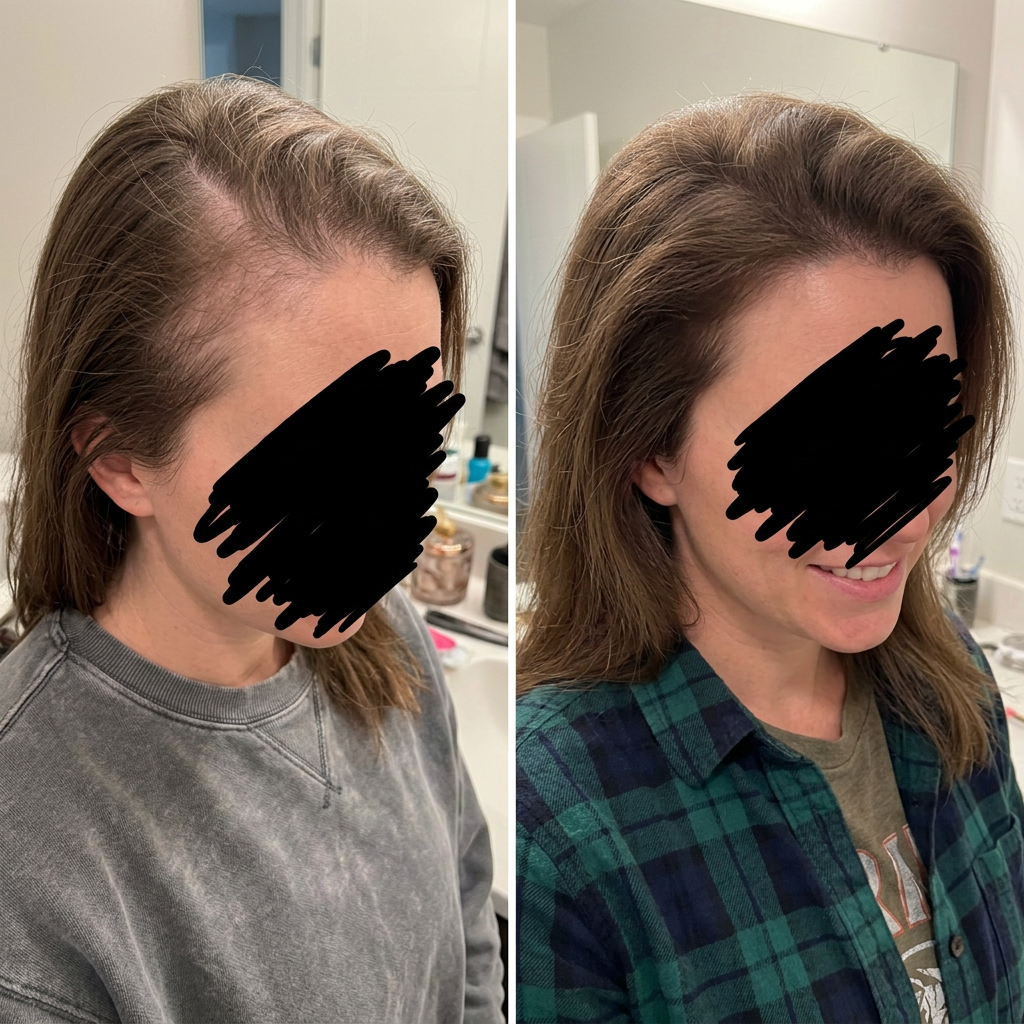
If your hair keeps thinning, you feel like you're doing everything right, you've tried every supplement and serum there is, and your doctor keeps telling you your bloodwork is "normal" — pull up a chair, because I'm about to tell you why. And by the end of this, you're going to be a little angry. Because there are three things happening right now: One — your follicles aren't shrinking because you've suddenly become "high testosterone"; they're shrinking because the protein that keeps your testosterone leashed has dropped, and the free, active hormone is now reaching your hairline. Two — the people you're paying for answers keep checking the wrong number and telling you you're fine. Three — there's a multi-billion-dollar industry that profits every single month you keep buying biotin gummies and volumizing shampoo that do nothing for the actual cause. So let me tell you what happened with my older sister, because her story is going to change how you look at your own part line. For years — and I mean four straight years — my sister watched her hair quietly thin out. Not bald patches. The diffuse kind. The kind where your ponytail gets a little thinner every season, your part looks a little wider in photos, and one day you're standing under the bathroom light and you can see your scalp through the top of your hair. And the thing that drove her crazy was that she was doing everything right. Clean eating. Walking. Sleeping. Every hair vitamin on the shelf. And still, every time she pulled her hair back, the ponytail felt thinner and the elastic wrapped one more time than it used to. She's 49 and she started parting her hair differently to hide the widening, dusting powder along her part, avoiding overhead light, and skipping the slicked-back styles she used to love because her scalp showed through. It all seemed to start around the same time her cycles got irregular and the first hot flushes showed up. But nobody connected those dots for her. So obviously, she does the responsible thing. She goes to the doctors. Her GP. A dermatologist. A gynecologist. We're talking a lot of appointments, a lot of bloodwork, a lot of co-pays. And you know what every single one of them told her? "Your bloodwork is normal." "Your testosterone is in range — it can't be hormonal." "It's just stress. It's just age. It's just menopause." "Try a biotin supplement and don't pull it back so tight." So she did everything they said. The supplements. The gentle styling. The "just give it time." And here's where it gets worse — and this is the part that made me start digging. Her labs really were "normal." Her total testosterone sat right in the middle of the range. And her part kept widening anyway. Month after month. Doing everything right and still losing ground. A year of this. Then closer to two. Same routine, same disappointing photos, same slow fade. She started to believe what they'd told her — that this was just what happens to women her age, that there was nothing to be done, that she should make peace with it. So at this point I'm frustrated for her. Because I'm watching my sister do everything by the book — taking the supplements, going to the appointments, never missing a follow-up — and getting nowhere. And that's when I started asking the questions nobody wants you to ask: If her testosterone is "normal," why did her hair start thinning the exact year her cycles changed? Why do so many women's hairlines start going right at perimenopause, when their hormone panels look completely unremarkable? And why do so many women who are doing absolutely everything right still lose their hair? So I went down a rabbit hole. A deep one. I started reading the actual endocrinology — not the wellness-blog version, the hormone-transport version — and what I found was something almost no one explains to women. The amount of a hormone in your blood is not the same as the amount that's active. And in midlife, the active fraction can climb sharply while the total never moves. Now pause for a second. We've all been taught to look at the headline number. Is your testosterone "in range"? Yes? Then it's fine. That's the whole conversation. But nobody — and I mean nobody — ever told us that most of your testosterone travels through your blood bound to a carrier protein that keeps it switched off, and that only the small, free, unbound fraction can actually reach a follicle. Here's what's actually happening. Most of the testosterone in your body is bound to a protein your liver makes called sex hormone-binding globulin — SHBG. Think of SHBG as a leash. While testosterone is on the leash, it's inactive; it floats by your follicles and does nothing. Only the free testosterone — the small fraction that's off the leash — can reach the follicle and act on it. And here's the key: estrogen is what tells your liver to keep SHBG high. Lots of estrogen, lots of leash, most of your testosterone held back. So watch what happens in perimenopause. Estrogen starts falling. Your liver makes less SHBG. The leash gets shorter. And the exact same amount of total testosterone you've always had — the "normal" number on your labs — now has a bigger free, active fraction coming off the leash. You didn't start making more testosterone. You started holding less of it back. And that free testosterone goes straight to the follicles on the top of your scalp that happen to be genetically sensitive to it. It shrinks them — cycle after cycle — so each hair comes in a little finer, a little shorter, until the part widens and the ponytail goes see-through. The diffuse female-pattern thinning that so often shows up right at perimenopause. There's even a number that captures this. It's called the Free Androgen Index — your total testosterone divided by your SHBG. It tells you how much of your hormone is actually active. But standard bloodwork checks total testosterone, sees a normal number, and never calculates the ratio — and a lot of panels never even measure SHBG. So a woman with a perfectly "normal" testosterone and a quietly collapsed SHBG gets told she's fine, while her free androgens are climbing. And here's the kicker: a biotin gummy does nothing about this. A volumizing shampoo does nothing about this. "Giving it time" does nothing about this — because every passing season of low SHBG means more free androgen reaching your follicles. That was the lightbulb. That's why my sister's labs could look "normal" while her part kept widening. Everyone was reading the total and ignoring the leash. The hormone story was right there — they were just looking at the wrong half of it. And it made a strange kind of sense. Think about the timing — hair starts going right as cycles change and hot flushes start, exactly when estrogen and SHBG fall. Think about the pattern — diffuse thinning on top, widening part, where the androgen-sensitive follicles live. Think about how it so often starts after going off the pill, or in the years around menopause — all moments when estrogen, and therefore SHBG, drops. It also explained the things that didn't fit the simple "you're just fine" story. Why two women with identical total-testosterone numbers can have completely different hair. Why hair vitamins do nothing for this kind of thinning. Why the women who "wait it out" usually just keep losing. And here's the part that made my blood pressure spike: This is established endocrinology. The free-versus-bound distinction is in every textbook. But there's no profit in telling a woman the real problem is a protein her labs don't even measure. There IS a fortune in selling her gummies, shampoos, and "just give it time" for the rest of her life. See how that works? So I kept researching. Studies now. Ingredient papers. Talking to formulators. And I found there's an actual approach for protecting the follicles and restarting the ones that have already started to shrink — using four specific peptide and botanical actives that work directly at the scalp, where the free androgen is doing the damage. One — sh-Polypeptide-1 and sh-Polypeptide-11. Signaling peptides that talk directly to the follicle stem cells androgen pressure has pushed into sleep mode, pushing them back into a real growth cycle. Your follicles aren't gone. The ones being shrunk have gone quiet. These wake them up. Two — sh-Oligopeptide-2 and sh-Oligopeptide-10. These rebuild the structure of follicles that have been miniaturizing for years, so they can carry a full-size hair again instead of a thin wispy one. Three — Arginine. The amino acid your body uses to make nitric oxide. Nitric oxide opens scalp blood flow and feeds the dermal papilla, so each follicle gets the oxygen and nutrients it needs to grow. Four — Botanical Anti-Inflammatory Extracts. These quiet the low-grade inflammation that free androgens stir up around the follicle, so the rest of the system can work. Together, these four work as a system. The peptides wake the follicles. The peptides also rebuild the ones that have shrunk. The arginine feeds them. The botanicals calm the irritation the androgens cause. You protect what you have and restart what's started to go. Now here's where it gets practical. You can buy these ingredients separately. A clean sh-Polypeptide blend will run you about $90 a month. Pure sh-Oligopeptides another $70. A pharmaceutical-grade Arginine topical, maybe $40. A real botanical anti-inflammatory blend at the right potency, easily $60. That's $260 a month for the full stack — and that's IF you can find clean versions, IF you measure correctly, IF you layer them right, and IF you remember to apply four serums every day. Most women can't sustain that. Most women don't want to. So they buy the gummies, give up on the rest, and watch their part widen by the month. That's where the brand I want to tell you about comes in. It's called FST-5 Peptide Complex, by a company called Richvell. They were a small peptide-research team that took over a hair brand called Keapers, brought their actual science with them, and built a single serum that combines all five of these actives at clinical concentrations. And the price isn't $260 a month. It's a fraction of that. We're talking about replacing four products with one bottle. My sister started using it on a whim. She'd given up on the whole space and just figured she'd give the peptide angle one honest shot. Three weeks in, the shedding in the shower started to thin out. The hairs that did come loose weren't the fine, wispy ones anymore. By one month, her part stopped widening — the first time in three years it hadn't quietly gotten worse. She sent me a photo with the caption "is it just me or…" and the part looked tighter. By two months, there was real growth coming in along her hairline and part — fine at first, but darker and holding. Her ponytail felt thicker in her hand. People started telling her she looked great without being able to say why. She stopped dusting powder on her part. She started wearing her hair back again. She stopped angling away from group photos. Her confidence quietly came back, and you could see it in the way she carried herself when we met up for lunch last month. And here's the part I love — she also went back to her doctor, asked them to actually check her SHBG and free androgen index, and finally had a real conversation about her hormones. The serum protected her follicles at the scalp while she sorted out the bigger picture. Two halves of the same problem, both finally addressed. She told me she wishes she'd known this five years ago. She wishes someone — any of the doctors she saw — had spent ten seconds looking past the total testosterone and checking the leash. She's not bitter about them anymore. She just doesn't trust them as the only voice in the room. Now, a heads up. FST-5 Peptide Complex isn't sold in pharmacies and they keep the stock tight on purpose so they don't dilute the formulation by mass-producing it. When I checked yesterday they were running a 30% off launch promo on the multi-bottle pack, which makes the per-month price genuinely silly compared to the $260-a-month stack version. I don't know how long that runs. It comes with a 100-day money-back guarantee. If it doesn't work, you don't pay. They eat the bottle. If your hair has been thinning despite "doing everything right," if your part keeps widening while your labs come back "normal," if it all started around the time your cycles changed — try it. The worst case is you get your money back. Click below to check it out. 👉 https://richvell.com/pages/the-fst5
Where the ad sends people
richvell.com
Dermatologist Discovers Peptide Breakthrough That Reactivates Hair Growth Like You're 17 Again
The FST-5 Peptide Complex by Richvell ™
Shop now: richvell.com(opens in a new tab)