Hiring a Facebook Ad Agency is like buying a used car. The sticker price is rarely the final price.
You ask for a quote, and you get a proposal full of jargon. "Setup fee." "Management fee." "Performance kicker." "Creative retainer."
It is designed to be confusing.
In this guide, we are going to demystify facebook ad agency pricing in 2026. We will explain the four standard pricing models, give you the actual dollar ranges you should expect to pay, and help you decide if the cost is worth it.
The 4 Pricing Models Explained
1. Percentage of Ad Spend (The Industry Standard)
How it works: You pay the agency a percentage of your total ad budget paid to Facebook.
The Rate: Usually 10% - 20%.
Example: If you spend $10,000 on ads, you pay the agency $1,500 (15%). Total cost: $11,500.
Pros: Incentivizes the agency to scale your account.
Cons: Massive conflict of interest. The agency makes more money if you spend more, even if your profitability drops.
2. The Flat Retainer
How it works: You pay a fixed monthly fee, regardless of ad spend.
The Rate: $2,000 - $10,000/month depending on agency size.
Pros: Predictable costs. No incentive to overspend.
Cons: If your ad spend is low (e.g., $1,000), paying a $2,000 retainer makes no sense. Your effective management fee would be 200%.
3. Performance Based (Revenue Share)
How it works: This model is designed to minimize risk for the client. You pay a lower base fee to cover their operational costs, plus a "kicker" based on the results they drive.
The Rate: Typically $1,000 - $2,000 base fee plus 5-10% of Revenue attributed to ads (or a % of Profit).
Pros: This aligns incentives perfectly. The agency "eats what they kill." If they don't generate sales, they don't get a bonus. It encourages them to be aggressive and find new scaling opportunities.
Cons: The Attribution Nightmare. Agencies will often claim credit for sales that came from your email list or organic traffic.
You need very strict contracts defining what counts as an "Ad Sale." (e.g., "Click-through attribution only, no View-through"). Also, if you scale to $1M/month, writing a $100,000 check to an agency can feel painful, even if they earned it.
4. Hourly Rate
How it works: You pay for hours worked.
The Rate: $100 - $300/hour.
Pros: Good for one-off audits or consulting calls.
Cons: Terrible for ongoing management. You are punishing them for being efficient.
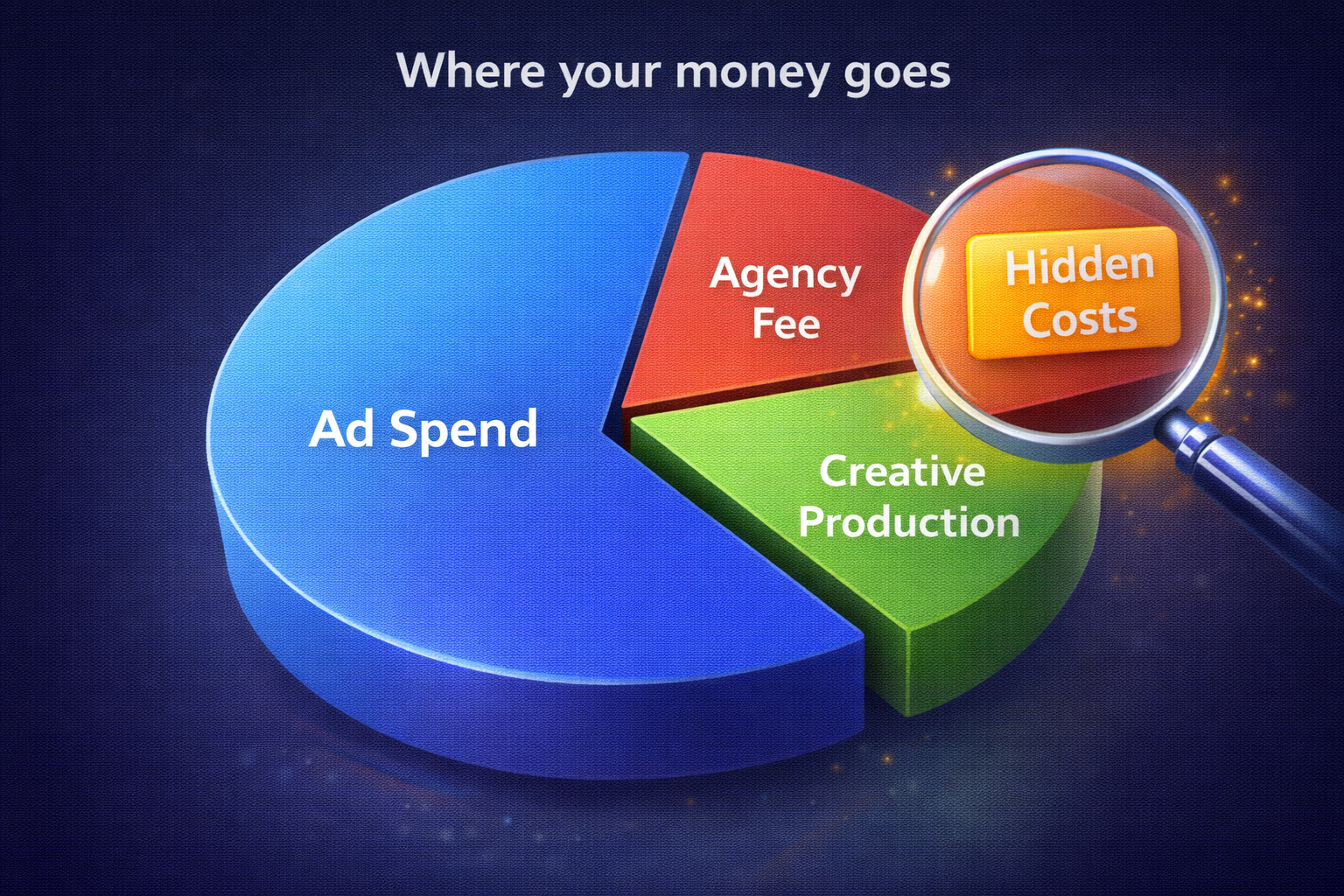
Average Agency Costs by Business Size (2026)
What should YOU pay? It depends on your size.
The "Starter" Tier (Spend < $5k/mo)
Recommendation: Do NOT hire an agency. Their minimum fees ($2k+) will destroy your margins.
Cost: $0 (Do it yourself or use software).
The "Growth" Tier (Spend $10k - $50k/mo)
Recommendation: Boutique Agency or Senior Freelancer.
Cost: $2,500 - $5,000/month (Flat) OR 15% of spend.
The "Scale" Tier (Spend $50k - $250k/mo)
Recommendation: Performance Agency.
Cost: $5,000 base + Performance Kicker.
The "Enterprise" Tier (Spend $250k+/mo)
Recommendation: In-House Team.
Cost: Salaries (Media Buyer $80k/yr + Creative Director $100k/yr).
Hidden Fees to Watch Out For: The "Fine Print" Trap
When you receive a proposal, it might look clean: "$3,000/month." But then the first invoice arrives, and it's $5,500.
What happened? You missed the hidden fees. Here is exactly what to look for in the contract.
1. The Onboarding/Setup Fee
Cost: $1,000 - $3,000 (One-time).
The Excuse: "We need to audit your account, set up pixels, and build the strategy."
The Reality: Often, this is just a way to juice their margin. If they are just duplicating your existing campaigns, this is a rip-off. Negotiate this down or ask them to waive it if you sign a 3-month deal.
2. Creative Production Fees
Cost: $150 - $500 per video.
The Excuse: "Media buying does not include video editing."
The Reality: This is actually fair, but you need to know about it upfront. Most "Media Buying" retainers ONLY cover the act of pushing buttons in Ads Manager.
If you need them to edit videos, design banners, or source UGC creators, that is a separate line item. Make sure you clarify: "Does the retainer include creative?" If not, budget an extra $2,000/month for assets.
3. "Tech Stack" Fees
Cost: $200 - $500/month.
The Excuse: "We use advanced tracking software (like Triple Whale or Hyros) and we pass the cost to you."
The Reality: You should own your own data. Do not let the agency hold the license. You should pay for the software directly so that if you fire the agency, you keep the data history.
4. The "Break-Up" Fee
Check the termination clause. Some agencies require a 30-day or even 60-day notice to quit. If you fire them on the 1st, you still have to pay them for the next two months while they do nothing. Look for a "14-day notice" clause.
5 Questions to Ask Before You Sign
To avoid getting ripped off, ask these five questions during your sales call. The answers will reveal if the agency is a partner or a predator.
"Who will actually be managing my account?"
Agencies often sell you with the CEO, but then hand your account to a junior intern. Demand to meet the actual media buyer who will be pressing the buttons.
"Do you outsource creative?"
If they say yes, ask for the portfolio of the specific editor they will use. If they say no (and they don't have an in-house team), it means they aren't doing creative at all. Run away.
"What is your average client retention rate?"
If clients leave after 3 months, something is wrong. A good agency keeps clients for 12+ months.
"Do you use your own ad accounts or mine?"
ALWAYS use your own ad account. If they use theirs, they hold your data hostage. If you leave, you lose your pixel data. Never agree to this.
"How do you report on results?"
If they send a PDF once a month, that is too slow. You want a live dashboard or a weekly Loom video breakdown.
The "Software" Alternative
In 2026, the question isn't "Which agency?" It is "Why agency?"
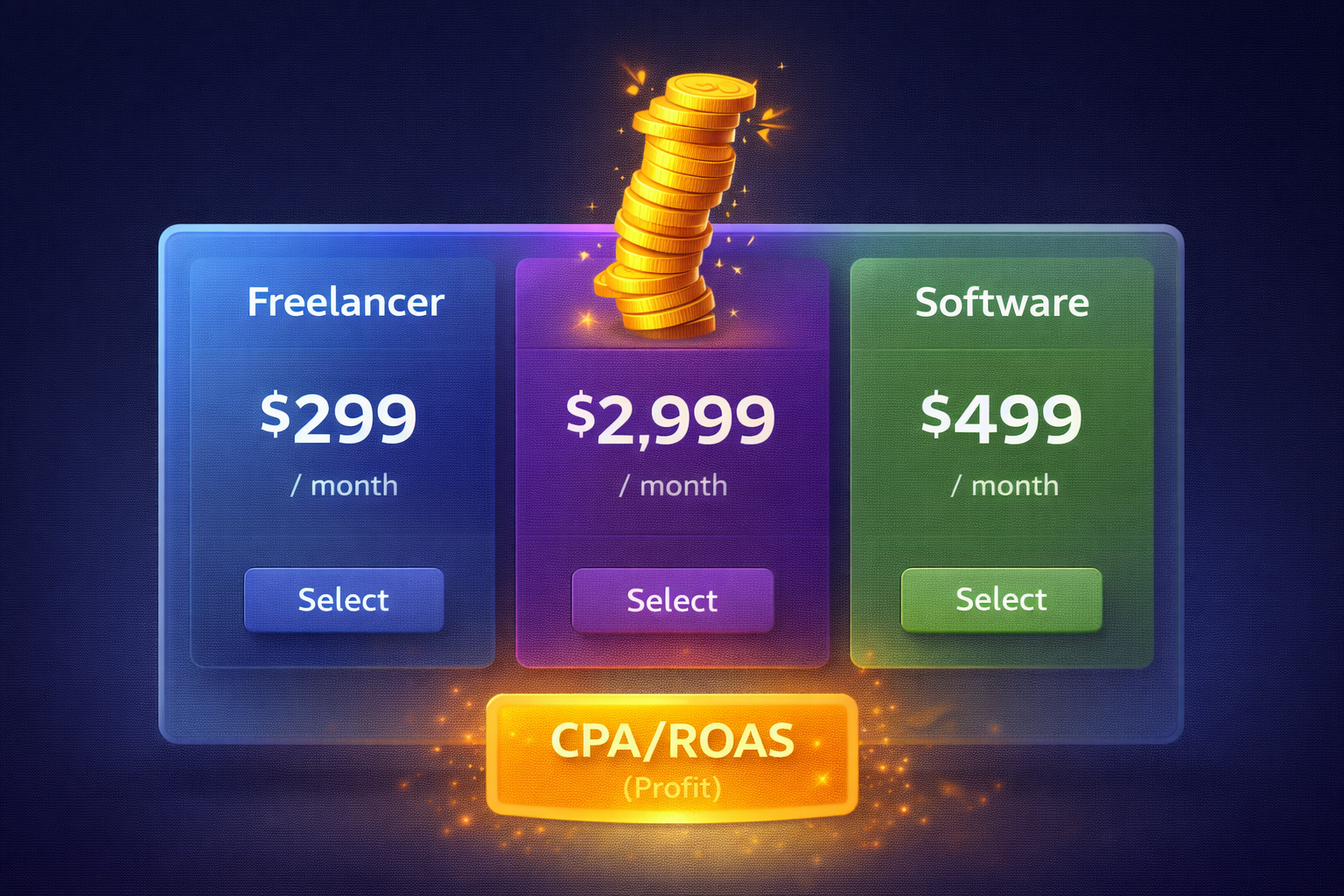
If an agency charges $3,000/month to press buttons that an AI can press for $300/month, the math is simple.
The "Hybrid" Model:
Spend your money on Creative (hiring video editors/creators) and use Software (like Crush) to handle the media buying.
This gives you the best of both worlds: Human creativity + Machine efficiency.
Conclusion
Don't overpay for commodity work.
Managing ad sets is a commodity. Creating persuasive video ads is an asset.
When looking at facebook ad agency pricing, make sure you are paying for the asset, not the commodity.
Want to save the $3,000/month agency fee? Switch to Crush and get agency-level performance for a software price.