
Key Takeaways
- 1Install the Facebook SDK to track deep funnel events beyond vanity metrics
- 2Progress from App Event Optimization (AEO) to Value Optimization (VO) for higher ROI
- 3Leverage Advantage+ App Campaigns to automate creative testing and targeting
- 4Use authentic gameplay and UGC-style creatives to stop the scroll
- 5Re-engage dormant users with deep-linked offers to boost retention
Building an app is hard; getting users is harder. Discover how to master Facebook App Campaigns, from SDK setup and AEO bidding to high-converting Advantage+ creative strategies.
If you are a mobile app developer or marketer, you know the struggle.
Building the app was hard. Getting people to download it is harder. Getting them to actually use it (and pay for it) is the hardest part of all.
This is where Facebook App Campaigns (formerly known as App Install Ads) come in.
Meta is arguably the most powerful platform for app growth in the world. It knows exactly who plays games, who subscribes to fitness apps, and who spends money on in-app purchases.
In this guide, we will go beyond the basics of "Install" ads. We will dive into the technical setup (SDK), the bidding strategies (AEO vs. VO), and the creative frameworks that drive massive scale in 2026.
The Foundation: The Facebook SDK
You cannot run a successful App Campaign without the Facebook SDK (Software Development Kit).
Think of the SDK as the "Pixel" for mobile apps.
If you don't install it, Facebook is blind. It can maybe see a click, but it can't see what happens after the user opens the app.
With the SDK installed, you can track standard events like:
App Install
App Launch
Complete Registration
Add to Cart
Purchase
Achieve Level (for games)
Pro Tip: Don't just track "Install." An install is a vanity metric. A user can install your app and delete it 5 seconds later. You want to optimize for deeper funnel events.
Bidding Strategies: The Hierarchy of Quality
Once your SDK is sending data, you have to tell Facebook what you want. This is done at the Ad Set level under "Optimization for Ad Delivery." There is a clear hierarchy of quality vs. volume here.
1. Mobile App Installs (MAI) - The Volume Play
The Goal: Get as many people as possible to download the app for the lowest cost.
The Mechanics: Facebook looks for users who have a history of installing apps. It ignores what they do after the install.
The Result: You will get very cheap installs (maybe $0.50 - $2.00). However, your retention rate will be terrible. 90% of these users will open the app once and delete it. Use this only if you need to boost your App Store ranking quickly.
2. App Event Optimization (AEO) - The Action Play
The Goal: Find users who will install the app AND take a specific action (e.g., "Complete Tutorial," "Create Character," or "Add Payment Info").
The Mechanics: Facebook looks for users who have a history of using apps, not just downloading them.
The Result: Your Cost Per Install (CPI) will double or triple (maybe $5.00 - $10.00). But your backend metrics (Retention, Daily Active Users) will skyrocket. This is the standard starting point for most serious app businesses.
3. Value Optimization (VO) - The ROI Play
The Goal: Find users who will spend the most money (ROAS). Not just any buyer, but "Whales."
The Mechanics: You pass the "Purchase Value" data back to Facebook via the SDK. Facebook then predicts which users are likely to have a high LTV (Lifetime Value) and bids aggressively for them.
The Result: You might pay $50 for an install. That sounds scary. But if that user spends $500 in the first month, it is the most profitable strategy you have. VO requires significant data (hundreds of purchases) to work effectively.
The "Graduation" Strategy:
Do not start with VO. You don't have enough data. Start with AEO optimized for a shallow event like "Registration." Once you have 500 registrations, move to AEO optimized for "Purchase." Once you have 500 purchases, graduate to VO to find the big spenders.
Automated App Ads (Advantage+ App Campaigns)
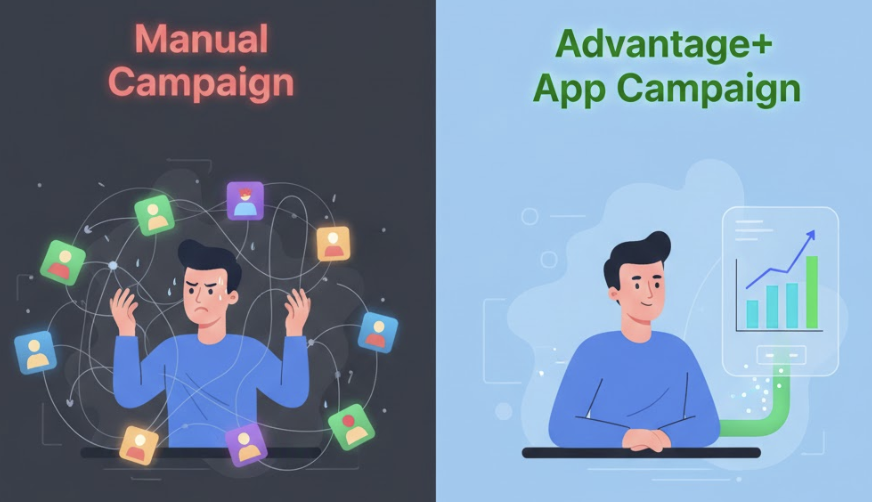
In 2026, manual setup is becoming obsolete. Meta pushes everyone toward Advantage+ App Campaigns (formerly AAA).
This is a "Black Box" campaign.
You give it 50 images/videos.
You give it 5 headlines.
You set a budget.
You hit Go.
The algorithm tests every combination of creative and audience automatically. It removes the need for manual Ad Set testing.
Does it work? Yes. For apps with broad appeal (like casual games or fitness), AAA almost always beats manual campaigns. For niche B2B apps, manual targeting might still be better.
Creative Strategy for Apps: The "Thumb-Stopping" Rules
Mobile users are ruthless. If your ad looks like a TV commercial, they scroll. Your creative needs to feel native to the platform (TikTok/Reels style) and deliver value instantly.
1. The "Gameplay" Ad (For Mobile Games)
The Mistake: Using cinematic, CGI trailers that look like a Marvel movie but nothing like the actual game. This is called "Bullshot" (Bullshit Screenshot).
The Fix: Show the actual UI. Show the finger tapping the screen. Show a "Fail" moment ("I can't reach Level 3!"). This triggers the "I can do better than that" competitive instinct in the user. Authentic gameplay footage often converts 2x better than CGI because it sets the right expectations.
2. The "UGC Problem/Solution" Ad (For Utilities/SaaS)
The Script:
0-3s: "Stop trying to learn Spanish like this." (Visual of boring textbook).
3-10s: "I found a hack that makes you fluent in 3 months." (Show the App UI).
10-20s: Show the specific features (Gamification, Streaks).
20-30s: "Download for free and keep your streak alive."
3. The "App Store" Aesthetic
A static image or video that mimics the look of the Apple App Store listing. It shows the App Icon, the Star Rating (⭐⭐⭐⭐⭐), and a "Get" button. This works surprisingly well because it leverages the trust users already have in the App Store ecosystem.
Retargeting: The Forgotten Goldmine
Most app marketers obsess over user acquisition. But what about the users who installed and left?
You can run Engagement Campaigns targeting specific segments:
"Users who installed but didn't register." -> Offer a 10% discount.
"Users who added to cart but didn't buy." -> "Your cart is waiting!"
"Users who haven't opened the app in 30 days." -> "We miss you! Come back for a free life."
This is called "Deep Linking." When they click the ad, it doesn't just open the app store; it opens the app directly to the specific page you want them to see.
Conclusion
Facebook app campaigns are a high-stakes game. The competition is fierce.
To win, you must respect the technical setup. Get your SDK right. Choose the right bidding event (don't settle for cheap installs). And feed the Advantage+ algorithm with a constant stream of fresh creative.
The users are out there. Go get them.
Need to scale your app without hiring a team? Crush can automate your Advantage+ creative testing for maximum ROI.
Frequently Asked Questions
Common questions about this topic
1What is the difference between Mobile App Installs (MAI) and App Event Optimization (AEO)?
2What are Advantage+ App Campaigns?
3When should I use Value Optimization (VO) for my app?
Written by

Ignas Obulaitis
Head of ITIgnas Obulaitis is the head of IT for TryCrush.ai, leading the platform’s engineering and AI innovation. With a strong background in product-driven development, Ignas has built and scaled complex systems across fintech, SaaS, and AI-focused companies. An ex-IBM engineer and former Head of Development at Fluensure, Ignas combines deep technical expertise with a sharp product mindset to turn ambitious ideas into scalable, production-ready technology.
Stop Guessing.
Start Crushing.
AI Ad Manager trained by world-class media buyers to generate your creatives and optimize your ads 24/7.
Learn more
Related articles

Ecom Benchmarks 2026: Why "Average" Means You're Losing Money
In 2026, aiming for average e-commerce metrics means aiming for bankruptcy. Discover the new CTR, AOV, and conversion benchmarks you need to survive, plus actionable AI and CRO strategies to push your brand into the profitable top 1%.
Lifetime Customer Value (LTV): Why It Matters More Than CPA
Stop obsessing over Day-1 CPA and start optimizing for the metric that truly scales businesses: Lifetime Customer Value (LTV). Discover the true LTV meaning, how to increase it, and why AI-driven platforms like TryCrush outsmart traditional ad buying.
Mastering Facebook Traffic Campaigns: Strategy & Setup
Most advertisers misuse the Facebook Traffic objective. Discover why "traffic" is often a vanity metric and how to set up campaigns correctly using "Landing Page Views" to avoid bots. Perfect for content promotion and newsletter growth.
Facebook Ads for Ecommerce & Affiliate Marketing: The Dual Strategy
Discover the two primary ways to make money with Facebook ads: Ecommerce and Affiliate Marketing. This guide breaks down specific strategies for both, including creative tips, funnel structures, and compliance secrets to keep your ad account safe.