
Key Takeaways
- 1Facebook creates demand (Push) while Google captures existing intent (Pull)
- 2The "Halo Effect" combines Facebook discovery with Google conversion for max ROI
- 3Avoid the "Boost Post" trap; use Ads Manager for precise targeting and ROI
- 4Success requires "entertainment first" creative to interrupt scrolling users
- 5Future trends include AI creative, WhatsApp messaging ads, and AR integration
Stop treating Facebook Ads like Google Ads. This guide breaks down the critical difference between Demand Capture and Demand Generation, explains the "Halo Effect," and reveals why boosting posts kills ROI. Learn where Facebook fits in a modern growth stack.
If you talk to an old-school marketer, they might say:
"We do SEO for organic traffic and PPC for paid traffic."
Usually, when they say PPC (Pay Per Click), they mean Google Ads. But strictly speaking, facebook ppc is a massive part of the ecosystem.
However, treating Facebook like Google is a recipe for disaster.
In this guide, we are going to zoom out. We will look at the broader landscape of digital marketing facebook ads, compare it to other channels, and explain where facebook paid marketing fits into a modern growth stack.
Is Facebook Actually "PPC"?
Yes and No.
Yes: You technically pay every time someone clicks (or views) your ad.
No: The intent is different. Google is "Search." Facebook is "Social."
On Google, you pay for explicit intent, keywords like "Buy red shoes."
On Facebook, you pay for attention. You are interrupting a user who is looking at photos of their nephew. You are paying for the opportunity to distract them.
This means your facebook paid promotion strategy cannot be "boring text ads." It must be "entertainment first, ad second."
Facebook vs. Google: The "Push" vs. "Pull"
Understanding this distinction is the key to millions in revenue. It's the difference between explicit intent and the implicit interest found in Facebook keywords and search targeting.
Google = Demand Capture (Pull)
The demand already exists. The user wants a plumber. You just need to show up.
Pros: High conversion rate.
Cons: Limited scale. There are only so many people searching for "Plumber" today. You can't force more people to have leaky pipes.
Facebook = Demand Generation (Push)
The demand does not exist yet. The user wasn't thinking about their bad posture. They were watching a video about cats.
You interrupted them. You showed them a video of someone slouching at a desk. You agitated the pain ("Does your back hurt at 3 PM?"). You introduced the solution ("This $20 strap fixes it").
This is Demand Generation. You created a customer out of thin air.
Pros: Infinite scale. You are not limited by search volume. You can reach millions of people who don't even know they have a problem yet.
Cons: Lower conversion rate. Because they weren't looking to buy, you have to work harder to convince them. You need better creative, better hooks, and a better offer.
Where Facebook Fits in Your Marketing Stack (The "Halo Effect")
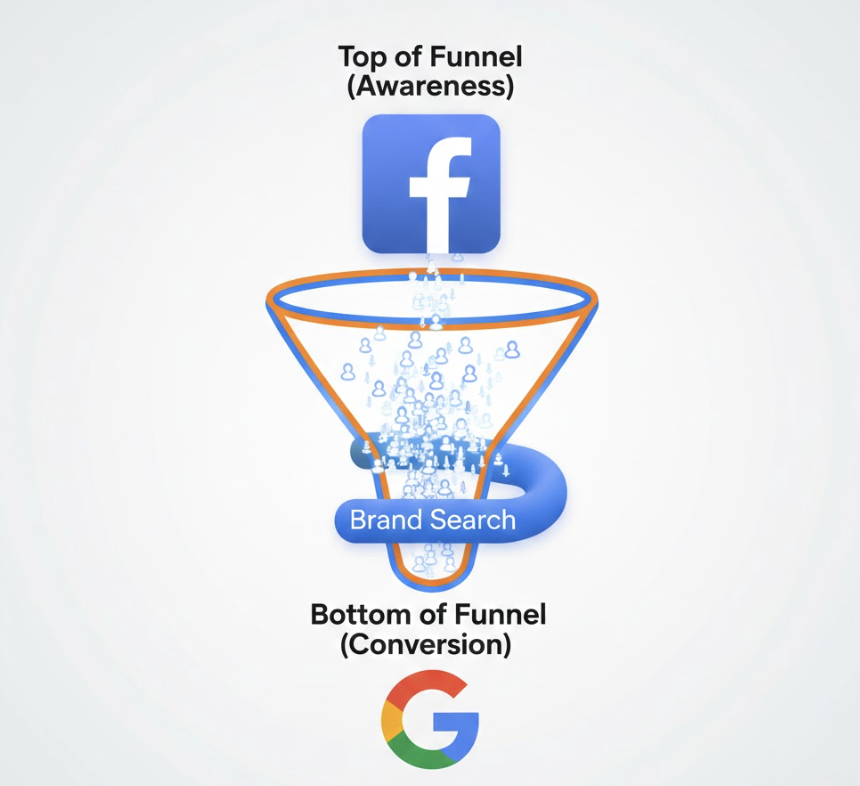
You shouldn't choose one. You need both. Facebook and Google work together in a symbiotic relationship, often called the "Halo Effect."
The Scenario
Day 1: A user sees your video ad on Instagram while waiting for the bus. They watch 10 seconds. They don't click.
Day 2: They see a retargeting image on Facebook. They stop scrolling, read the headline, but keep going.
Day 3: They are at work. They remember your product. They type your brand name into Google. They click your Search Ad and buy.
The Attribution Problem
Google Analytics will give 100% of the credit to Google Ads. It will say Facebook did nothing. This leads to severe data blindness regarding Facebook's ROAS. Without those first two touchpoints on Facebook, the search never would have happened.
If you turn off Facebook Ads to "save money," your Google Brand Search volume will plummet by 20-30% within two weeks. You stopped feeding the top of the funnel.
The Ecosystem Metaphor
Facebook/Instagram: The Hunter. It goes out and finds new people.
Google Ads: The Gatherer. It captures people who are already looking.
Email/SMS: The Farmer. It nurtures the leads you have already acquired.
If you only do Google, you will eventually tap out the existing demand. You need Facebook to create new demand.
The "Paid Promotion" Trap (Boost Post)
We need to address a specific term: facebook paid promotion. This phrase is dangerous because it means two very different things to different people.
To a Professional:
It means running sophisticated campaigns in Facebook Ads Manager, using CBO, Exclusion Audiences, and Dynamic Creative.
To a Beginner:
It means clicking the blue "Boost Post" button next to a post on their Page.
Why "Boost Post" is a Trap
When you click "Boost," Facebook asks: "What is your goal?" The default answer is usually "Get more engagement."
Facebook then shows your ad to people who are addicted to clicking "Like" but never buy anything. You get a dopamine hit from the notifications ("100 Likes!"), but your bank account stays empty.
The Limitations of Boosting:
No Objective Control: You often can't select "Purchase" or "Lead" as a conversion event. You are optimizing for "Link Clicks" or "Post Engagement" by default.
Limited Targeting: You can't use sophisticated Lookalikes or Customer Lists effectively. You are stuck with basic Interest targeting or "People who like your page."
No Creative Testing: You can only boost one post at a time. You can't test 5 headlines against each other to see which one works. You are betting everything on one horse.
Placement Control: You can't stop your ad from showing up on low-quality sites in the Audience Network. Your ad might appear on a flashlight app in between game levels.
The Verdict: If you want vanity metrics (social proof), Boost. If you want ROI (money), build a campaign in Ads Manager.
Future Trends in Facebook PPC (2026 and Beyond)
Where is the industry going?
1. AI-Generated Creative
Tools are getting good enough to generate ad variations instantly. We are moving from manual media buying to "Creative Prompting."
2. Messaging Ads (WhatsApp/Messenger)
In many countries (Brazil, India), commerce happens in chat. "Click to WhatsApp" ads are exploding. Expect this to come to the US/EU soon.
3. Augmented Reality (AR) Ads
"Try on these sunglasses" ads using the camera. This reduces return rates for e-commerce brands massively.
Conclusion
Facebook is not just a social network. It is the world's most sophisticated demand generation engine.
It is not "PPC" in the traditional sense. It is a machine that turns money into attention, and attention into revenue.
Mastering it requires you to be half-mathematician, half-entertainer.
Ready to upgrade your paid marketing strategy? See how Crush leverages AI to stay ahead of the Facebook PPC curve.
Frequently Asked Questions
Common questions about this topic
1Is Facebook advertising considered PPC?
2What is the difference between Facebook Ads and Google Ads?
3Why shouldn't I use the Boost Post button on Facebook?
4What is the Halo Effect in digital marketing?
Written by

Rokas Steponavičius
Founder, CEORokas is the Founder and CEO of TryCrush.ai, an ex-IBM professional turned entrepreneur focused on building AI-driven growth platforms. With a strong background in ecommerce, performance marketing, media buying, and artificial intelligence, Rokas specializes in creating scalable, data-led systems that drive measurable revenue. His mission is to help modern businesses leverage AI to optimize acquisition, conversions, and long-term profitability.
Stop Guessing.
Start Crushing.
AI Ad Manager trained by world-class media buyers to generate your creatives and optimize your ads 24/7.
Learn more
Related articles
The "Facebook Ads Guru" is Lying to You: How to Avoid Scams in 2026
"Secret hacks" don't exist. Discover how to identify fake Facebook Ads gurus, avoid churn-and-burn agencies, and properly audit your ad account. Protect your ad budget with science, data, and AI-driven marketing instead of empty promises.
Understanding Cost Per Lead (CPL) on Facebook: Benchmarks & Optimization
Stop chasing $5 leads. We reveal the real 2026 Facebook advertising cost benchmarks across industries. Plus, discover 5 strategies to optimize your campaigns for quality over quantity and improve your ROAS.
The Return of the Image: Why Static Ads Are Beating Video in 2026
Think video is the only way to win? Think again. In 2026, static ads are outperforming high-production videos by up to 50%. Discover why simple image ads are dominating feeds and how to use them to scale your ad accounts profitably.
Higgsfield AI vs TryCrush: Which Platform Delivers Better ROAS?
The arms race in generative AI is accelerating. Discover the core differences between Higgsfield AI and TryCrush, and learn why transitioning from organic content creation to profitable paid ad conversion requires a specialized performance engine.