Key Takeaways
- 1TryAtria offers strong tools for organizing ad assets, writing briefs, and saving creatives via a Chrome extension.
- 2The TryAtria Core plan costs $129 per month annually and includes a $500K ad spend cap.
- 3User reviews highlight occasional glitches with the Chrome extension and thin support times.
- 4Crush tracks over 1.7 million Facebook ads, keeping history of ads even after they are taken down.
- 5While Atria focuses on the creative brief workflow, Crush acts as an autonomous media buyer that automatically scales winners and kills losers.
TryAtria offers strong creative organization tools for media buyers, but lacks autonomous campaign scaling. We break down the pricing and compare its workflow against data-backed automation.
What is TryAtria and How Does It Work?
TryAtria is an AI platform designed to manage the ad creative workflow for performance marketers. It helps teams research competitors, generate briefs, and organize assets.
If you need a comprehensive tool for creative analysis, Atria is a solid contender. However, it focuses heavily on creative organization rather than full media buying automation.
TryAtria Features: What It Does Well for Media Buyers
End-to-End Creative Management
According to their own blog, the platform covers the entire creative workflow, including competitor research, creative inspiration, image generation, brief creation, ad creation, ad launch, and performance analysis (Atria). Consolidating research, brief writing, and image generation into a single workspace saves hours of administrative work.
If your workflow relies heavily on generated assets, comparing platforms is essential. For instance, you can check out our AdCreative.ai review to see how other popular AI generation features stack up against TryAtria, or explore our AdSpy 2026 review for alternative ad intelligence and competitor research tools.
When a team operates efficiently, they can test a higher volume of ad variations every week. Testing volume directly correlates with finding profitable ads faster. You no longer need to switch between ChatGPT, a spreadsheet, and Meta Ads Manager.
Ad Saving and Organization
For saving references, the platform offers a Chrome extension that enables one-click saving of ads from Meta and TikTok (Chrome Web Store). If you are evaluating different clipping tools, our Foreplay Chrome extension review demonstrates how similar tools handle asset collection while highlighting the need for deeper performance metrics.
While searching the Facebook ad library manually is a painful process, Atria's one-click solution lets your team pull competitor creatives directly into their workspace.
Once the assets are saved, the organization features take over. Users can organize saved ads into customizable boards and sub-boards, tag them, and utilize rich filters for seamless content management (Chrome Web Store).
This organizational structure keeps media buyers and creative teams perfectly aligned. If you need to brief an editor on a new hook, you simply pull up the filtered board and share it. This eliminates chaotic slack threads filled with random video attachments.
TryAtria Cons: Where the Platform Falls Short
Support and Billing Issues
No software is flawless. When evaluating a core piece of your tech stack, you must look at user feedback regarding reliability. Trustpilot reviews for tryatria.com show recurring complaints about billing after trials and issues with support.
Users note that assistance is "fairly thin" and can take days to resolve even minor issues (Aiignitions). If a bug breaks your workflow during a critical launch period, waiting days for a response costs money.
Media buying moves fast, and tool support needs to keep up. Days of downtime can ruin a campaign launch.
Mobile Experience and Glitches
Account managers rarely work exclusively from a desktop. A G2 review indicates that Atria is "not mobile friendly" and that the "screen is too small for the app and it hinders the quality" (G2 Reviews). If you need to check a creative brief or approve an asset from your phone, this lack of optimization adds friction.
Furthermore, a Reddit user complained that the Atria Chrome extension is "way too glitchy" and that support responsiveness is poor, which led them to switch to a different tool (Reddit r/FacebookAds thread). Since the Chrome extension is the primary method for saving competitor ads, glitches here directly impact the platform's core utility.
TryAtria Pricing Breakdown for 2026
Subscription Tiers
TryAtria utilizes a tiered pricing model based on team size, tracked brands, and ad spend. Here is a breakdown of their primary subscription options:
- Core Plan: $129 per month (billed annually) or $159 per month (month-to-month) (Aiignitions).
- Plus Plan: $479 per month (billed annually) for agencies managing higher budgets (Aiignitions).
- Business Plan: $959 per month (billed annually) designed for enterprise operations (Aiignitions).
Plan Limitations and Extras
You need to understand exactly what is included in the base price. The Core plan includes 5 team seats, 4,000 AI credits per month, 50 brands tracked, a $500K per month ad spend cap, and 5 GB of asset storage (Aiignitions). The $500K ad spend limit forces successful agencies into higher tiers quickly.
Another important detail involves the AI credits. AI credits included with monthly plans do not roll over, but non-expiring top-up credits can be purchased (Hack'celeration). This means you lose any unused generation capacity at the end of the month.
If you hire more staff, additional team seats on any paid plan cost $20 per seat per month (Aiignitions). Before committing, Atria offers a 7-day free trial that requires a credit card for verification, but no charge occurs during the trial period (Max Productive AI).
TryAtria vs. Crush: Feature Comparison
Here is how TryAtria compares to our product Crush. While Atria focuses on the creative workflow, our platform acts as a fully autonomous media buyer.
| Feature | TryAtria | Crush (our product) |
|---|---|---|
| Core Focus | Creative briefs and asset organization | Autonomous media buying and scaling |
| Campaign Management | Manual launch and analysis | Fully automatically runs Facebook ads |
| Ad History Tracking | Saves active ads via extension | Keeps history, including taken down ads |
| Creative Iteration | Image generation and brief writing | Generates iterations from a winning reference |
Using Data to Find Winning Ads (Our Approach)
Tracking Ad Longevity
Creative tools help you build ads, but data tells you what to build. Crush tracks competitors' Facebook ads via the Meta Ad Library natively. We even keep records of ads that were taken down by the advertiser.
Crush's ad library tracks 1,753,236 unique Facebook ads, with 443,774 currently active.
Our ads library contains millions of Facebook ads across niches, with longevity data showing how many days an ad has been running. We use ad longevity as our primary signal for success. If an advertiser runs a specific creative for months, it is highly profitable.
Ecommerce Campaign Benchmarks
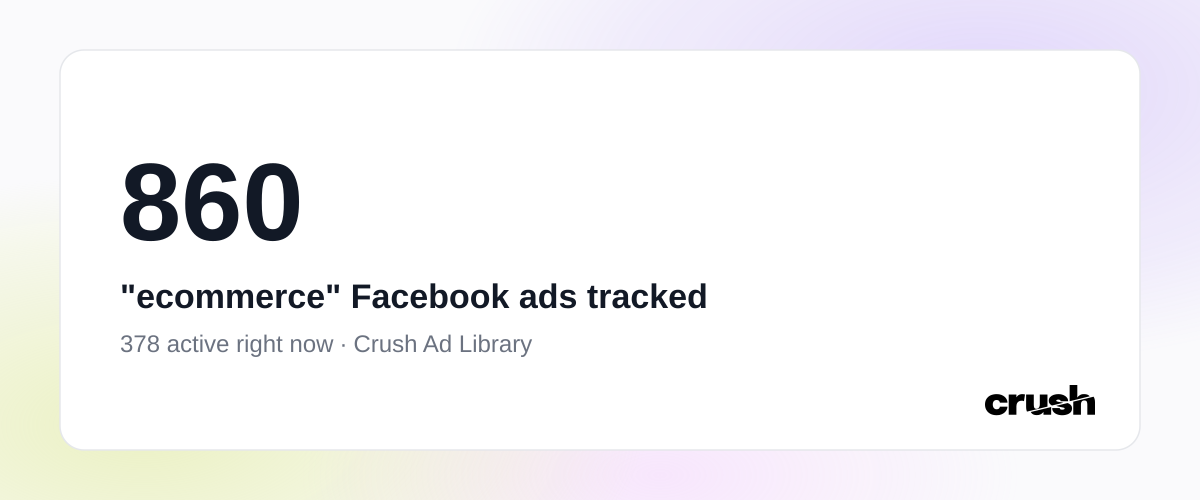
When we isolate specific industries, the longevity metrics become incredibly clear compared to standard ecommerce benchmarks for 2026. Currently, 860 tracked ads match "ecommerce" with 378 active right now. Among top "ecommerce" ads, the average run time is 141 days.
More importantly, 156 of the top 400 ran 90+ days, firmly crossing the proven winner threshold. We also look at how these brands structure their calls to action.
The most common CTA buttons on "ecommerce" ads reveal clear trends:
- Learn more: (24%)
- Whatsapp message: (14%)
- Shop now: (13%)
The dominance of "learn more" lowers the psychological barrier for the user. It invites them to read about the product rather than demanding an immediate purchase.
Real Examples of Winning Ecommerce Ads
High Ticket and Travel Creatives
Let us review exact creatives that have proven profitable over massive timeframes. Justine's Jewels Mtl has an ad running 1,657 days, relaunched 0 times, using the CTA "shop now".
The opening line is: “Beautiful pink stone earrings in rose sterling Italian silver”. It is simple, direct, and clearly effective.
Chikigo provides another excellent example of extreme longevity. Their ad ran 1,506 days, relaunched 0 times, with the CTA "book travel".
The opening line reads: “Spotted @__auliafitri__ in our polo knit - earthy blue 💙🤍 Grab yours now at our ecommerce store! 😃”. This proves that direct copy paired with a strong offer can run for years.
Niche Products
We see similar long-term performance in niche ecommerce. BmxWrld has an ad that ran 1,177 days, relaunched 0 times, using the CTA "message page". The opening line reads: “Striving to be the Best E-commerce store for all your BMX needs!”.
Common Mistakes in Creative Workflows
Ignoring Historical Failures
Many media buyers only focus on active ads when researching competitors. This is a critical mistake. If you only look at what is live, you miss the context of what failed.
Because Crush keeps history, including ads that were taken down, you can identify patterns in losing creatives. Avoid replicating hooks and visuals that your competitors already tested and discarded.
Relying on Subjective Opinions
Another frequent error is launching creatives based purely on gut feeling. A video might look highly polished, but if it does not convert, it is useless.
We built our platform to prioritize metrics over aesthetics by establishing a data-driven creative strategy. Tracking longevity data and duplicate counts forces you to respect the market.
If a low production ad has a high duplicate count, you should iterate on that concept immediately.
Failing to Iterate Quickly
When you finally find a winning ad, the worst thing you can do is let it fatigue without backup variations. Media buyers often wait until performance drops before briefing the creative team.
By the time the new assets are ready, the campaign has already lost momentum. You must generate ad-creative iterations from a winning reference ad while the original is still peaking.
Automating the Media Buying Process with Crush
Execution Over Organization
Organizing your creative references is helpful, but executing the media buy is where the money is made. Our product Crush fully automatically runs Facebook ads.
It creates campaigns, scales winners, and kills losers based on the rules you set. Say your target CPA is $40. You define the parameters, and our system handles the daily account management.
We provide deeper intelligence by tracking duplicate counts, which shows how many times an advertiser relaunched the same creative. A high duplicate count is a massive signal that an ad is profitable.
Generating Creative Iterations
When you identify a proven ad in our system, you can immediately build upon it. Crush can generate ad-creative iterations from a winning reference ad in seconds.
This allows you to launch fresh variations of proven concepts without waiting for a video editor. You can access our free public ad library to start researching exactly what your competitors are doing right now.
If you are ready to automate your account management, you can view our paid plans which start with a trial at trycrush.ai/pricing.
Who Should Pick Which Platform?
Checklist for Choosing a Creative Tool
Before committing to an annual contract, evaluate your tech stack against these criteria:
- Does this tool eliminate manual data entry from Ads Manager?
- Can the software automatically pause losing campaigns during the weekend?
- Does the platform track ads that competitors take down?
- Will this tool generate immediate creative iterations for testing?
When to Choose TryAtria
The decision comes down to what specific bottleneck your team faces today. If your main struggle is aligning your creative strategy with execution, TryAtria provides a highly structured workspace for your team.
Frequently Asked Questions
Common questions about this topic
1What is the pricing for TryAtria?
2Does TryAtria offer a free trial?
3Are there limitations on the TryAtria Core plan?
4How does Crush differ from TryAtria?
About this article
This article was written with AI assistance. Ad examples and ad data come from the Crush ad library.
Written by

Albertas Pocius
Co-founder, CMOAlbertas is the Co-Founder and CMO of TryCrush.ai, bringing elite-level performance marketing expertise to the platform. With over $50M+ in combined Facebook and TikTok ad spend, Albertas has launched and scaled dozens of projects from zero, driven by a deep obsession with data and experimentation. He has trained 20+ media buyers, consulted 100+ companies, and is widely recognized as one of Europe’s early TikTok pioneers, likely the first to scale campaigns beyond $100K per day. Today, he also teaches advertising strategy at two colleges, shaping the next generation of media buyers.
Stop Guessing.
Start Crushing.
AI Ad Manager trained by world-class media buyers to generate your creatives and optimize your ads 24/7.
Learn more
Related articles
BigSpy Review 2026: Pricing, Features, and Honest Comparison
We review BigSpy's multi-platform ad tracking capabilities, break down its true costs for 2026, and compare it against our automated Facebook ad platform, Crush.
AdSpy 2026 Review: Features, Pricing & Adspyder Alternatives
A detailed 2026 review of AdSpy features, pricing, and limitations. We explore how it compares to other adspyder alternatives and our execution platform, Crush.
The Return of the Image: Why Static Ads Are Beating Video in 2026
Think video is the only way to win? Think again. In 2026, static ads are outperforming high-production videos by up to 50%. Discover why simple image ads are dominating feeds and how to use them to scale your ad accounts profitably.

The Art of the Algorithm: Mastering AI Creative Advertising
The era of the subjective Creative Director is over. Discover how AI creative advertising replaces human opinion with objective data to generate high-converting ads. Learn the H.E.R.O framework and modern testing methodologies to scale your campaigns efficiently.